3行でわかる結論
- 8時間耐久は通常「3人×交代」で走る。だが2026年の鈴鹿8耐では、8台が2人(以下)で最後まで走り切った。
- その頂点が優勝した #30 Honda HRC ── 高橋巧とジョナサン・レアの2人だけで188周を走り、登録した3人目のチャントラは一度もマシンに乗らなかった。
- 対極にあるのが #93 TONE Team4413 BMW ── 星野が転倒離脱したあと、吉田がレース終盤をひとりで走り切り、SST15位で完走した(単独走行は転倒後の約4時間)。
「3人ではない」という同じ事実が、速さの余裕(HRC)と、諦めない意地(TONE)という正反対の物語を生んだ。決勝の走行データ(誰が・いつ・何周乗ったか)を全車ぶん洗い出し、その両極を可視化した。
この資料の読み方: 各ライダーの「走行帯」と「周回数」は決勝の計時ログから機械的に集計したもの。「なぜ2人だったか」の理由は計時では分からないため、公式発表・チーム公式・実況を参照し、断定できる範囲と推察を明確に分けて記す。
1. 全体像 ── 8時間を「2人」で走り切った8台
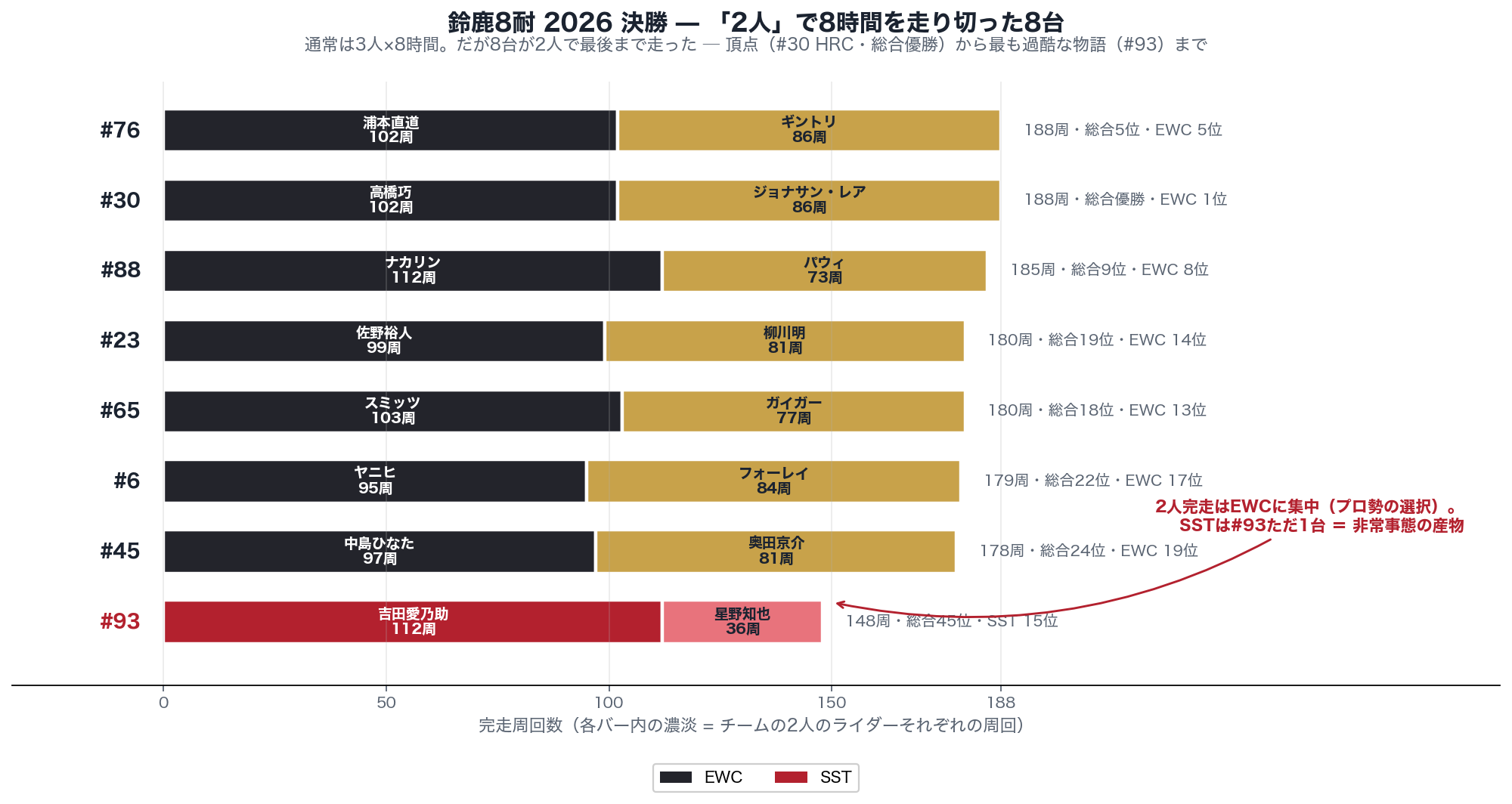
※ この図から: 各バー=1台。バー内の濃淡が、そのチームの2人のライダーそれぞれの周回数。上ほど周回が多い(=完走順位が上)。#93だけが赤(SST)で、他はすべて黒×金(EWC)。
決勝を「規定人数より少ない人数で完走した」という視点で見ると、8台が該当した。内訳は次の通り(周回数は公式計時、順位は最終公式順位)。
| 車番 | クラス | ライダー2人(周回) | 総周回 | 最終順位 |
|---|---|---|---|---|
| #30 Honda HRC | EWC | 高橋巧 102 / ジョナサン・レア 86 | 188 | 総合優勝・EWC 1位 |
| #76 オートレース宇部 | EWC | 浦本直道 102 / ギントリ 86 | 188 | 総合5位・EWC 5位 |
| #88 ホンダ・アジア・ドリーム | EWC | ナカリン 112 / パウィ 73 | 185 | 総合9位・EWC 8位 |
| #65 Motobox Kremer | EWC | スミッツ 103 / ガイガー 77 | 180 | 総合18位・EWC 13位 |
| #23 KRP三洋 & RS-ITOH | EWC | 佐野裕人 99 / 柳川明 81 | 180 | 総合19位・EWC 14位 |
| #6 ERC Endurance | EWC | ヤニヒ 95 / フォーレイ 84 | 179 | 総合22位・EWC 17位 |
| #45 SHINSYUREN | EWC | 中島ひなた 97 / 奥田京介 81 | 178 | 総合24位・EWC 19位 |
| #93 TONE Team4413 BMW | SST | 吉田愛乃助 112 / 星野知也 36 | 148 | 総合45位・SST 15位 |
はっきりした発見がひとつある。2人完走はEWC(世界耐久選手権クラス)にほぼ集中している。7台がEWCで、SSTはただ1台、#93だけだ。EWC勢のそれ(#30〜#45)は、後述するHRCに象徴されるように「プロが2人いれば足りる」という選択の色が濃い。対してSSTの#93は、選んだのではなく追い込まれた末の2人だった(§3)。
なお、2人以下で走ったが完走には至らなかった車もある。#59 チーム・ベビーフェイス(2人で72周)と、#4 タティ・チーム(1人で13周)は途中でレースを去っており、本稿の「完走した8台」とは分けて扱う。
2. Honda HRCは、2人で勝った
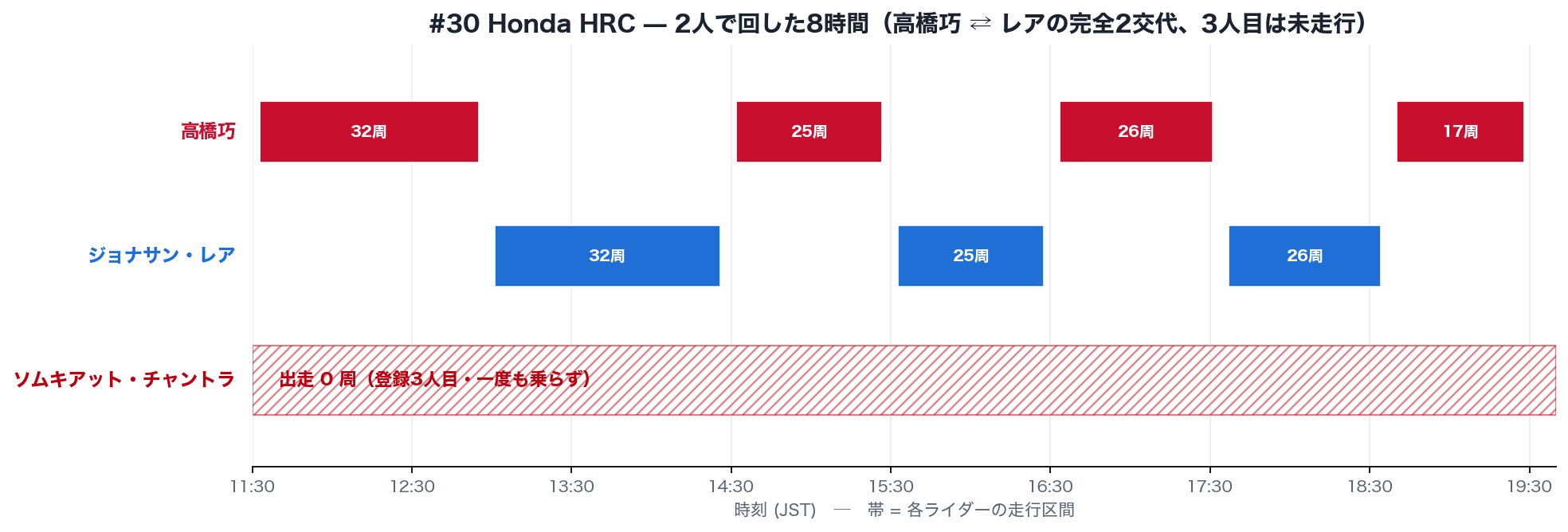
※ この図から: 3本のレーンが登録3ライダー。高橋巧(赤)とレア(青)がほぼ均等に4回・3回のスティントを分け合い、最下段のチャントラ(斜線)は8時間ずっと空 = 一度も走っていない。各スティントの周回数はDB実走集計(ピットイン周を除くため、合計は公式の102周/86周をわずかに下回る)。
優勝した#30 Honda HRCの走行帯は、驚くほど整然としている。スタートから最終スティントまで、高橋巧とジョナサン・レアが交互に乗り続けた。高橋巧が4スティント、レアが3スティント(公式の完走周回は高橋巧102周・レア86周)。そして登録3人目のソムキアット・チャントラは、決勝で1周も走っていない。これは計時データが明確に示す事実だ(passingsのdriver_nameにチャントラの記録はゼロ)。
なぜ2人で走ったのか。公式に断定できるのはここまで ── 決勝は雨に見舞われるコンディションで、HRCは3人目のチャントラを起用せず、高橋巧・レアの2名で走り切って優勝した(高橋巧のコメント/Honda公式リリース)。
その先、「チャントラは元ザルコの代役で加入したばかりでウェット経験が乏しかった」「レイン走行はドライほど身体負荷が高くないため2人で足りた」といった理由付けは、公式発表に明文はない。そうした見方も一部で指摘されてはいるが、あくまで推察の域を出ない(本稿では断定しない)。確かなのは、世界最高峰の2人が揃えば、雨の8時間を3人目なしで頂点に立てたという結果である。
3. 吉田のひとり ── #93が最後まで諦めなかった8時間
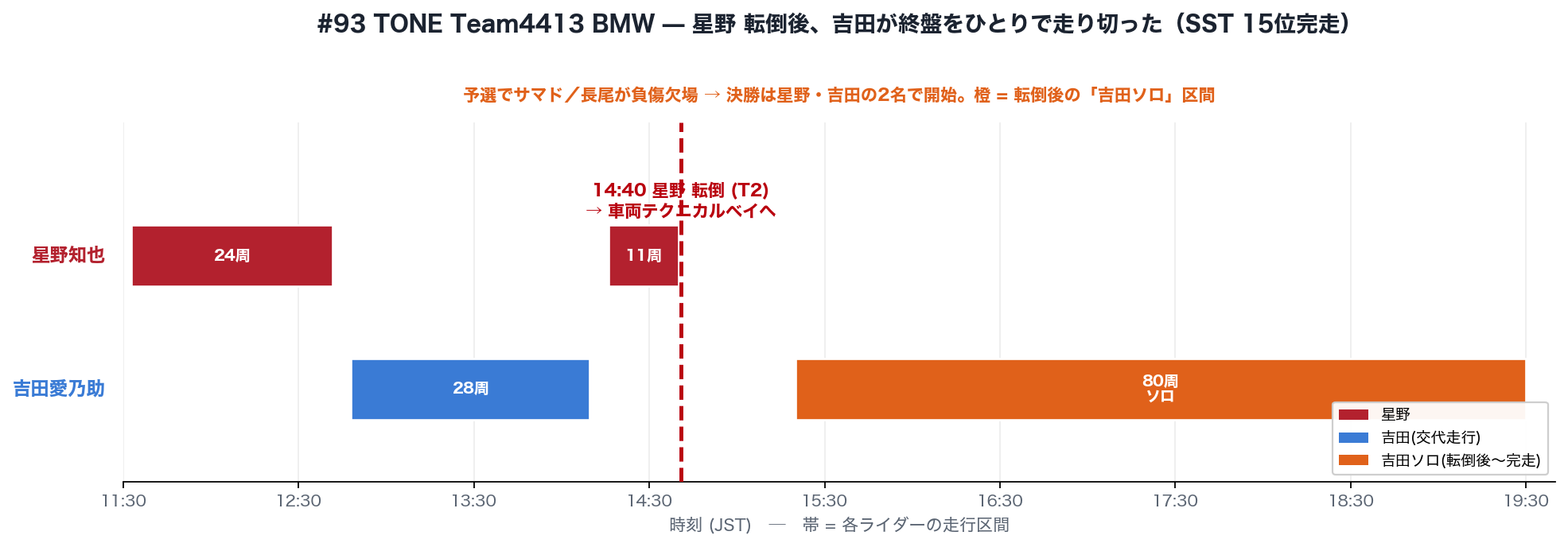
※ この図から: 14:40(赤い破線)で星野が転倒。以降、吉田の橙色の帯が終盤までひとりで伸びる = ソロ走行。帯内の周回はDB実走集計(ピット周除外。公式は吉田112周・星野36周)。14:40〜15:20頃の空白は車両修復で誰も走っていない時間。
93 TONE Team4413 BMWの物語は、HRCの対極にある。ここでの「2人」は選択ではなく、次々にライダーを失った末の結果だった。
- 予選: チーム公式ブログによれば、登録ライダーのサマド(ズマドー)と長尾が負傷で欠場。決勝は星野・吉田の実質2名でスタートを迎えた。
- 序盤: レース序盤にはライダー交代手順の違反でライドスルーペナルティも科されている(レースコントロール記録、14:00頃)。
- 転倒(14:40): 2度目の走行に入っていた星野がT2で転倒。マシンはテクニカルベイへ運ばれ、星野はコースを去った。星野は転倒後にメディカル対応を受け、負傷している(チーム公式)。※本稿は一次記録にない容態(快復の見通し等)には踏み込まない。
- 終盤〜完走: 修復を経て吉田が15:20頃に復帰し、そこから19:30のチェッカーまでの約4時間をひとりで走り切った。転倒の14:40を起点に見れば、レース最後の約5時間を吉田ひとりで完走したことになる。
正確に言えば、吉田が8時間すべてをひとりで走ったわけではない(前半は星野と交代しながら走っている)。だが星野の離脱後は、交代要員がいないまま吉田ひとりで走り続けた。結果は総合45位、SSTクラス15位 ── 15台のSSTで最後の完走枠ではあるが、完走できたこと自体が、この日のこのチームにとっては勝利に等しい。吉田の周回は112周に達し、これは#93全体の完走148周の8割近くを占める。
まとめ ── 同じ「3人ではない」の、両極
30 HRCと#93 TONEは、「規定人数を満たさずに8時間を走り切った」という一点で並ぶ。だがその中身は正反対だ。片方は速さの余裕が生んだ2人(3人目を温存してなお優勝)、もう片方は諦めない意地が守り抜いた2人(1人を失ってなお完走)。
耐久レースの規定では、8時間レースは2〜3名でエントリーでき、1人あたりの連続騎乗時間に上限を設ける規定は必須ではない(ブリヂストンの規則解説による)。つまり2人で ── あるいは終盤ひとりで ── 走り切ることは、ルール上は合法だ。今回の8台は、その制度の幅の両端を、同じ決勝の中で見せてくれた。
方法論 / 来歴
- データソース: EnduraBase タイミングDB(etoile03 ライブ収集レプリカ、
turso_replica_prod_main.dbを SSH read-only 参照)、session_id=327(鈴鹿8耐2026 決勝)、取得 2026-07-13。 - 走行帯・交代時刻・転倒時刻:
passingsのdriver_name × epoch_msを実走集計(フィニッシュライン確定行を lap_number で重複除去)。転倒時刻はrace_messages("BIKE 93 CRASH T2" 14:40:46)で照合。 - 完走周回数: 公式 FIM EWC 計時(
Lap_by_lap_by_rider/Lap_by_lap)を採用。DBの driver_name 実走集計はピット周(無名義)が欠けるため、公開周回数は公式計時を正とした(例: 高橋巧は実走集計100周・公式102周)。 - 「2人だった理由」: 計時では判定不能。以下の公式発表・チーム公式・実況を参照し、断定と推察を分離した。
参照ソース一覧
| 出所 | 媒体種別 | URL |
|---|---|---|
| Honda 公式(決勝レポート) | メーカー公式 | https://global.honda/jp/news/2026/2260705.html |
| Car Watch(決勝記事) | 報道 | https://car.watch.impress.co.jp/docs/news/2122477.html |
| HRC(チャントラ代役発表) | チーム公式 | https://suzuka-8h.hondaracingcorporation.com/report/somkiat-chantra-to-replace-johann-zarco-at-the-47th-suzuka-8-hours/ |
| TONE Team4413 公式ブログ | チーム公式 | https://ameblo.jp/syncedge4413/entry-12972215964.html |
| AUTOSPORT web(順位) | 報道 | https://www.as-web.jp/bike/1332345 |
| ブリヂストン(8耐 規則解説) | 主催関連 | https://ms.bridgestone.co.jp/2/8tai/about |
ÉTOILE DATA LAB ── 2人で走ったチーム / data: EnduraBase timing DB (session 327) / © Team Étoile
The conclusion in three lines
- An eight-hour endurance race is normally run by "three riders taking turns." Yet at the 2026 Suzuka 8 Hours, eight bikes went the full distance with two riders (or fewer).
- At the very top of them sat the winning #30 Honda HRC ── Takumi Takahashi and Jonathan Rea covered all 188 laps between just the two of them, and their registered third rider, Chantra, never once got on the bike.
- At the opposite pole stood #93 TONE Team4413 BMW ── after Hoshino crashed out, Yoshida rode the closing stages alone and brought the bike home 15th in SST (his solo running was about four hours after the crash).
The very same fact ── "not three riders" ── produced two completely opposite stories: the comfort of sheer speed (HRC) and the stubbornness of refusing to give up (TONE). We pulled the on-track data of the entire field for the final (who rode, when, and for how many laps) and visualised both extremes.
How to read this piece: each rider's "riding band" and "lap count" were compiled mechanically from the timing log of the final. The reason "why they ran with two" cannot be read from the timing data, so we drew on official releases, team statements and live commentary, keeping a clear line between what can be asserted and what is conjecture.
1. The big picture ── eight bikes that went the distance with "two"
※ From this chart: each bar = one bike. The two shades within a bar show the lap counts of that team's two riders. The higher up the bar, the more laps (= the better the finish). Only #93 is red (SST); all the others are black × gold (EWC).
Viewed through the lens of "finished the race with fewer than the usual number of riders," eight bikes qualify. Here is the breakdown (lap counts are official timing, positions are the final official classification).
| No. | Class | Two riders (laps) | Total laps | Final position |
|---|---|---|---|---|
| #30 Honda HRC | EWC | Takumi Takahashi 102 / Jonathan Rea 86 | 188 | Overall win · EWC 1st |
| #76 AutoRace Ube | EWC | Naomichi Uramoto 102 / Sylvain Guintoli 86 | 188 | Overall 5th · EWC 5th |
| #88 Honda Asia-Dream | EWC | Nakarin 112 / Pawi 73 | 185 | Overall 9th · EWC 8th |
| #65 Motobox Kremer | EWC | Smits 103 / Geiger 77 | 180 | Overall 18th · EWC 13th |
| #23 KRP Sanyo & RS-Itoh | EWC | Hiroto Sano 99 / Akira Yanagawa 81 | 180 | Overall 19th · EWC 14th |
| #6 ERC Endurance | EWC | Jähnig 95 / Foray 84 | 179 | Overall 22nd · EWC 17th |
| #45 SHINSYUREN | EWC | Hinata Nakajima 97 / Kyosuke Okuda 81 | 178 | Overall 24th · EWC 19th |
| #93 TONE Team4413 BMW | SST | Ainosuke Yoshida 112 / Tomoya Hoshino 36 | 148 | Overall 45th · SST 15th |
One finding stands out clearly. Two-rider finishes are almost entirely concentrated in EWC (the FIM Endurance World Championship class). Seven of the bikes are EWC; SST has only one, #93. For the EWC entries (#30 through #45), the colour is heavily one of choice ── "two pros are enough," as symbolised by HRC, discussed below. By contrast, SST's #93 did not choose it: theirs was a two-rider effort forced upon them (§3).
Note that some bikes also ran with two or fewer riders but did not make it to the finish. #59 Team Baby Face (72 laps with two riders) and #4 Tati Team (13 laps with one rider) left the race partway through, and we treat them separately from the eight finishers covered here.
2. Honda HRC won with two
※ From this chart: the three lanes are the three registered riders. Takahashi (red) and Rea (blue) split the stints almost evenly, four and three; the bottom lane, Chantra (hatched), stays empty for all eight hours = he never rode. The lap count of each stint is a measured tally of actual laps in the DB (pit-in laps are excluded, so the totals fall just short of the official 102 / 86 laps).
The riding band of the winning #30 Honda HRC is astonishingly orderly. From the start to the final stint, Takumi Takahashi and Jonathan Rea took turns and simply kept riding. Takahashi did four stints, Rea three (their official finishing laps were 102 and 86). And the registered third rider, Somkiat Chantra, did not turn a single lap in the final. This is a fact the timing data states plainly (there is zero record for Chantra in the driver_name field of passings).
Why did they run with two? This is as far as the official record lets us state with certainty ── the final was run in wet conditions, and HRC won by going the distance with the two riders Takahashi and Rea, without deploying their third rider Chantra (per Takahashi's comment / Honda's official release).
Beyond that, reasons such as "Chantra had only just joined as a replacement for the departed Zarco and had little wet-weather experience," or "riding in the rain is less physically demanding than in the dry, so two were enough," are not stated in writing in any official announcement. Such views have been floated in some quarters, but they remain no more than conjecture (we do not assert them here). What is certain is the result: with two of the world's very best, the wet eight hours could be conquered without a third rider.
3. Yoshida alone ── the eight hours in which #93 never gave up
※ From this chart: at 14:40 (the red dashed line) Hoshino crashes. From then on, Yoshida's orange band stretches alone to the closing stages = solo running. The laps within the band are a measured DB tally (pit laps excluded; the official figures are Yoshida 112, Hoshino 36). The gap from around 14:40 to 15:20 is the time during which the bike was being repaired and no one was riding.
The story of #93 TONE Team4413 BMW is the polar opposite of HRC's. Here "two" was not a choice but the result of losing rider after rider.
- Qualifying: according to the team's official blog, registered riders Zmándó and Nagao were sidelined by injury. The final began with, effectively, just the two riders Hoshino and Yoshida.
- Early running: in the opening phase the team was also handed a ride-through penalty for a rider-change procedure infringement (race control record, around 14:00).
- The crash (14:40): Hoshino, out for his second run, crashed at T2. The bike was taken to the technical bay, and Hoshino left the track. He received medical attention after the crash and was injured (per the team). ※ This piece does not go into any condition (prospects for recovery, etc.) that is not in the primary record.
- Closing stages to the finish: after repairs, Yoshida rejoined around 15:20 and rode the roughly four hours from there to the chequered flag at 19:30 alone. Taking the crash at 14:40 as the reference point, he completed the last five or so hours of the race by himself.
To be precise, Yoshida did not ride all eight hours alone (in the first half he rode in rotation with Hoshino). But once Hoshino was out, with no relief rider available, Yoshida just kept riding on his own. The result was 45th overall and 15th in the SST class ── the last finishing slot among 15 SST bikes, but finishing at all was, for this team on this day, tantamount to a win. Yoshida's laps reached 112, close to 80% of #93's total of 148 finishing laps.
Summary ── the two poles of the same "not three riders"
30 HRC and #93 TONE stand side by side on a single point: they went the full eight hours without meeting the usual rider quota. But the substance is exactly opposite. One is a pair born of the comfort of sheer speed (winning while holding a third rider in reserve); the other is a pair defended by the stubbornness of refusing to give up (finishing even after losing a rider).
Under endurance regulations, an eight-hour race may be entered by two or three riders, and a mandatory cap on each rider's continuous riding time is not required (per Bridgestone's rules explainer). In other words, going the distance with two ── or, in the closing stages, alone ── is legal under the rules. These eight bikes showed us both ends of that regulatory latitude within the same final.
Methodology / provenance
- Data source: EnduraBase timing DB (etoile03 live-collection replica,
turso_replica_prod_main.dbreferenced read-only over SSH), session_id=327 (Suzuka 8 Hours 2026 final), retrieved 2026-07-13. - Riding bands, change times, crash time: measured from
passingsasdriver_name × epoch_ms(finish-line confirmation rows deduplicated by lap_number). The crash time was cross-checked againstrace_messages("BIKE 93 CRASH T2" 14:40:46). - Finishing lap counts: the official FIM EWC timing (
Lap_by_lap_by_rider/Lap_by_lap) was used. Because the DB driver_name tally misses pit laps (which are unattributed), the published lap counts follow the official timing (e.g. Takahashi's measured tally is 100 laps vs. the official 102). - The "why two riders" question: undeterminable from the timing. We drew on the official releases, team statements and live commentary below, keeping assertion and conjecture separate.
List of sources referenced
| Source | Media type | URL |
|---|---|---|
| Honda official (race report) | Manufacturer official | https://global.honda/jp/news/2026/2260705.html |
| Car Watch (race article) | Press | https://car.watch.impress.co.jp/docs/news/2122477.html |
| HRC (Chantra replacement announcement) | Team official | https://suzuka-8h.hondaracingcorporation.com/report/somkiat-chantra-to-replace-johann-zarco-at-the-47th-suzuka-8-hours/ |
| TONE Team4413 official blog | Team official | https://ameblo.jp/syncedge4413/entry-12972215964.html |
| AUTOSPORT web (standings) | Press | https://www.as-web.jp/bike/1332345 |
| Bridgestone (8 Hours rules explainer) | Organiser-related | https://ms.bridgestone.co.jp/2/8tai/about |
ÉTOILE DATA LAB ── Teams that ran with two / data: EnduraBase timing DB (session 327) / © Team Étoile
La conclusion en trois lignes
- Une course d'endurance de huit heures se court normalement « à trois pilotes qui se relaient ». Or, aux 8 Heures de Suzuka 2026, huit motos ont parcouru toute la distance avec deux pilotes (ou moins).
- À leur sommet, la #30 Honda HRC victorieuse ── Takumi Takahashi et Jonathan Rea ont bouclé les 188 tours à eux deux seulement, et leur troisième pilote inscrit, Chantra, n'est pas monté une seule fois sur la moto.
- À l'opposé se dresse la #93 TONE Team4413 BMW ── après la chute de Hoshino, Yoshida a couru seul la fin de course et a ramené la moto à la 15e place en SST (son run en solitaire a duré environ quatre heures après la chute).
Un seul et même fait ── « pas trois pilotes » ── a engendré deux récits diamétralement opposés : le confort de la vitesse pure (HRC) et l'obstination à ne jamais renoncer (TONE). Nous avons extrait les données de piste de tout le plateau pour la finale (qui a roulé, quand, et combien de tours) afin de visualiser ces deux extrêmes.
Comment lire ce document : la « plage de roulage » et le « nombre de tours » de chaque pilote ont été compilés mécaniquement à partir du journal de chronométrage de la finale. La raison du « pourquoi à deux » ne peut se lire dans le chronométrage ; nous nous appuyons donc sur les communiqués officiels, les déclarations des équipes et les commentaires en direct, en distinguant clairement ce qui peut être affirmé de ce qui relève de la conjecture.
1. Vue d'ensemble ── les huit motos qui ont fait la distance « à deux »
※ Ce que dit ce graphique : chaque barre = une moto. Les deux nuances au sein d'une barre montrent le nombre de tours de chacun des deux pilotes de l'équipe. Plus la barre est haute, plus il y a de tours (= meilleur classement final). Seule la #93 est en rouge (SST) ; toutes les autres sont en noir × or (EWC).
Vue sous l'angle « a terminé la course avec moins de pilotes que d'ordinaire », huit motos entrent dans le cadre. Voici le détail (les tours sont le chronométrage officiel, les places sont le classement officiel final).
| N° | Classe | Deux pilotes (tours) | Total tours | Classement final |
|---|---|---|---|---|
| #30 Honda HRC | EWC | Takumi Takahashi 102 / Jonathan Rea 86 | 188 | Victoire au général · EWC 1er |
| #76 AutoRace Ube | EWC | Naomichi Uramoto 102 / Sylvain Guintoli 86 | 188 | 5e au général · EWC 5e |
| #88 Honda Asia-Dream | EWC | Nakarin 112 / Pawi 73 | 185 | 9e au général · EWC 8e |
| #65 Motobox Kremer | EWC | Smits 103 / Geiger 77 | 180 | 18e au général · EWC 13e |
| #23 KRP Sanyo & RS-Itoh | EWC | Hiroto Sano 99 / Akira Yanagawa 81 | 180 | 19e au général · EWC 14e |
| #6 ERC Endurance | EWC | Jähnig 95 / Foray 84 | 179 | 22e au général · EWC 17e |
| #45 SHINSYUREN | EWC | Hinata Nakajima 97 / Kyosuke Okuda 81 | 178 | 24e au général · EWC 19e |
| #93 TONE Team4413 BMW | SST | Ainosuke Yoshida 112 / Tomoya Hoshino 36 | 148 | 45e au général · SST 15e |
Un constat s'impose nettement. Les finishers à deux pilotes se concentrent presque entièrement en EWC (la classe du Championnat du Monde d'Endurance FIM). Sept motos sont en EWC ; le SST n'en compte qu'une, la #93. Pour les engagés EWC (#30 à #45), la couleur est fortement celle d'un choix ── « deux pros suffisent », comme le symbolise HRC, évoquée plus bas. À l'inverse, la #93 en SST ne l'a pas choisi : leur duo leur a été imposé (§3).
À noter que certaines motos ont aussi roulé à deux pilotes ou moins sans toutefois rallier l'arrivée. La #59 Team Baby Face (72 tours à deux pilotes) et la #4 Tati Team (13 tours à un pilote) ont quitté la course en cours de route ; nous les traitons à part des huit finishers couverts ici.
2. Honda HRC a gagné à deux
※ Ce que dit ce graphique : les trois couloirs sont les trois pilotes inscrits. Takahashi (rouge) et Rea (bleu) se partagent les relais presque à parts égales, quatre et trois ; le couloir du bas, Chantra (hachuré), reste vide pendant les huit heures = il n'a jamais roulé. Le nombre de tours de chaque relais est un décompte mesuré des tours réels dans la base (les tours d'entrée aux stands sont exclus, si bien que les totaux restent juste en deçà des 102 / 86 tours officiels).
La plage de roulage de la #30 Honda HRC victorieuse est d'une régularité stupéfiante. Du départ au dernier relais, Takumi Takahashi et Jonathan Rea se sont relayés et ont simplement continué de rouler. Takahashi a assuré quatre relais, Rea trois (leurs tours officiels à l'arrivée étaient de 102 et 86). Et le troisième pilote inscrit, Somkiat Chantra, n'a pas bouclé un seul tour en finale. C'est un fait que les données de chronométrage énoncent clairement (aucun enregistrement pour Chantra dans le champ driver_name de passings).
Pourquoi ont-ils roulé à deux ? C'est jusqu'ici que le dossier officiel permet d'affirmer avec certitude ── la finale s'est déroulée sur le mouillé, et HRC l'a emporté en faisant la distance avec les deux pilotes Takahashi et Rea, sans engager leur troisième pilote Chantra (d'après le commentaire de Takahashi / le communiqué officiel Honda).
Au-delà, des raisons telles que « Chantra venait tout juste d'arriver en remplacement de Zarco, parti, et manquait d'expérience sur le mouillé » ou « rouler sous la pluie est physiquement moins éprouvant que sur le sec, donc deux suffisaient » ne figurent noir sur blanc dans aucune annonce officielle. De telles lectures ont bien été avancées ici ou là, mais elles ne dépassent pas le stade de la conjecture (nous ne les affirmons pas ici). Ce qui est certain, c'est le résultat : avec deux des tout meilleurs pilotes du monde, les huit heures sous la pluie ont pu être remportées sans troisième pilote.
3. Yoshida en solitaire ── les huit heures où la #93 n'a jamais renoncé
※ Ce que dit ce graphique : à 14h40 (la ligne rouge en pointillés) Hoshino chute. À partir de là, la bande orange de Yoshida s'étire seule jusqu'à la fin = roulage en solitaire. Les tours au sein de la bande sont un décompte mesuré dans la base (tours de stand exclus ; les chiffres officiels sont Yoshida 112, Hoshino 36). Le trou d'environ 14h40 à 15h20 est le laps de temps durant lequel la moto était en réparation et où personne ne roulait.
L'histoire de la #93 TONE Team4413 BMW est l'exact opposé de celle de HRC. Ici, « deux » n'était pas un choix, mais le résultat de la perte d'un pilote après l'autre.
- Qualifications : selon le blog officiel de l'équipe, les pilotes inscrits Zmándó et Nagao étaient forfaits sur blessure. La finale a débuté, de fait, avec seulement les deux pilotes Hoshino et Yoshida.
- Début de course : dans la phase initiale, l'équipe a en outre écopé d'une pénalité de ride-through pour une infraction à la procédure de changement de pilote (relevé de la direction de course, vers 14h00).
- La chute (14h40) : Hoshino, entamant son deuxième relais, chute à T2. La moto est emmenée au technical bay, et Hoshino quitte la piste. Il a reçu des soins médicaux après la chute et il est blessé (selon l'équipe). ※ Ce document n'aborde aucun état de santé (perspectives de rétablissement, etc.) qui ne figure pas dans le relevé primaire.
- Fin de course jusqu'à l'arrivée : après réparation, Yoshida est reparti vers 15h20 et a couru seul les quelque quatre heures qui l'ont mené du damier à 19h30. En prenant la chute de 14h40 comme point de référence, il a bouclé seul les cinq dernières heures environ de la course.
Pour être précis, Yoshida n'a pas roulé seul les huit heures (en première moitié il roulait en alternance avec Hoshino). Mais une fois Hoshino hors course, faute de pilote de relève, Yoshida a simplement continué de rouler seul. Le résultat fut la 45e place au général et la 15e en classe SST ── la dernière place de finisher parmi les 15 motos SST, mais terminer, tout court, équivalait pour cette équipe, ce jour-là, à une victoire. Les tours de Yoshida ont atteint 112, soit près de 80 % des 148 tours à l'arrivée de la #93.
Conclusion ── les deux pôles d'un même « pas trois pilotes »
La #30 HRC et la #93 TONE se rejoignent sur un point : avoir couru les huit heures sans atteindre le quota habituel de pilotes. Mais la substance est diamétralement opposée. L'un est un duo né du confort de la vitesse pure (gagner tout en gardant un troisième pilote en réserve) ; l'autre, un duo défendu par l'obstination à ne jamais renoncer (terminer même après avoir perdu un pilote).
Selon la réglementation de l'endurance, une course de huit heures peut être engagée avec deux ou trois pilotes, et un plafond obligatoire sur le temps de roulage continu de chaque pilote n'est pas requis (d'après l'explication du règlement par Bridgestone). Autrement dit, faire la distance à deux ── ou, en fin de course, seul ── est légal au regard du règlement. Ces huit motos nous ont montré les deux extrémités de cette latitude réglementaire au sein d'une même finale.
Méthodologie / provenance
- Source des données : base de chronométrage EnduraBase (réplique de collecte en direct sur etoile03,
turso_replica_prod_main.dbconsultée en lecture seule via SSH), session_id=327 (8 Heures de Suzuka 2026, finale), extraction le 2026-07-13. - Plages de roulage, heures de relais, heure de la chute : mesurées depuis
passingsendriver_name × epoch_ms(lignes de confirmation de ligne d'arrivée dédupliquées par lap_number). L'heure de la chute a été recoupée avecrace_messages(« BIKE 93 CRASH T2 » 14:40:46). - Nombre de tours à l'arrivée : le chronométrage officiel FIM EWC (
Lap_by_lap_by_rider/Lap_by_lap) a été retenu. Comme le décompte par driver_name de la base omet les tours de stand (non attribués), les tours publiés suivent le chronométrage officiel (ex. : le décompte mesuré de Takahashi est de 100 tours contre 102 officiels). - La question du « pourquoi à deux » : indéterminable à partir du chronométrage. Nous nous appuyons sur les communiqués officiels, déclarations d'équipes et commentaires en direct ci-dessous, en séparant affirmation et conjecture.
Liste des sources consultées
| Origine | Type de média | URL |
|---|---|---|
| Honda officiel (rapport de course) | Officiel constructeur | https://global.honda/jp/news/2026/2260705.html |
| Car Watch (article de course) | Presse | https://car.watch.impress.co.jp/docs/news/2122477.html |
| HRC (annonce du remplacement par Chantra) | Officiel équipe | https://suzuka-8h.hondaracingcorporation.com/report/somkiat-chantra-to-replace-johann-zarco-at-the-47th-suzuka-8-hours/ |
| Blog officiel TONE Team4413 | Officiel équipe | https://ameblo.jp/syncedge4413/entry-12972215964.html |
| AUTOSPORT web (classement) | Presse | https://www.as-web.jp/bike/1332345 |
| Bridgestone (explication du règlement 8 Heures) | Lié à l'organisateur | https://ms.bridgestone.co.jp/2/8tai/about |
ÉTOILE DATA LAB ── Les équipes qui ont roulé à deux / data: EnduraBase timing DB (session 327) / © Team Étoile