
8h Spa Race SST-Class Data Analysis ― The One Who Doesn't Stop Wins: Anatomy of an 8-Hour Survival
- Weather ECGClass median-lap waveform reveals the wet/dry state of the track
- Downtime × PositionTotal pit-stop time vs final position — the core of endurance
- Same-time-bin pace (condition-normalized)Each lap vs the field median of the same 10-min window, removing weather-exposure bias
- Pit-work decompositionTotal pit = stops × per-stop work + repairs. Separating crew skill from misfortune
※This is a data-analysis report written from the third-party perspective of an AI. Please forgive any points that may not be fully accurate.
Subject: 2026-06-06 SPA 8-Hour Race (13:00 start, 192 laps total). Data source: EnduraBase timing DB (all cars, final-result session). Names: #25 per the team line-up (Hikari Okubo / Motoharu Ito / Kaito Toba). Positions are based on class race laps completed (retired cars noted separately).
0. This race in one line ―― it wasn't "speed" but "the one who didn't stop" that won
Just as the qualifying preview warned, the race became an 8-hour survival in on-again, off-again rain. And what decided the order was not single-lap speed. It was the smallness of the time spent stationary in the pits = staying alive. This article proves that with timing data. To put the conclusion first: #25 Team Étoile held the fastest SST-class race lap (2:21.852) yet crashed early and dropped to last → but ran out the full 8 hours with one of the class's lowest stopped times, finishing 4th in the SST class. Speed and survival, both embodied in a single race.
1. The weather's electrocardiogram ―― 8 hours of track surface drawn as a "curve"
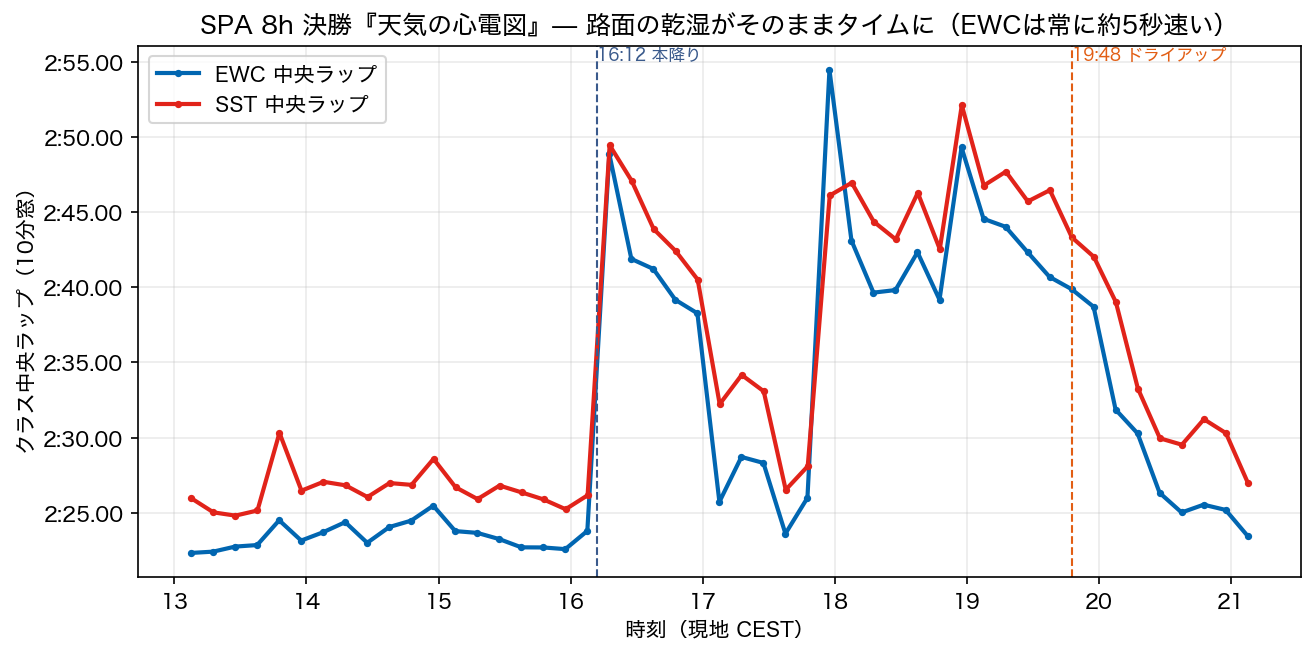
Lining up every car's class-median lap in chronological order, the wet/dry state of the surface becomes a waveform. - The first 3 hours were stable dry (EWC about 2:23 / SST about 2:26). - Heavy rain at 16:12 spiked times by about +25–30 seconds at once (median toward around 2:50). - After that came wild swings of on-again, off-again rain (2:32–2:55), with a brief dry window too. - From 19:48 it dried up, and times recovered toward the end. - And EWC is about 3–5 seconds faster than SST in every phase (prototype regulations vs. production-based). This constant gap is the "class wall" that doesn't disappear even under identical weather.
This 8-hour weather rollercoaster was precisely the stage set for the survival game.
2. The core: position was decided by "time spent stopped"
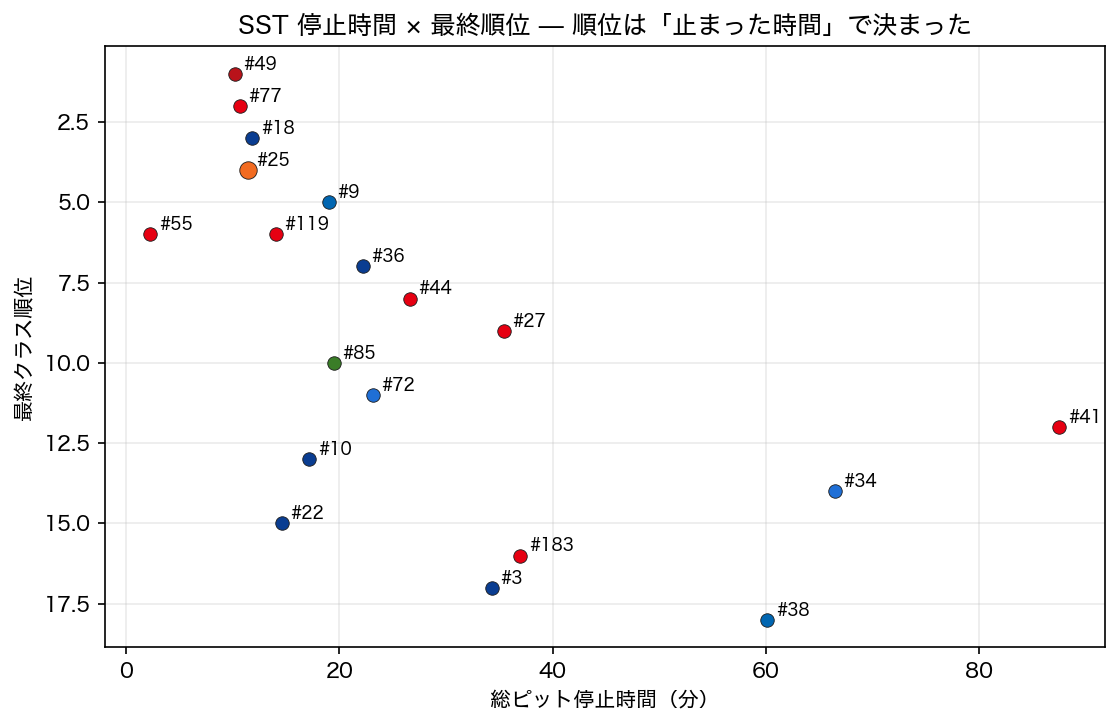
Lining up each car's total pit stopped time against its final position reveals a strong correlation ―― the shorter a team's stopped time, the higher it finished. - The leaders are #49 (10 min stopped), #77 (11 min), #18 (12 min), #25 (11 min), #9 (19 min) ―― all with short stops. - The back markers are #41 (88 min), #34 (66 min), #27 (35 min) ―― long times stopped with trouble. - #25 stopped just 11 min = among the class's lowest. The early crash cost it position, but in cumulative terms its stopped time was in the shortest group. This is the foundation of P4. - ※ #55 stopped only 2 min but retired early at 67 laps (an exception where stopped time didn't accumulate because the car wasn't running).
The speed gap is everyone within a half-second world. But "time stopped" is a world of 10 minutes versus 88 minutes. In an 8-hour endurance race, the latter governed the order.
2b. The mechanics' pit work ―― separating "number of stops" from "work per stop"
"Total pit time" is the product of two completely different factors: ① number of pit stops (fuel economy / stint length = the domain of strategy/the car) × ② work time per stop (tire change, refueling, rider swap = the mechanics' skill). On top of that rides ③ crash/equipment repair. Looking only at total time mixes up the team that's "fuel-efficient with few stops" and the team that's "fast per stop." So we break it apart.
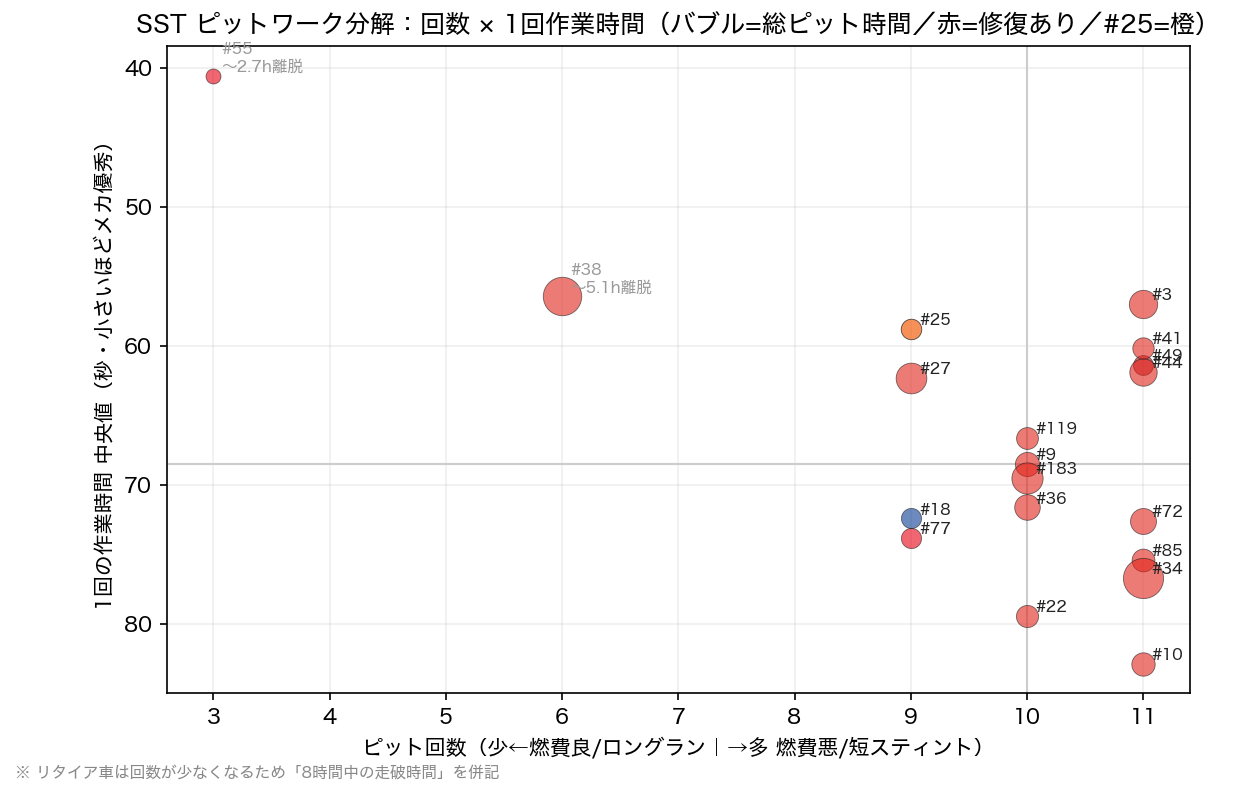
A scatter plot of number of stops (horizontal) × work time per stop (vertical, higher = faster). - #25's mechanics are "59 sec per stop" = among the very fastest in SST (median of normal work excluding repairs; equivalent to 3rd in class). The number of stops is also on the low side at 9 = the favorable top-left zone. - Winner #49 had a fairly high stop count of 11 (somewhat not fuel-economy-type), but 61 sec per stop + zero repairs for the lowest total pit time. "Stop often, but be fast and error-free every time" is the shape of a champion. - Bottom-right (many stops × slow work) = #10, #34, #85 and the like. The classic case of total pit time piling up.
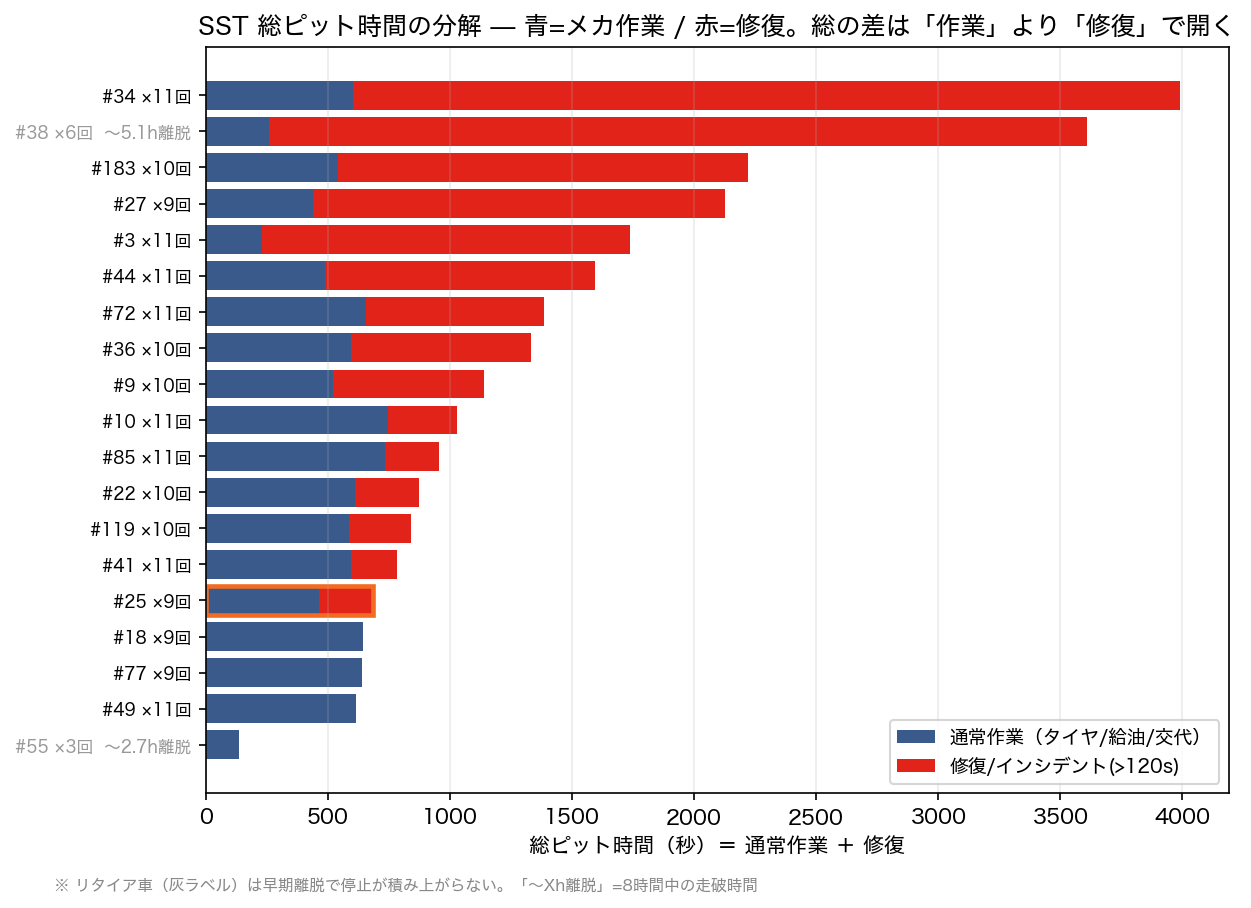
Splitting total pit time = normal work (blue) + repair (red), the lower positions = mostly red (repair): #34, #38, #27, #183 had ordinary normal-work times, but their total time exploded due to repairs. Conversely the leaders #49, #77, #18, and #25 have small, efficient blue (mechanic work). The gap in total pit time opened up not by "work speed" but by "whether or not there were repairs."
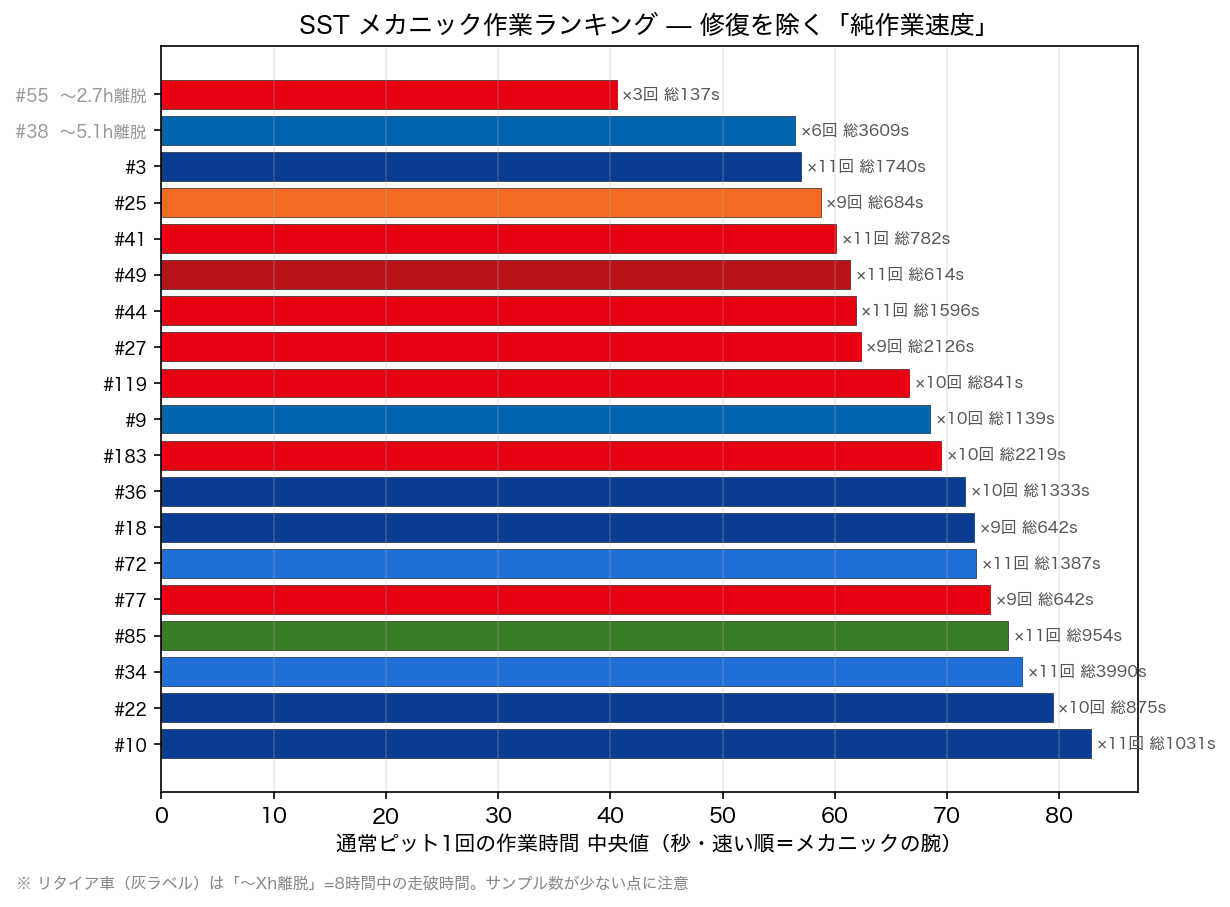
In the pure mechanic-work speed ranking (excluding repairs), #25 is top-tier in SST (≈59 sec). The reason #25's total pit time is somewhat inflated is not that the mechanics were slow, but that crash repair (about 222 sec, once) rode on top ―― "work skill" and "the price of bad luck" should be evaluated separately, and #25's pit crew was among the most reliable across these 8 hours.
Note: retired cars naturally have fewer pit stops, so they are kept in the graph with a gray label noting "~Xh out (= running time within the 8 hours)" appended (SST: #38 = 5.1h, #55 = 2.7h). This prevents the misreading that little stopped time means fast, when it is actually due to early departure.
2c. The pit-strategy pivot ―― the 16:11 rain
The biggest pit-strategy pivot was the 16:11 rain (race control: 16:10:57 "RAIN AT T15" → 16:12:52 "RAIN ON ALL THE TRACK"). Within a 10-minute window, over 40 cars pitted at once (the wet-changeover scramble). Front-runners who had just come in on their fuel cycle (15:56–16:09) could refuel and switch to wets in a single stop, gaining an advantage, while cars caught out on slicks dropped back sharply. Crew speed was tiered by manufacturer (EWC works level ~40 s < SST 56–68 s < PRD over 110 s), and the number of pit stops depended on fuel economy (tank capacity): PRD the most (13.3 on average) > EWC 10.9 > SST 9.9, with the rain pushing the counts up.
3. The what-ifs ―― who would have won on pure pace?
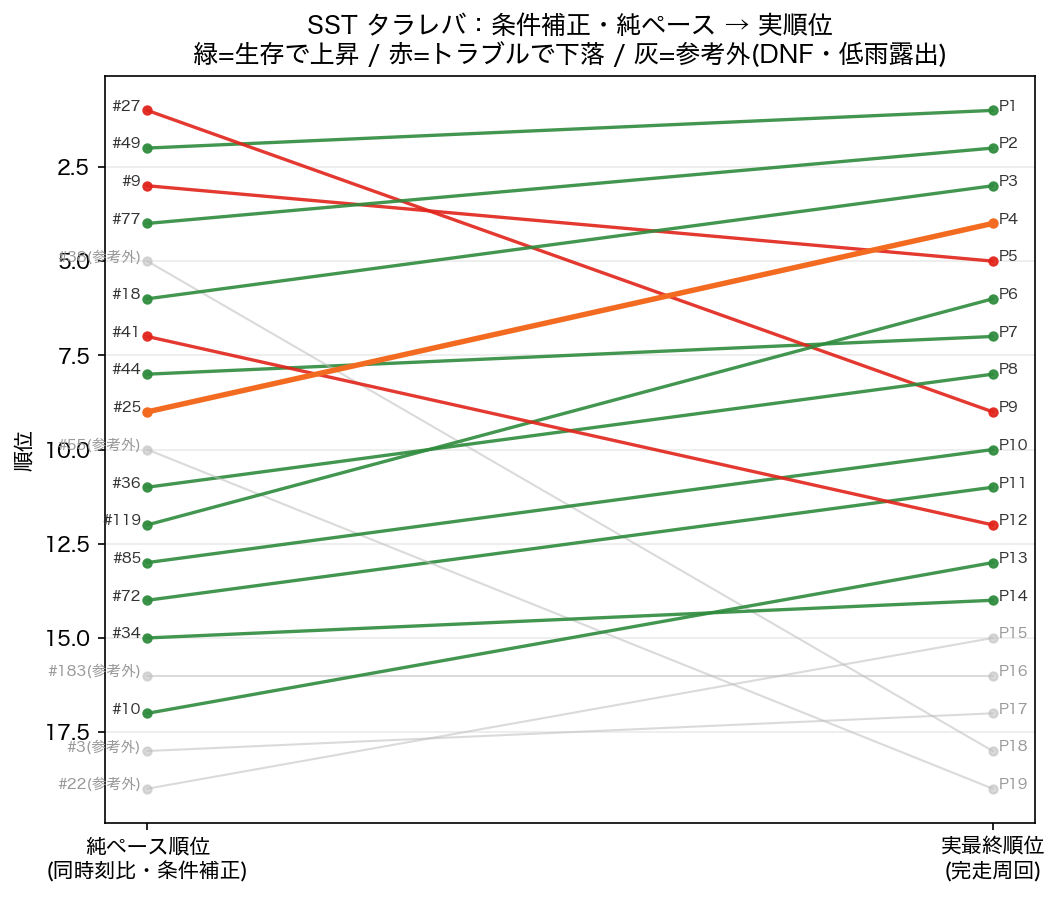
"Pure pace" cannot be measured by a simple median lap. A car that ran much of its distance in the heart of the rain shows an unfairly slow median, while a car that retired early ran only in the dry and gets a flattering median (e.g., #55 dropped out at 67 laps with 0% rain; #38 dropped out at 100 laps with 18% rain = dry-biased). So this article measures pure pace by "the gap of each lap against the times other cars were setting in the same 10-minute window (= same-moment comparison, condition-corrected)." Since every car experiences the same weather at the same instant, it is fair.
- The fastest condition-corrected pure pace is #27 (−2.67 sec vs. field). But with 35 min stopped it finished an actual 9th. The classic case of the No. 1 in speed failing to convert to a result.
- Next come #49 (−2.63, actual 1st/winner) / #9 (−2.22) / #77 (−1.96). Winner #49 was 2nd in pure pace = it won by running out almost the fastest pace without stopping.
- #38's "raw-median 1st" is an illusion: with 18% rain it was dry-biased, and condition-correction drops it back to about 5th (and it dropped out anyway). #55 at 0% rain = not comparable (excluded from reference). These too are shown in gray = out-of-reference on the graph.
- The pure-pace leaders (#27, #41, etc.) sank with trouble, while the non-stopping #49/#77/#18 made the podium. What separated the actual order was not the slim margins of pace but the time spent stopped ―― the essence of a survival race.
Note: the raw median lap is distorted by "when you ran (weather exposure)," so it is not adopted. This section evaluates by same-moment comparison (condition-corrected), and treats DNFs and under-25% rain exposure as "out of reference."
4. Speed ≠ result ―― #25 held the fastest lap of the class
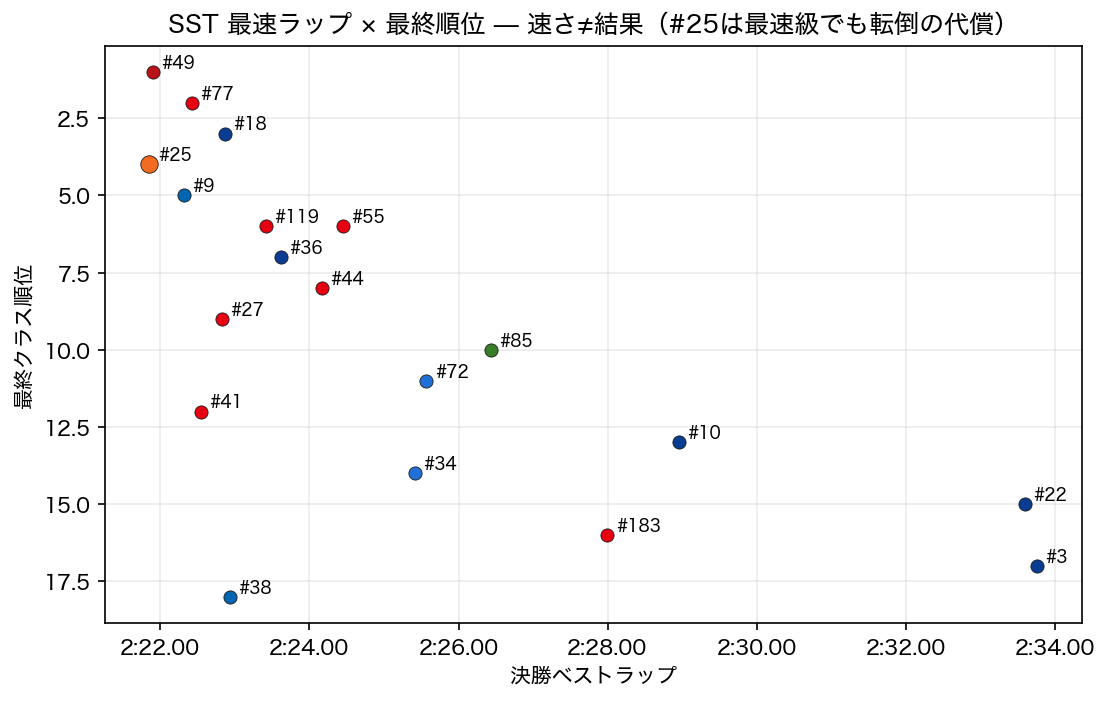
The race's best lap × final position. - #25's 2:21.852 (Kaito Toba, lap 5) is the fastest lap of the SST class in the race (beating even winner #49's 2:21.895). Speed was unmistakably class-leading. - But best-lap speed guarantees no position. #25, holder of the fastest lap, finished P4, while the slightly slower #49 won ―― over 8 hours, "not stopping" matters more than "one-shot speed." #25 embodies both the price (early crash) and the recovery (fewest stops) within a single graph.
5. The scale of attrition ―― the stopped time the rain swallowed
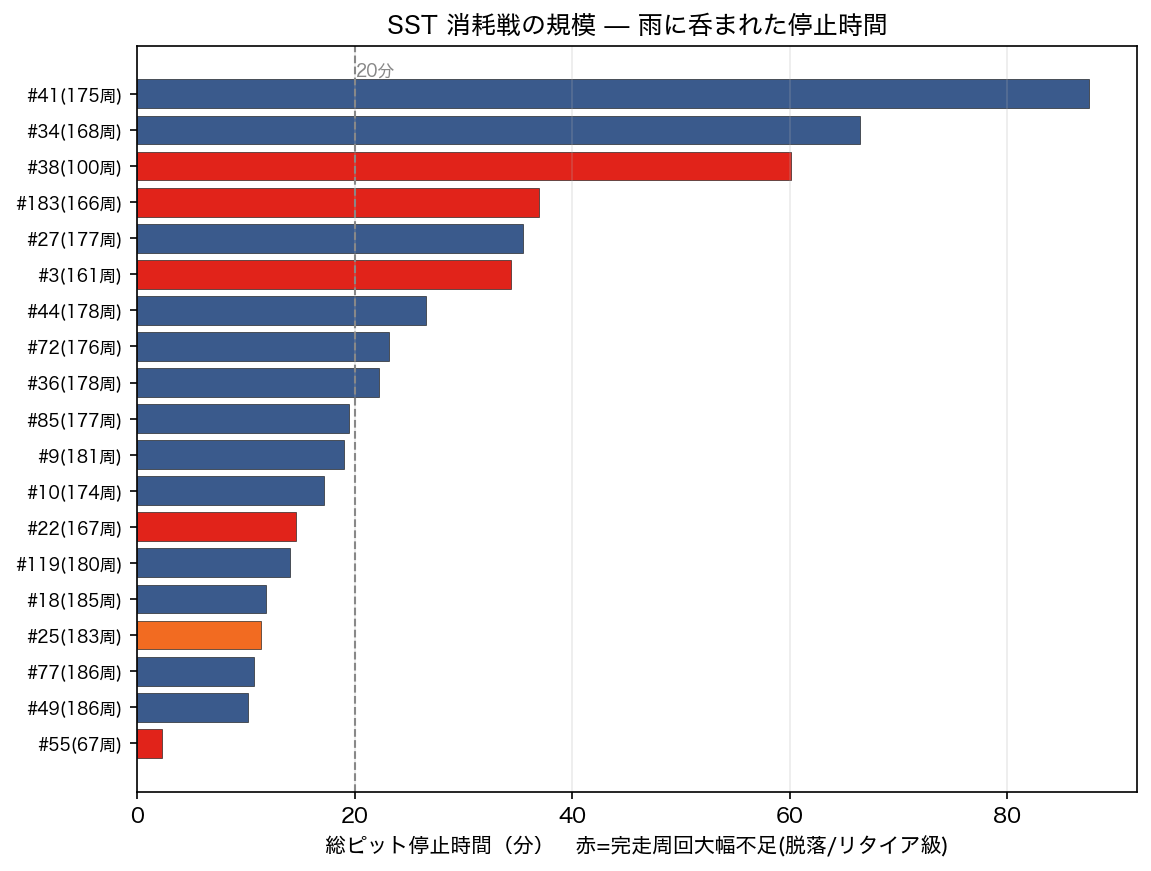
The rainy SPA was a merciless war of attrition. - Effective retirement / dropping out at the halfway mark: #38 Champion-Hert (qualifying class P3 yet dropped out at 100 laps with 60 min stopped), #55 National Motos (67 laps). - Big losses: #41 (88 min stopped), #34 (66 min), #183 (37 min), #27 (35 min). - What held onto the top spots was a handful that hung on within 20 minutes stopped. Running out the rainy 8 hours "unscathed" was itself the greatest competitiveness.
6. #25 Team Étoile's comeback ―― from last to P4
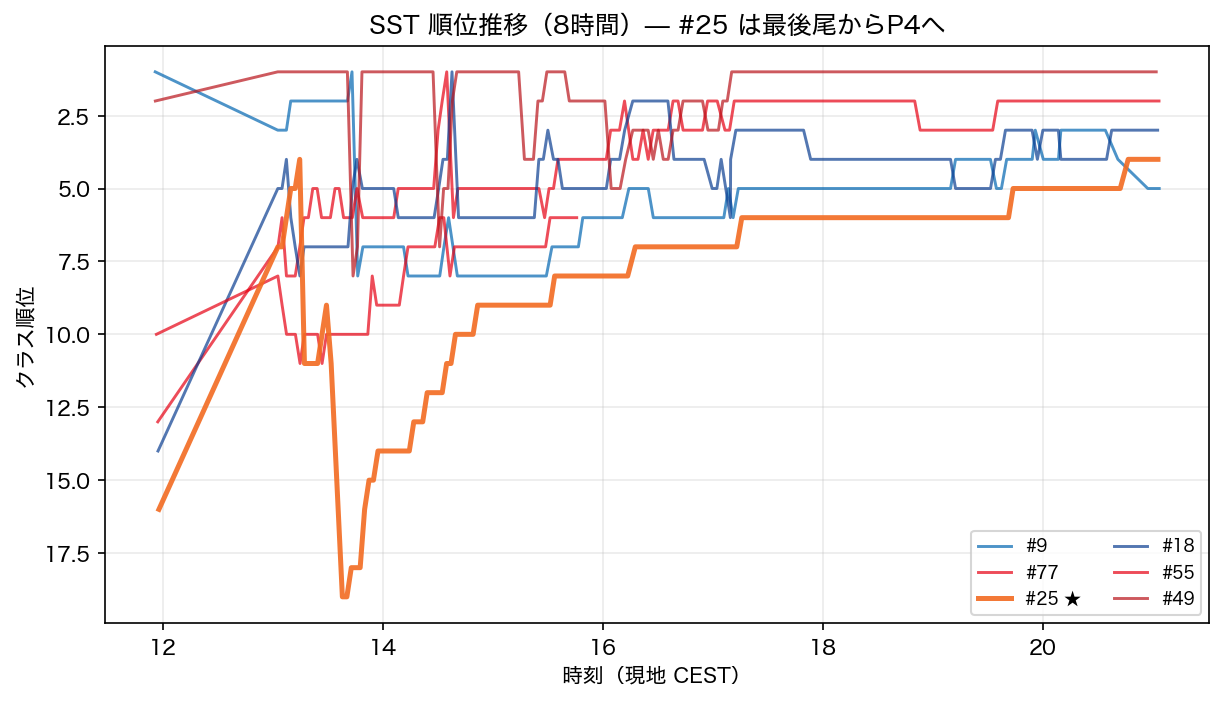
25's story as seen in the 8-hour position progression:
- Early: Kaito Toba set 2:21.852 (class fastest) on lap 5, climbing to 4th in the SST class by lap 6. The speed was real.
- Crashed on lap 7, with shift-system damage that meant he couldn't run out the first stint; after repairs the car dropped to near the back.
- Mid-race: solidly survived the rain (from 16:12), recovering to SST 7th at the 4-hour mark (the turnaround). With the timing of the rain-to-slick tire change and Toba's double stint, it made an ally of the drying surface.
- Late: as #27 and others who had long run 2nd fell out with trouble, #25 kept running without stopping and climbed up to P4.
- Final SST class 4th (183 laps, 11 min stopped). It seized this great comeback from last place by combining speed (fastest lap) and survival (fewest stops).
7. Final result (SST class, based on race laps completed)
| Pos | No. | Team | Bike | Laps | Stopped | Best |
|---|---|---|---|---|---|---|
| P1 | #49 | Revo-M2 | Aprilia | 186 | 10 min | 2:21.895 |
| P2 | #77 | Wójcik #77 | Honda | 186 | 11 min | 2:22.423 |
| P3 | #18 | Pompiers IGOL | Yamaha | 185 | 12 min | 2:22.870 |
| P4 | #25 | Team Étoile | BMW | 183 | 11 min | 2:21.852 (class fastest) |
| P5 | #9 | TECMAS Minerva | BMW | 181 | 19 min | 2:22.318 |
| P6 | #119 | Slider Endurance | Honda | 180 | 14 min | 2:23.413 |
(Below: #36 178 / #44 178 / #27 177 / #85 177 / #72 176 / #41 175 / #10 174 / #34 168 / #22 167 / #183 166 / #3 161. Retired / dropped out halfway: #38 100 laps, #55 67 laps)
8. Summary ―― #25's 4th place, mastering survival
- Position was decided by "time stopped": cars with stopped times in the 10-minute range finished high, cars stopped 30–90 minutes with trouble finished low. The iron rule of 8-hour endurance came out exactly as written.
- In speed, #25 had the class's fastest lap (2:21.852). But one-shot speed guarantees no result.
- #25 came from last after an early crash and survived with the fewest stops to take P4. From 5th in qualifying (→ 4th), the race too was 4th in class. It closed out a hard weekend with "survival" at the very end.
- The rainy war of attrition swallowed even fast cars like #38 (qualifying P3). First, don't stop ―― the 8 hours proved the value of that.
ÉTOILE DATA LAB|#FIMEWC #8hSpaMotos #Superstock
🔬 Methodology & verification
- Source: EnduraBase timing DB (official timing passings), final race session, deduplicated by (car, lap).
- Clean-lap band: 2:05–4:00 (dry to wet). Median laps computed in 10-minute windows.
- Same-time-bin pace: each lap compared with the field median of the same 10-minute window — condition-normalized, immune to weather-exposure bias. DNF or wet exposure <25% flagged "for reference only".
- Pit-work decomposition: individual stops extracted from stand-time transitions; ≤120 s = routine work (median = crew skill), >120 s = repair/incident. Retired bikes stay on the charts with hours-lasted noted.
- Order: by completed laps within class.
- Verification: cross-checked against official results, then re-verified by two independent review agents (two figures were corrected before publication).
- Boundary: timing facts and situation description only — no team-internal setup information.