
Eight Hours, 362 Laps, 43 Seconds — Suzuka Twin 8H 2026
4th Riding Sports Cup — Étoile Suzuka TWIN 8 Hours Endurance Race 23 August 2026 / Suzuka Twin Circuit / 41 entries, 13,651 laps
Start 08:30, interval 12:30–13:30 (no running), restart 13:30, chequered flag 17:30.
Final result
| Pos | # | Class | Laps | Team |
|---|---|---|---|---|
| 1 | 5 | EXP | 362 | TSR to Chou Yukai na Nakamatachi |
| 2 | 32 | EXP | 362 | TEAM NOJIMA with TYK |
| 3 | 59 | EXP | 359 | YD Moto-Mushoku Rengou |
| 4 | 25 | EXP | 356 | Team Étoile #25 |
| 5 | 44 | EXP | 355 | Mini-Tomo |
| 6 | 15 | EXP | 353 | Muffler no Koto nara Unlabel |
| 7 | 649 | EXP | 352 | MH to YD to Team Nozuka @ Moto-Mushoku |
| 8 | 52 | EXP | 352 | Team Étoile #52 |
| 9 | 8 | EXP | 349 | YTR+T-TECH |
| 10 | 27 | EXP | 347 | IMSC&DRUG+JUBET |
EJ class: 1st #12 JDC+A.S.H.OIL① (339) / 2nd #16 Team Shinchan (336) / 3rd #14 JDC+A.S.H.OIL② (334)
The winner and the runner-up finished on the same lap count — 362. After eight hours, the gap was 43.0 seconds.
1. Eight hours, decided by 43 seconds
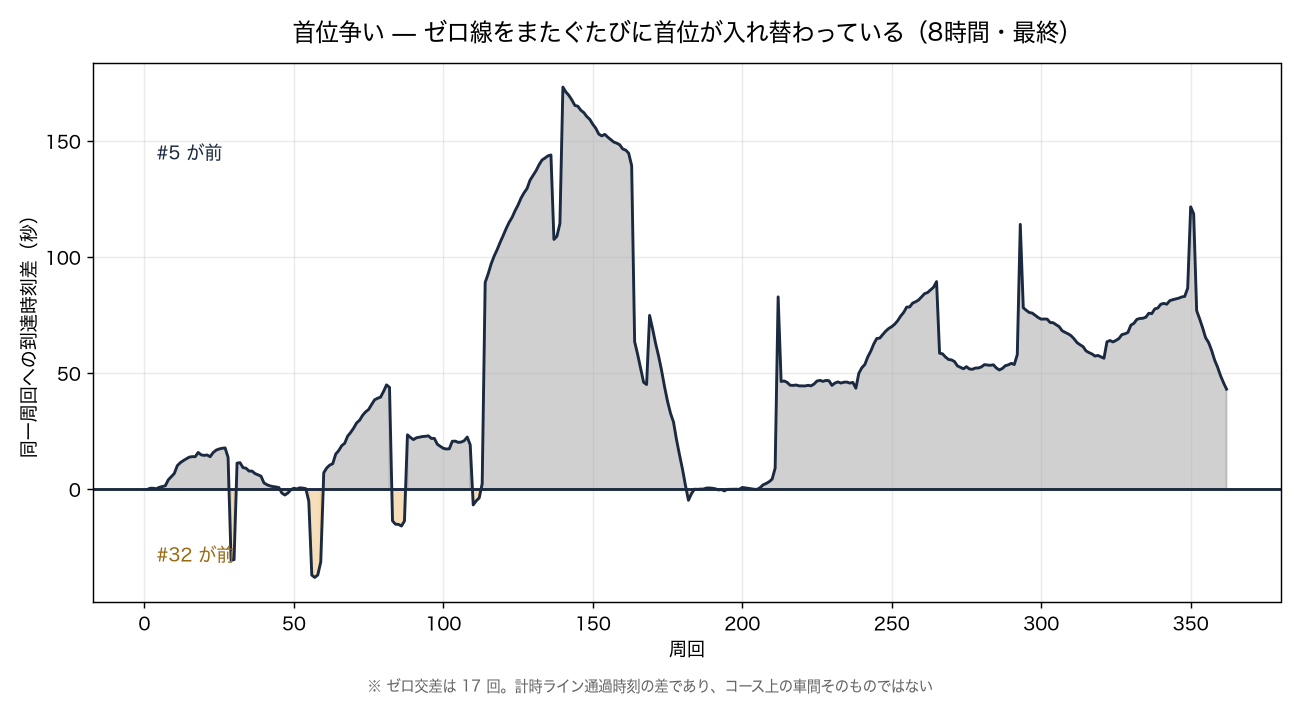
The lead changed hands 17 times between #5 TSR and #32 TEAM NOJIMA. Every time the line crosses zero on the chart, first and second swapped on the timing screen.
Their median lap times were 1:17.55 and 1:17.56 — one hundredth of a second apart. Two cars this evenly matched spent eight hours in each other's company.
The moment it was settled
Straight after the restart, across laps 184–206 — 23 consecutive laps — the two were never more than one second apart at the same lap number (closest: 0.005 s). Neither car pitted during that stretch. It was settled on track, not in the pit lane.
The gap opened at the stops on laps 212 and 213.
| #5 | #32 | |
|---|---|---|
| Pit lap time | lap 213 115.3 s | lap 212 153.5 s |
| Gap immediately after | — | 46.4 s |
Thirty-eight seconds of difference across those two pit laps. A lead that 23 laps of wheel-to-wheel racing could not resolve was decided in a single lap.
The final ten laps
| Lap | #5 | #32 |
|---|---|---|
| 353 | 81.1 s | 77.5 s |
| 357 | 81.9 s | 78.5 s |
| 360 | 80.8 s | 77.1 s |
| 362 | 80.1 s | 77.3 s |
#5 backed off to 80–81 s and brought it home; #32 kept pushing in the 77s. The gap fell from 86.5 s at lap 349 to 43.0 s at lap 362 — and then the flag came out.
On that rate, #32 needed roughly thirteen more laps.
1b. Where the 43 seconds came from
Add up every lap of the eight hours and the final margin reconciles to within a second.
| #5 (winner) | #32 (2nd) | Difference (#32 − #5) | |
|---|---|---|---|
| 348 racing laps | 27,064.08 s | 27,042.13 s | −21.95 s |
| 12 pit laps | 1,440.13 s | 1,503.35 s | +63.23 s |
| Interval lap | 3,619.8 s | 3,621.7 s | +1.9 s |
| Opening lap | 87.1 s | 87.0 s | −0.1 s |
| Total | 32,211.0 s | 32,254.1 s | +43.0 s |
#32 was some 22 seconds quicker on track. Over eight hours and 348 laps it beat the winner where the racing happens.
It lost because it spent 63 seconds more in the pit lane.
About twenty-two seconds faster, sixty-three seconds longer stopped. Net: forty-three seconds. That was the race.
2. Raw pace
A best lap is the single best moment of the day. Over eight hours what matters is the speed you actually run, lap after lap.
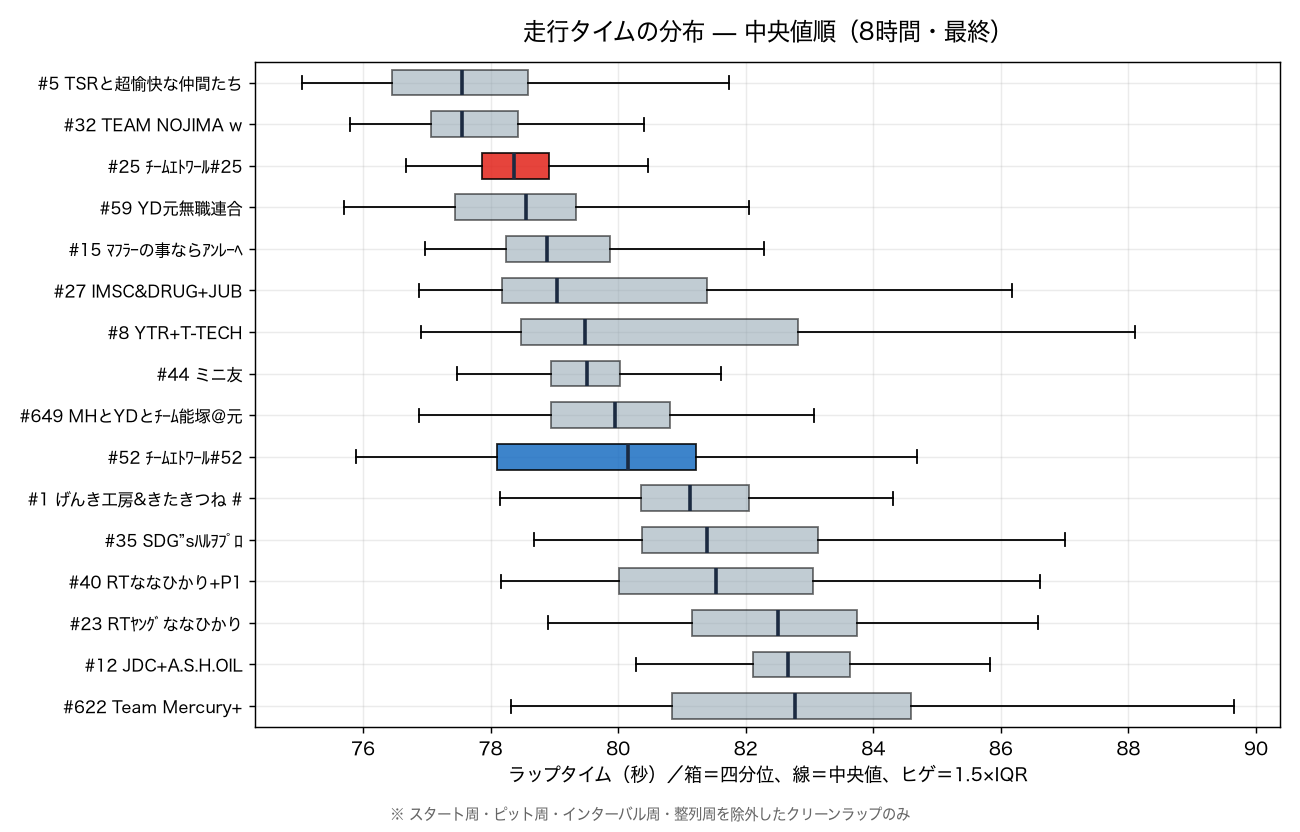
| Pos | # | Median | Best |
|---|---|---|---|
| 1 | 5 | 1:17.55 | 1:15.040 |
| 2 | 32 | 1:17.56 | 1:15.797 |
| 4 | 25 | 1:18.36 | 1:16.670 |
| 3 | 59 | 1:18.56 | 1:15.704 |
| 6 | 15 | 1:18.89 | 1:16.970 |
| 10 | 27 | 1:19.04 | 1:16.886 |
| 9 | 8 | 1:19.48 | 1:16.910 |
| 5 | 44 | 1:19.51 | 1:16.667 |
| 7 | 649 | 1:19.95 | 1:16.886 |
| 8 | 52 | 1:20.16 | 1:15.883 |
#25's median of 1:18.36 is the third fastest of all 41 entries — while its best lap ranks only ninth. Fourth place overall starts here.
#52 set the fourth fastest lap of the race (1:15.883) yet its median is 1:20.16. Two machines from the same team, with opposite profiles.
3. How much of that speed was repeatable
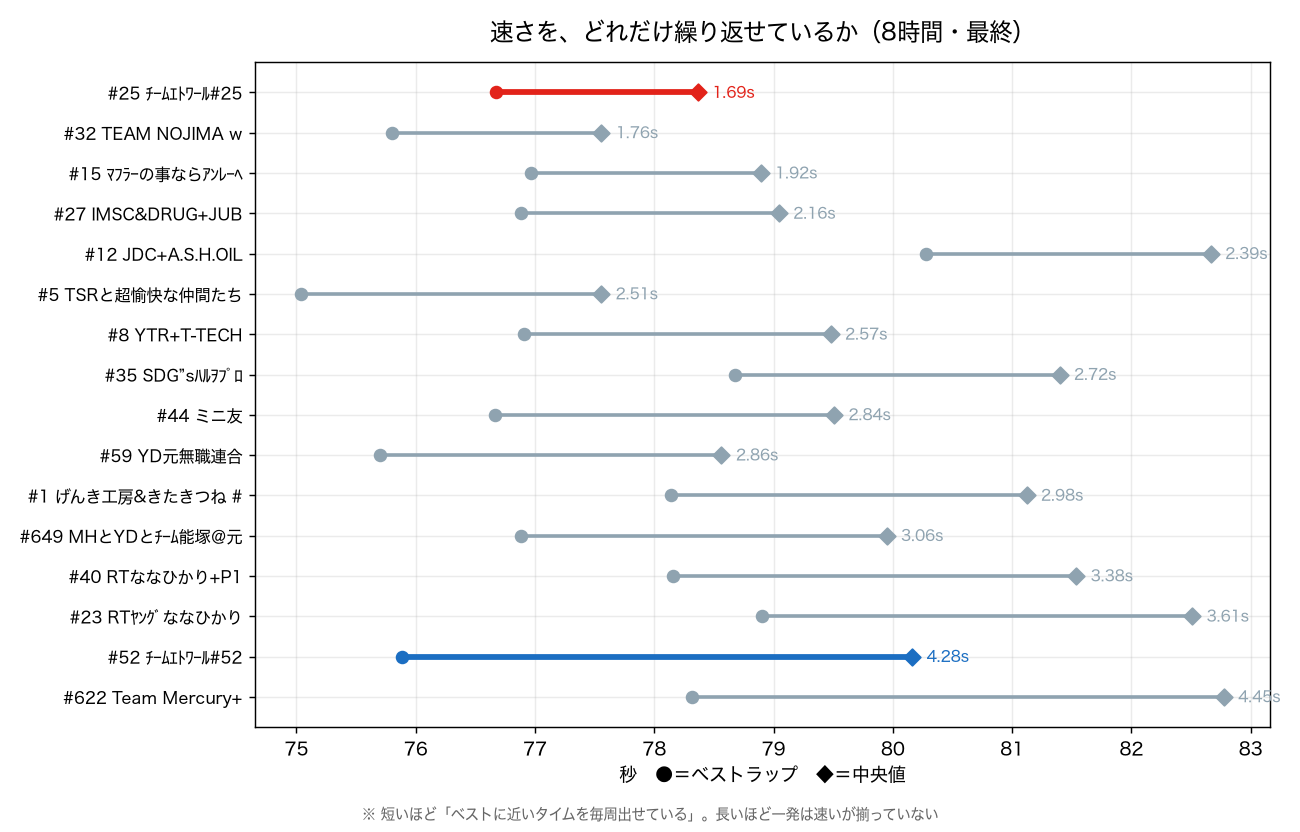
The distance between best and median is the distance between one good lap and your normal speed.
| # | Best → median |
|---|---|
| 25 Team Étoile #25 | 1.69 s ← smallest of all 41 |
| 32 NOJIMA | 1.76 s |
| 15 Unlabel | 1.92 s |
| 27 IMSC&DRUG | 2.16 s |
| 5 TSR | 2.51 s |
| 52 Team Étoile #52 | 4.28 s |
#25 came closer to its own best lap, more often, than any other car in the race.
4. Were the riders matched?
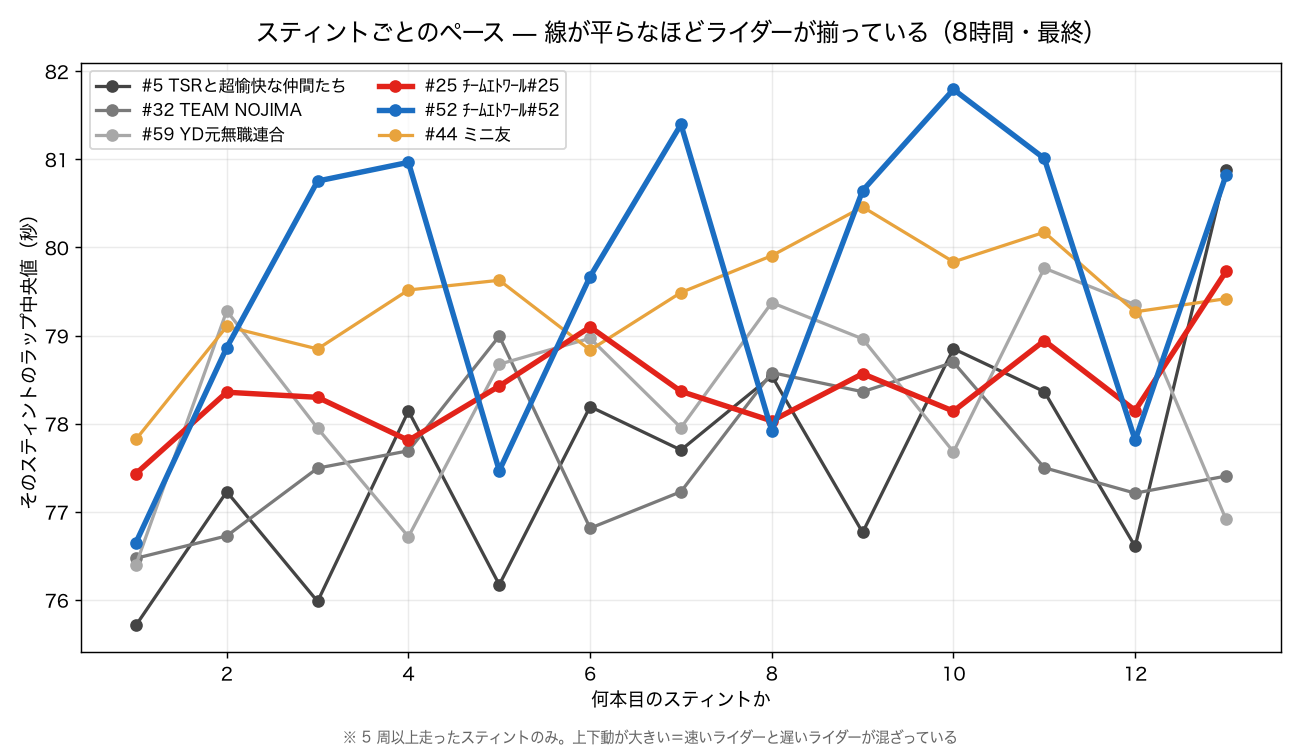
Plotting each stint's median lap time shows how much a team's pace moved across the race. (Rider identity is not in the data, so fuel load and traffic are folded in alongside rider differences.)
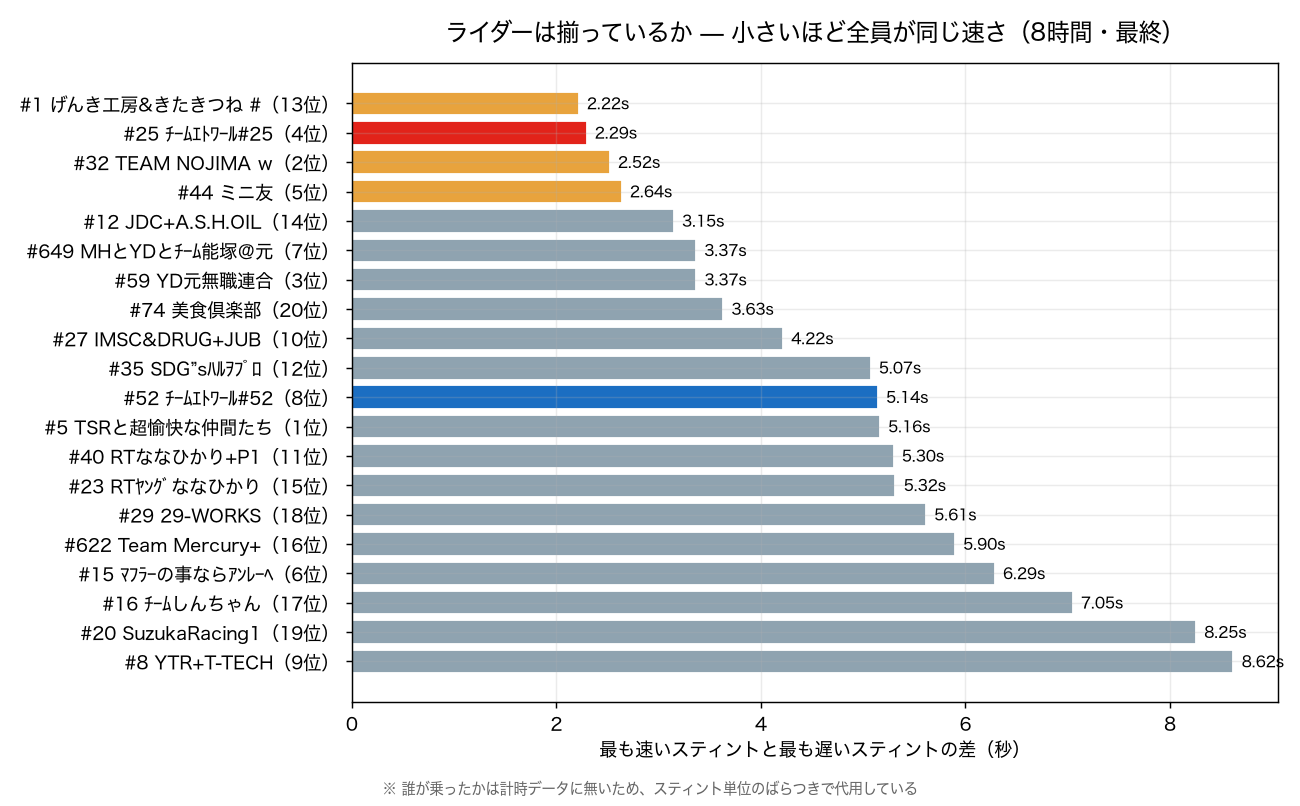
| # | Fastest stint vs slowest stint | Pos |
|---|---|---|
| 25 Team Étoile #25 | 2.29 s | 4th |
| 32 NOJIMA | 2.52 s | 2nd |
| 44 Mini-Tomo | 2.64 s | 5th |
| 59 YD Moto-Mushoku | 3.37 s | 3rd |
| 649 MH to YD | 3.37 s | 7th |
| 5 TSR | 5.16 s | 1st |
| 52 Team Étoile #52 | 5.14 s | 8th |
| 8 YTR+T-TECH | 8.62 s | 9th |
#25's 2.29 s is the tightest among the front-runners. All thirteen of its stints landed in the same narrow band.
#52 spread 5.14 s — stints in the 1:16s alongside stints in the 1:21s. Gain in the quick stints, hand it back in the others.
The result: #25 fourth, #52 eighth. A 1.80 s difference in median pace became four laps.
Note: #5's 5.16 s includes the closing stint, where it deliberately ran 80–81 s to bring the win home. Through the middle of the race it sat in the low 3s.
5. Did one fast lap become a result?
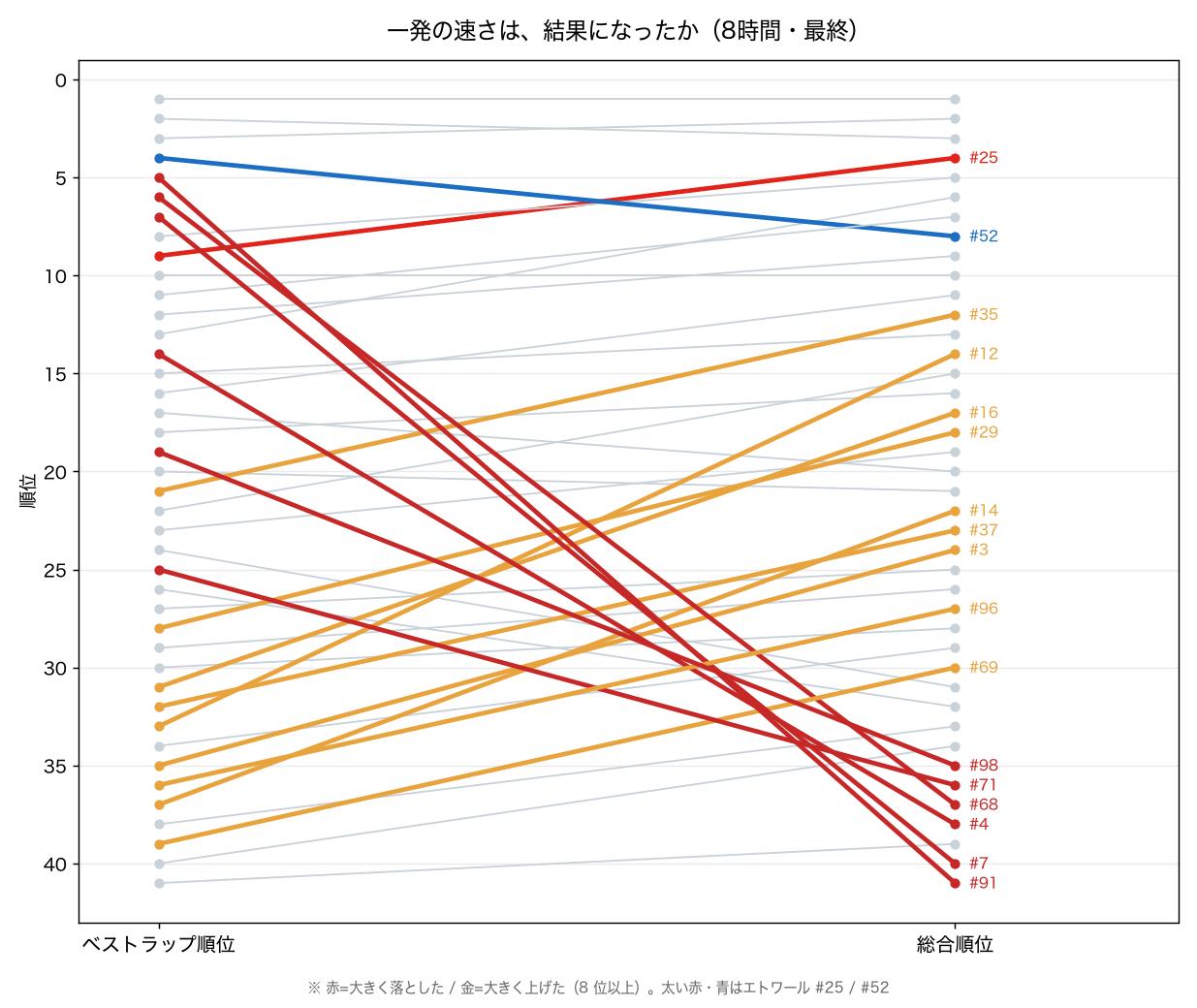
| Best-lap rank | # | Time | Finish |
|---|---|---|---|
| 1 | 5 | 1:15.040 | 1st |
| 2 | 59 | 1:15.704 | 3rd |
| 3 | 32 | 1:15.797 | 2nd |
| 4 | 52 | 1:15.883 | 8th |
| 5 | 91 | 1:16.022 | 41st |
| 6 | 68 | 1:16.349 | 37th |
| 7 | 7 | 1:16.458 | 40th |
| 8 | 44 | 1:16.667 | 5th |
| 9 | 25 | 1:16.670 | 4th |
The fifth, sixth and seventh fastest machines finished 41st, 37th and 40th. The ninth fastest finished fourth. Speed was not what separated them.
6. Every team's pit stops and refuelling
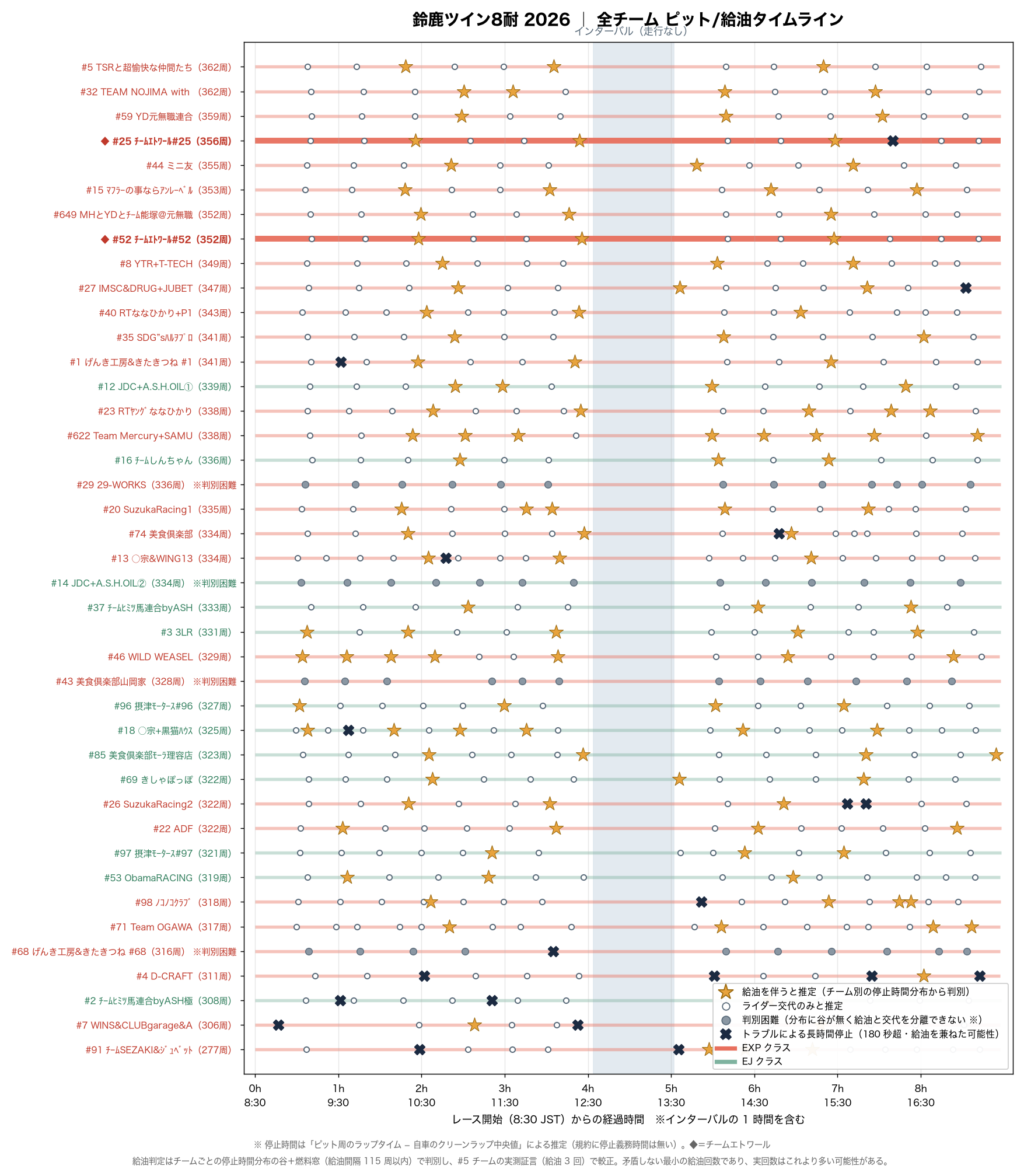
There were 558 pit stops in eight hours, sorted into four kinds:
| Count | Reading | |
|---|---|---|
| ○ | 358 | rider change only |
| ★ | 132 | refuelling stop |
| ● | 48 | undecidable (no gap in the team's stop-time distribution — 4 teams) |
| ✕ over 180 s | 20 | long stop after a problem (likely refuelled as well) |
Every front-running team made 12 stops, of which 3–4 were ★.
| # | Total stops | ★ (refuel) | ✕ (trouble) |
|---|---|---|---|
| 5 TSR | 12 | 3 | 0 |
| 32 NOJIMA | 12 | 4 | 0 |
| 59 YD Moto-Mushoku | 12 | 3 | 0 |
| 25 Team Étoile #25 | 12 | 3 | 1 |
| 44 Mini-Tomo | 12 | 3 | 0 |
| 52 Team Étoile #52 | 12 | 3 | 0 |
Change riders every 24–30 laps; refuel at every third change — every 80–100 laps. That was the rhythm of this race.
At last month's Takasu 8 Hours a refuelling stop carried a mandatory two-minute hold, so fuel stops were obvious in the data. Suzuka Twin sets no minimum stop time — the rules require only that refuelling happens in the pit box, engine off, with at least two crew, and that a rider change accompanies it. The classification above is an estimate: it splits each team's own stop-time distribution at its natural gap, checks the result against fuel range (a refuel at least every 115 laps), and was calibrated against first-hand information from team #5 ("we refuel at every third change — three refuels in total"). Refuelling adds roughly 30 seconds, so for teams with fast rider changes the whole stop stays under a minute — no single cut-off fits everyone. The counts shown are the smallest numbers consistent with the data; the real ones may be higher.
7. What decided the order
| Measure | Correlation with finishing position (ρ) |
|---|---|
| Total time lost in the pits | +0.76 |
| Median clean lap time (raw pace) | +0.64 |
| Number of stops | +0.41 |
Total pit loss explains the finishing order better than raw pace does.
But that 0.76 includes the long stops after a problem. Exclude every stop over 180 s and ρ drops to 0.45 — below raw pace at 0.64. What moved the order was not routine pit work; it was not stopping at all.
8. One problem was enough
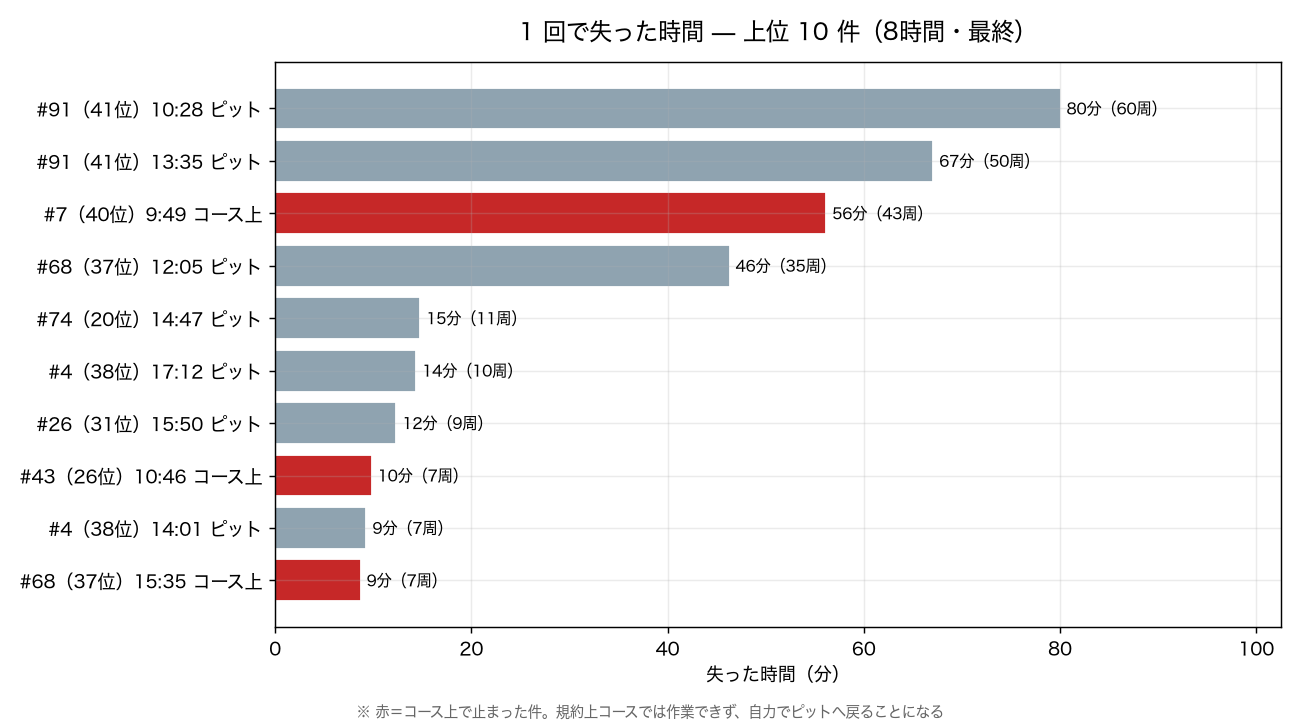
| Lost | Laps | # | Finish | Time | Where |
|---|---|---|---|---|---|
| 4,803 s | 59.6 | 91 | 41st | 10:28 | pit lane (80 min) |
| 4,024 s | 50.0 | 91 | 41st | 13:35 | pit lane (67 min) |
| 3,371 s | 42.7 | 7 | 40th | 09:49 | on track (56 min) |
| 2,779 s | 35.4 | 68 | 37th | 12:05 | pit lane (46 min) |
| 888 s | 11.0 | 74 | 20th | 14:47 | pit lane |
| 863 s | 11.0 | 4 | 38th | 17:12 | pit lane |
| 741 s | 9.0 | 26 | 31st | 15:50 | pit lane |
#91 set the fifth fastest lap of the race and lost two and a half hours in two stops. #7, seventh fastest, spent 56 minutes stopped on track at 09:49 — and since the rules forbid working on the machine anywhere but the pit box, that means getting back under your own steam.
In every case a problem stretched the stop, and the stop set the finishing position.
#25, at 16:09
lap 297    82.9 s   16:04
lap 298   282.5 s   16:09  ← PIT
lap 299    80.7 s   16:11
#25 was fighting for third when trouble arrived with 80 minutes left. Subtracting the routine stop it would have made anyway, the cost was 162 seconds — 2.1 laps. At 16:04 the gap to third-placed #59 had been 12.5 seconds. After this, it was gone.
From lap 299 the car was back to 78–82 s. Fixed, and running to the flag.
9. A wall that held for seven hours, broken twice in the last two
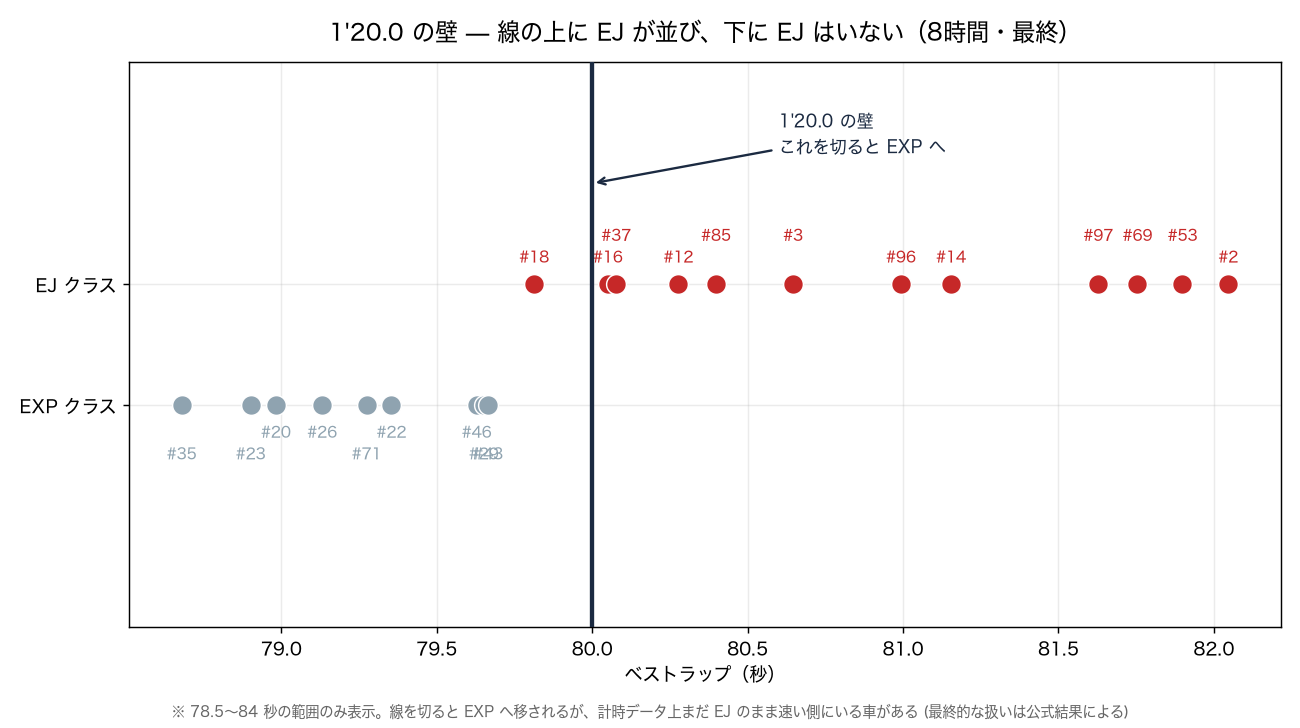
In the EJ class, a best lap under 1:20.0 during the race means automatic promotion to EXP. Going faster is, quite literally, a penalty.
For seven hours nobody crossed it. Then, in the closing two hours, the timing sheets recorded two cars going under.
| Time | # | Lap | Class |
|---|---|---|---|
| 15:40 | 46 WILD WEASEL | 1:19.734 | changed to EXP |
| 16:58 | 18 ○Sou + Kuroneko House | 1:19.813 | still listed as EJ in the timing data |
| 17:02 | 37 Team Himitsu Uma Rengou byASH | 1:20.077 | 0.077 s from the wall |
Note: #46 appears as EXP in the timing data. #18 is still listed as EJ at this snapshot; its final classification rests with the official results.
#46 set 1:20.162 at 12:29 and then did not improve for three hours. At 15:37 it grazed the wall with 1:20.132 — and three minutes later went through it.
The price: sixth in class had it stayed in EJ; around twentieth once moved to EXP. The lap count does not change. Only the class does — and with it, the result.
Both crossings came late — #46 at 15:40 and car 18 at 16:58, thirty-two minutes from the flag. A record that had not moved for seven hours was rewritten twice in the closing stages.
10. Eight hours, and the race never stopped
Minibike circuits do not run a safety car. The only way the track is neutralised is a red flag — and a red flag stops everyone, so it shows up directly in the lap record.
Grouping every clean lap into two-minute windows and measuring each car against its own median, the worst window in eight hours cost the median machine just 1.41 s (16:28). Not one window exceeded even two seconds.
The race stopped only for the scheduled one-hour interval. There was no red flag.
Individual machines lost long stretches — but the track itself ran for eight hours without interruption.
11. What this race leaves behind
① Speed and repeatable speed are different things. The fifth, sixth and seventh fastest cars finished 41st, 38th and 40th; the ninth fastest finished fourth. Eight hours asks for your slowest speed, not your fastest.
② Evening out your pace is worth more than sharpening one lap. #25's stint spread of 2.29 s and best-to-median gap of 1.69 s were among the tightest in the field. It finished fourth while eight cars had a faster single lap.
③ What really moves the order is not stopping — more than routine pit work. Total pit loss correlates at ρ = 0.76, but strip out the long stops after a problem and it falls to 0.45 (raw pace: 0.64). Trimming a routine stop is worth doing; point ④ is worth an order of magnitude more.
④ Design for not stopping on track. Four separate incidents cost 40–80 minutes each. Because the rules allow work only in the pit box, being able to reach the pits under your own power is worth far more than shaving seconds off a stop.
⑤ The single most valuable thing to record next time is pit-exit time. This year's timing data has pit entry only, so actual stationary time is unknown. With it, the margin against the 40-minute rule could be designed precisely.