
Race Preview · SST — The Final 45 Minutes Were the Week's Full Revision. #25 Went to Buy Back the Rain
- Lap trend & spread bandMedian lap + spread band (IQR) tracing the 45 minutes the shower came and went
- Pit-lane strategyOn-track vs waiting in the pit — wait, run, or gamble
- The protagonist's traceOne bike's lap history tracking the mixed-condition choices
On Wednesday afternoon, Suzuka got wet once. Then in FP13, on the eve of the race, dry → drizzle → drying came around again — this time complete with the transitions — compressed into 45 minutes. #25 Team Étoile, whose dry-to-wet drop-off in Wednesday's rain came out as the largest in class (+21.2 s), stayed out on track through the rain for those 45 minutes — going to buy back their wet weakness at the very last opportunity. And the timing left one yardstick for the race: after the rain stops, the track comes back at roughly one second per lap.
4 July 2026, 13:10–13:57 (JST), FP13 (EnduraBase Turso prod, id=325). The last practice before the race became a dress rehearsal for tomorrow's forecast of "rain and sun in alternation". We read the SST class in the context of the week.
§1 The Shape of 45 Minutes — Dry → Drizzle → Drying
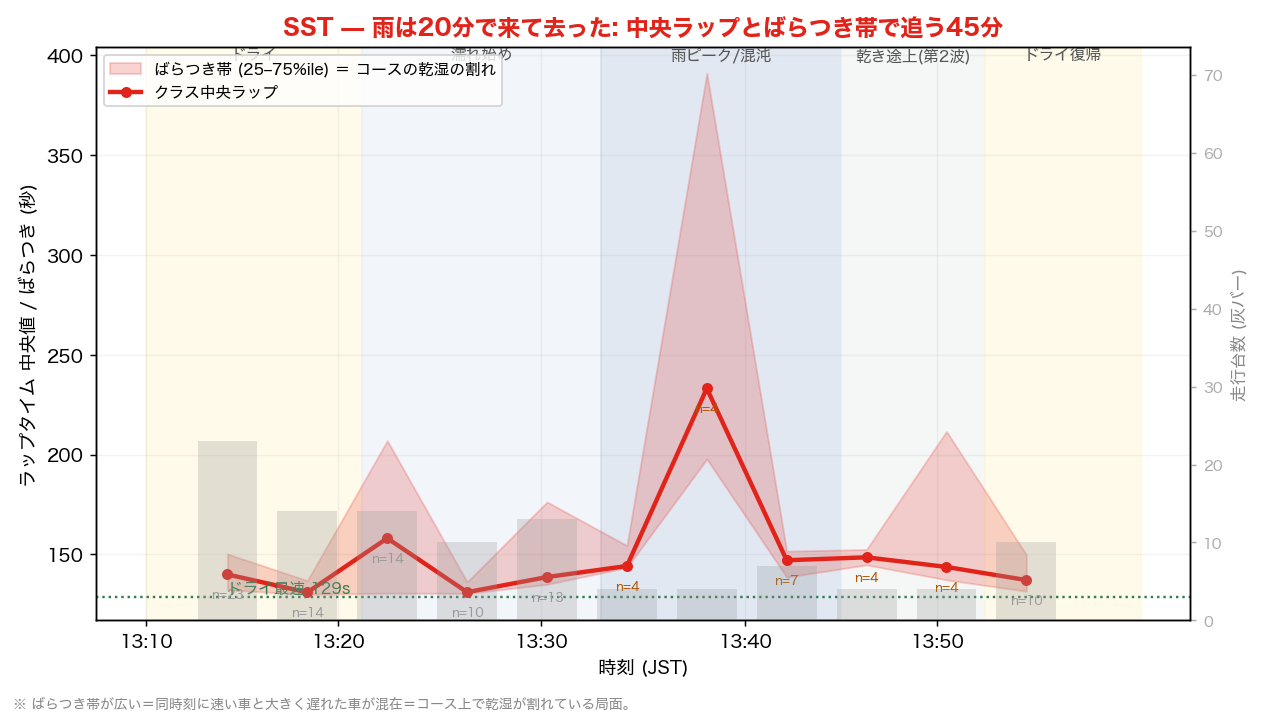
Class median lap in 4-minute windows (solid line) and the spread band (IQR). A wide band = cars lapping normally and cars badly delayed sharing the same moment on track = a surface split between wet and dry. 13:12–20 was dry (median 137→134 s); at 13:22 the band ballooned (IQR 52.7), announcing the onset of drizzle; 13:33–45 was the peak of the rain; from 13:46 the track headed for dry (with a brief second wave at 13:49).
Wednesday afternoon's wet (FP8-10) was a half-day affair: it rained, eased, and lifted. FP13 compressed all of that into 45 minutes — and, crucially, contained both of the transitions that are hardest to judge: the onset of rain and the drying edge. That this arrived on the eve of the race is what gives the session its value.
§2 Three Ways to Use 45 Minutes — Call It a Day / Wait for the Dry / Run in the Wet
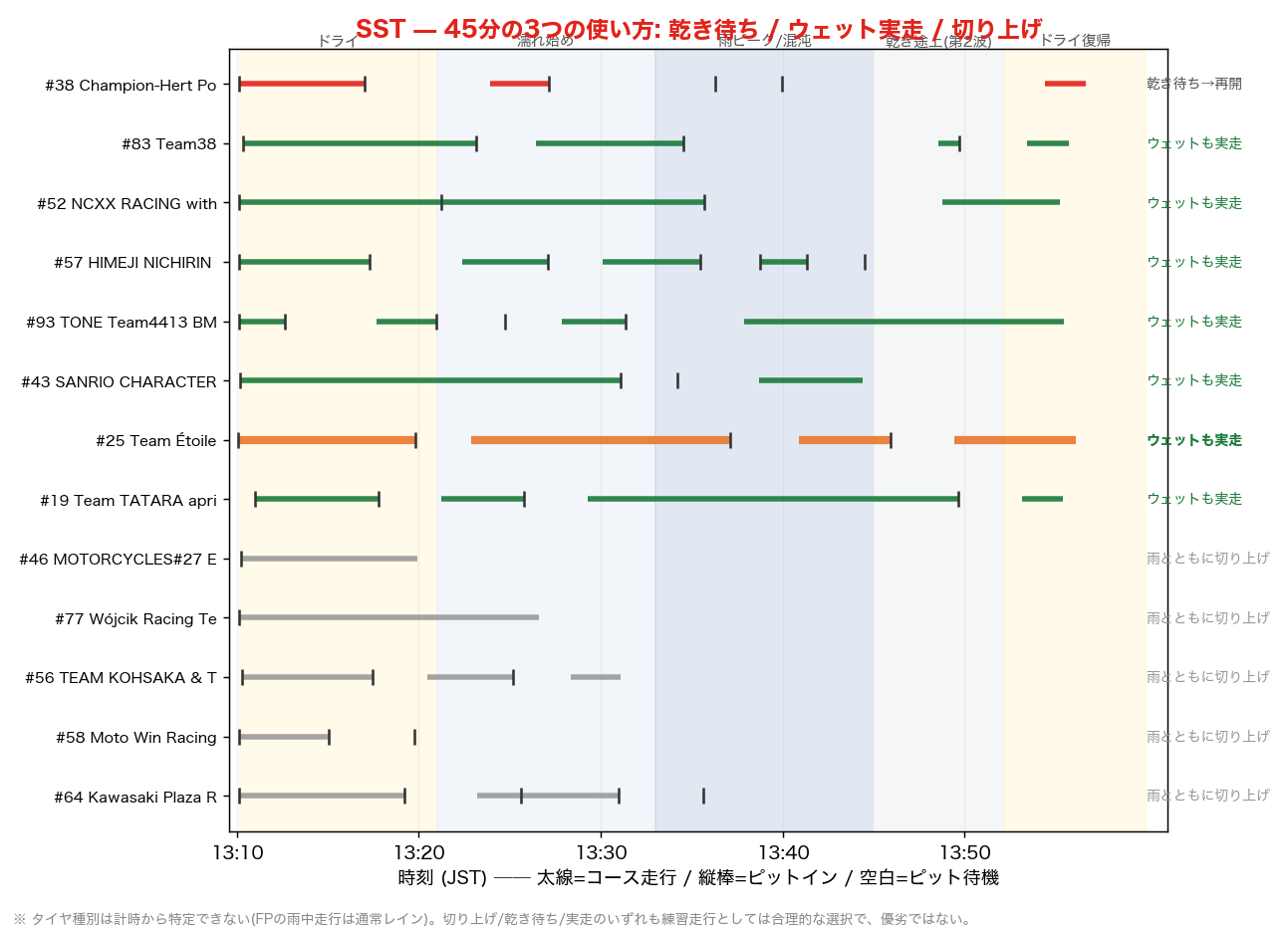
Each machine's track running (thick line) and pit stays (blank), laid out on a timeline. The usage split three ways.
- Call it a day with the rain — #46 (13:19), #77 (13:26), #56 and #58 ended their running around the rain. On race eve, on a wet track, no risk taken — shutters down. A perfectly respectable choice.
- Wait for the dry, then resume — #83, #52 and #38 sat out the peak of the rain in the pits, returning for confirmation runs once the drying began.
- Run in the wet — #25 (5 core laps, joint most in class), #19 (5 laps), #43, #93, #52 (first half). They lapped the wet track and brought home the data on the transitions.
Note that tyre choice cannot be identified from the timing (in practice, wet running is normally done on rain tyres). All three are rational uses of an FP session — this is not a ranking — the only difference is what each team stocked up on, the day before the race.
§3 The Drying-Track Yardstick — After the Rain Stops, the Track Comes Back About One Second Per Lap
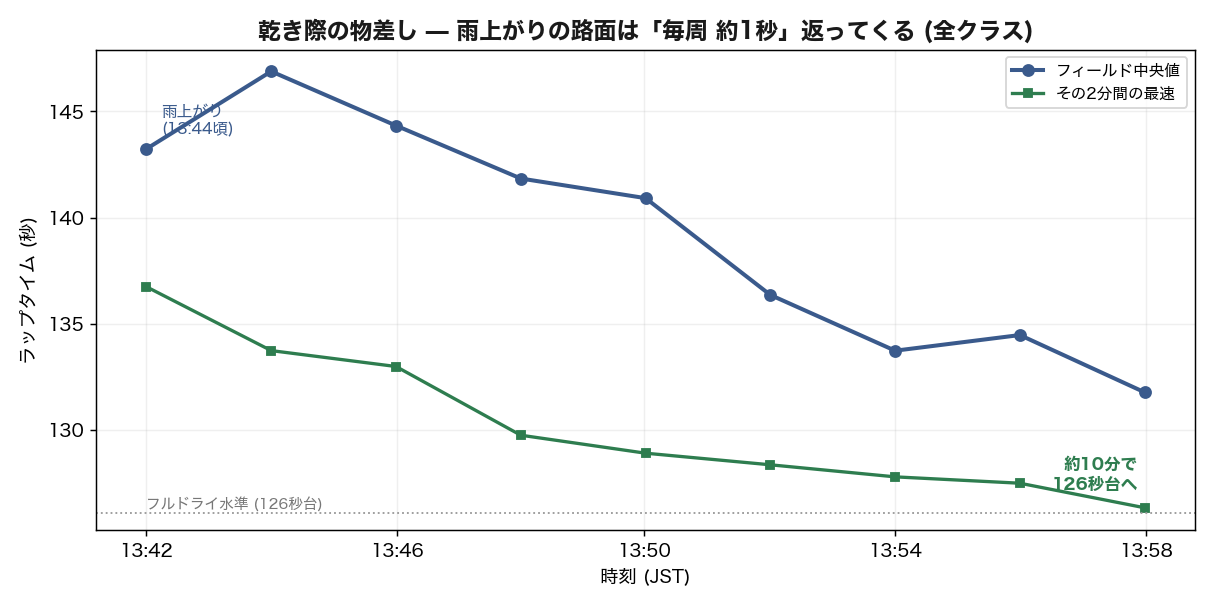
This is FP13's greatest gift to the race. From around 13:44, once the rain had stopped, the field median fell from 144 s to 132 s, and the fastest lap of the moment from 137 s into the 126 s bracket (full-dry level). In other words —
From the moment the rain stops, the track comes back at roughly one second per lap for about ten minutes — after which full slick pace is on.
Where Wednesday's wet analysis (equal-rainfall comparison, wet penalty) was a yardstick for "who is fast on a wet track", this one measures "when to attack a drying one". Tomorrow, every time the rain stops, these ten minutes will come around again. The side that calls the tyre change or the move one lap earlier banks that one second per lap.
§4 #25's 45 Minutes — Going to Buy Back the Weakness
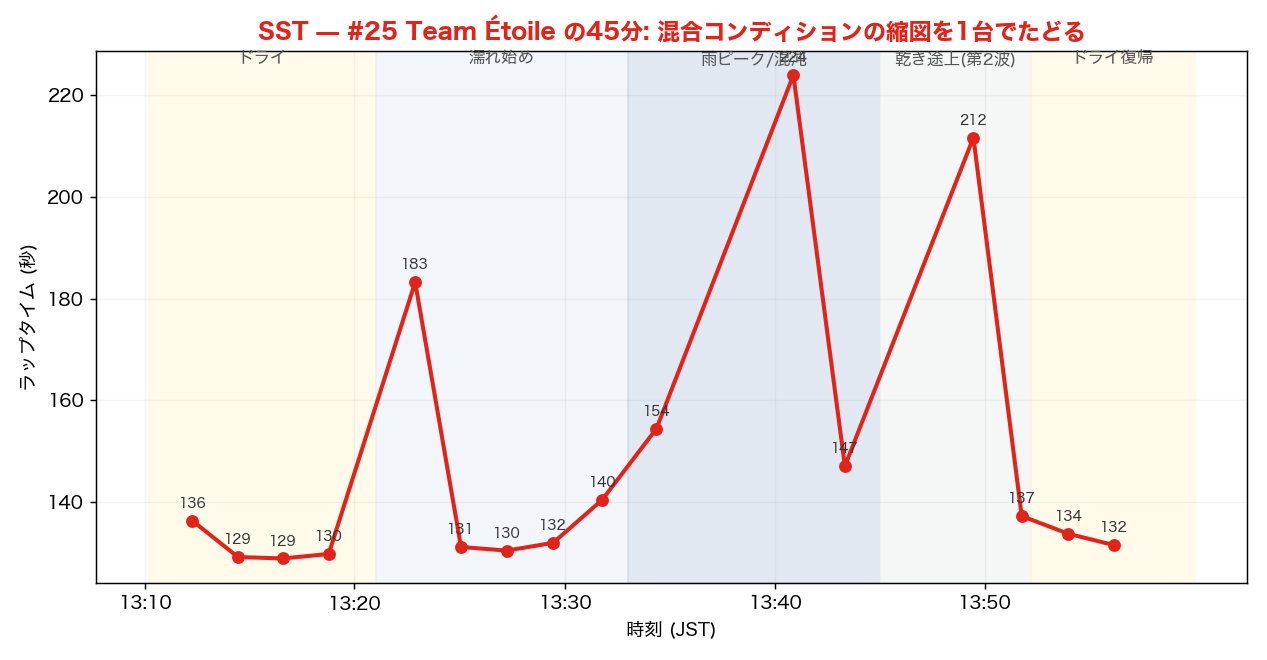
Seen in the week's context, #25's 45 minutes read as a single consistent story. In Wednesday's wet, this column noted their dry-to-wet drop-off as the largest in class (+21.2 s) — the price of a package honed to a fine edge for the dry. On the other hand, their speed of adaptation to the rain was third in class, and on Thursday they were fastest in SST in the dry — pole position. The only homework left was the rain.
In FP13, #25 went after that homework. After confirming around 129 s in the dry opening phase (among the fastest in class), they stayed out when the rain arrived and ran 5 core wet laps (joint most in class). They took the 13:49 second wave as well, and at the drying edge experienced the recovery gradient first-hand, 137 → 132 s. Forty-five minutes in which the pole-sitter exposed themselves to race-eve rain — it leaves no trace on the timesheet, but if tomorrow brings "rain and sun in alternation", having or not having this experience will tell.
§5 Implications for the Race
- The onset of rain shows first in the spread — before the median moved, the sudden widening of the spread band (IQR 52.7 at 13:22) announced the splitting surface.
- The drying edge means "ten minutes, one second per lap" — about ten minutes from rain-stop to full slick pace. This yardstick becomes the baseline for tyre calls.
- #25 goes into the race with both the speed (pole) and the wet experience they bought back. As for the aggressive play of punching straight through the rain on slicks, there is little incentive to try it in FP, and no machine visibly did so in the timing — whether anyone will choose it in the race is left as one of tomorrow's pleasures.
Methodology / Provenance
- Data: EnduraBase Turso prod, FP13 (id=325), retrieved 2026-07-04. The week's context comes from this column's published reports (Wednesday wet analysis, FP11).
- Phase identification does not rely on rain-gauge readings (a simple gauge can report light rain as zero); it is inferred from lap spread (IQR) and each machine's pit behaviour. The 500–800 s "laps" at the peak of the rain are pit-inclusive out-laps and are excluded from the pace aggregates.
- Core wet laps = clean laps in 13:26–13:46 (out-laps excluded, 118–300 s). Tyre choice cannot be identified from the timing.
-
25's riders per the entry list are Hikari Okubo / Motoharu Ito / Kaito Toba, but this piece deliberately describes the team as a unit without identifying individuals. It does not touch on setup or strategic cards. This is third-party AI analysis; we ask your indulgence for any inaccuracies.