
Decoding the Race・SST ― The order shuffle the safety cars caused: what happened in 108 minutes
- SC gain/loss (gap delta across each window)How many seconds the gap to the class winner moved per SC window — positive = gained, negative = lost
- Which SC you got behind (two SC trains, machine-detected)The safety cars' own transponder passings locate the two trains and who was housed where
- Red-light excess (the real cost of SC pits)SC-window stop time minus the bike's routine stop — pricing the pit-exit red light
- Class waveform with red SC bands10-minute median laps draw the rain; red bands draw the 108 minutes of queues
The conclusion in three lines
- Of the 8 hours, 108 minutes (nearly a quarter) were spent behind a safety car (SC).
- #25 Team Étoile's net SC gain/loss was −140 seconds ― but most of that was the 2nd SC's "red-light wait"; in the queue positioning they actually gained +71 seconds.
- From there they clawed back +122 seconds through the race's own running, to 2nd place, 17 seconds down ― bad luck recovered with speed and strength.
A safety car's gain/loss splits into two kinds. There's the loss of being held at the "red light" at pit exit, and the gain/loss that moves while you keep riding, depending on which of the two safety cars you ended up behind. This time, we separated those two and settled the books for every bike.
How to read this piece: every number is "the change in the gap to the winning bike." + = closed up on the winner (gained), − = dropped back from the winner (lost). This is not about whether a bike is fast or slow; it is relative, measured against the winner. Chapters 1–5 are the main article; the "Appendix" at the end is a cross-race analysis that steps away from this particular race.
1. Eight hours, and three safety cars
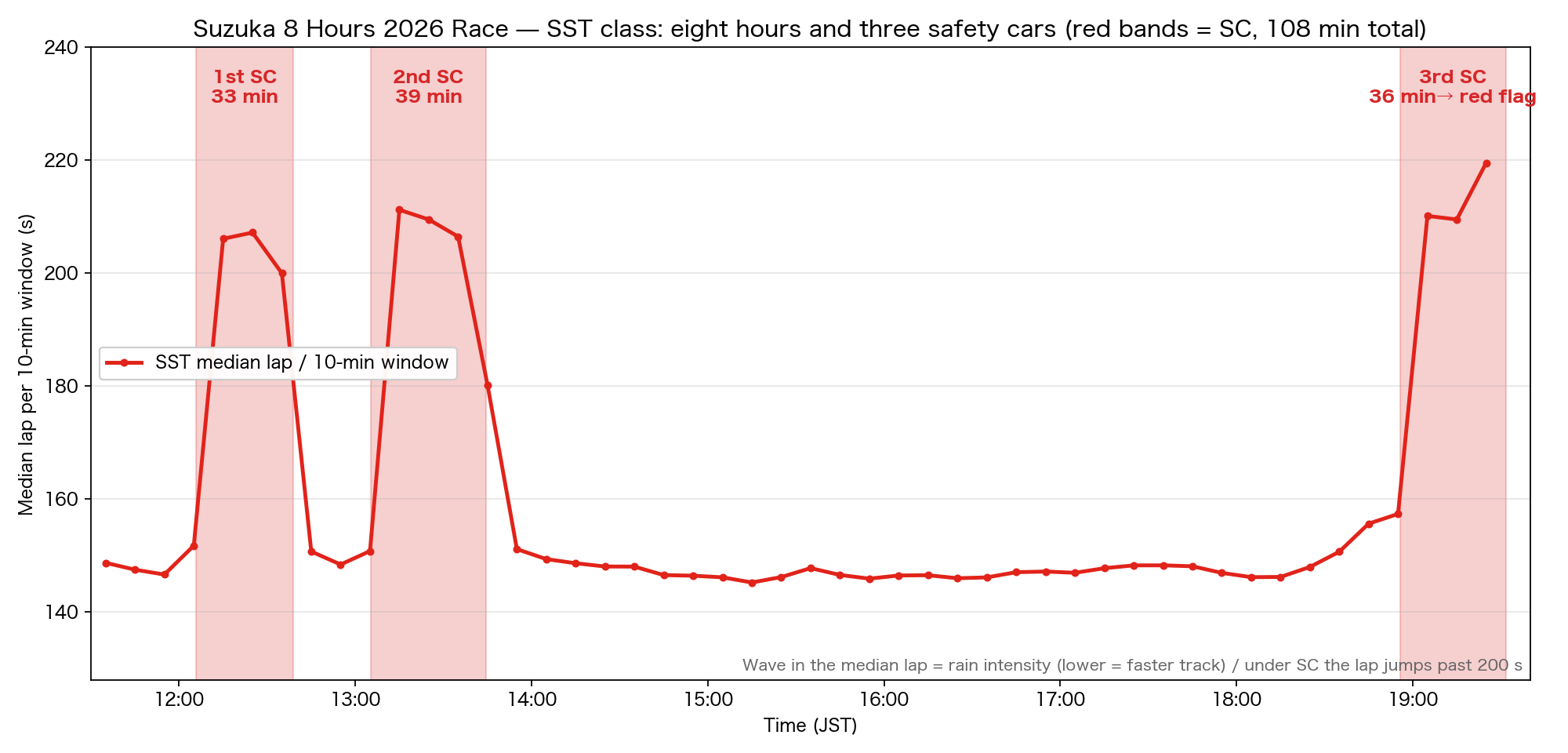
From this chart: the red bands are the three SCs. Inside the bands, laps spiking above 200 seconds are "queue running," and the up-and-down of the line shows the rain getting heavier or lighter.
A safety car (SC) is the mechanism where, while an on-track incident is being cleared, all bikes form a no-overtaking queue behind a lead vehicle. The chart shows the SST class's "median lap every 10 minutes." The red bands are the three SCs, and during queue running the laps jump to over 200 seconds.
- 1st SC: 12:05–12:38 (33 min) ― #4 laid down oil, and the SC was deployed to clean it up. In the run-up, from 11:44 to 12:02, there had been five crashes in a row believed to be connected to that oil.
- 2nd SC: 13:05–13:44 (39 min) ― deployed in response to #3's crash at 13:04:53 (T4). Even after the bike was removed it was not lifted right away; the reason it ran as long as 39 minutes appears to be that the timing of the lift was judged while watching the rainfall situation.
- 3rd SC: 18:55–19:31 (36 min) ― a series of crashes at 18:50–52 and renewed rain. The race then went straight to the red flag at 19:31, which was the finish.
- About 108 minutes in total. The swing in the median lap (146–157 sec) is due to the rain getting heavier or lighter, and lap times kept getting slower toward the end.
The win went to #52 NCXX RACING with RIDERS CLUB with 182 laps. #25 Team Étoile finished 2nd on the same lap, about 20 seconds back (17 seconds by the actual final-queue measurement), and #77 Wójcik Racing Team was 3rd, a further 1 second behind.
2. A safety car's gain/loss splits into two
Under EWC (World Endurance Championship) rules, when an SC is deployed two safety cars enter the track, one behind the other (in other categories of endurance racing there is sometimes only one). Here we call the one running ahead SC-A and the one behind SC-B. Every bike is gathered behind one or the other, and the field splits into two lines: the front queue (behind SC-A = ①) and the rear queue (behind SC-B = ②). That the gain/loss splits depending on which of the two you ended up behind is the distinctive feature of the EWC safety car. The gain/loss that arises from this divides into the following two. The main article looks at them in this order.
- The red light at pit exit (= the loss while you are stopped) ― in other categories of endurance racing, a pit stop during an SC often works out as a "discount" (because you can get your tire change or refuel done while rivals ride the slow queue). But in the EWC a red light comes on at pit exit, and even a bike that has finished its work must wait to launch until it turns green. → 3a
EWC regulations (excerpt / summary): during a race neutralization, a machine may pit. After the pit stop, the rider lines up single file at the pit lane exit and may rejoin the track only when the light there turns green. The green light comes on 15 seconds after the safety car passes the red light, and stays lit for just 15 seconds. After that, the exit is closed again (red light / red flag). A rider who could not get out during that window must wait until the next group (the group on the other SC's side) passes.
In other words, while in other races a pit stop during an SC can work in your favor, in the EWC the green light is on for only 15 seconds per SC pass. Miss that window and you are held until the next group, so situations where you can strategically aim to pit during an SC and gain are extremely limited. Far from a discount, it tends to be a penalty.
- The queue while riding ― which SC pinned you behind it (= the gain/loss while you are riding) ― if an SC cuts in ahead of you, you are shut in right behind that SC and cut off from the group ahead by a whole SC's worth (about 80 seconds) ― a loss. If it cuts in behind you, you are swept up to the group ahead ― a gain. Within a line the front-to-back is compressed to nearly zero gap: leads are confiscated, deficits are wiped out. → 3b
Gain/loss = how many seconds the gap to winner #52 moved between the entry and exit of that SC section (+ = closed up / − = dropped back). We split this into the queue component (which SC pinned you behind it) and the pit component (the discount of one SC-led lap − the actual stop, including the red-light overrun), and settled the books for every bike. Only the 3rd SC, which ended under the red flag, is evaluated on the frozen final queue.
3a. Axis 1: The red light at pit exit ― time lost while stopped
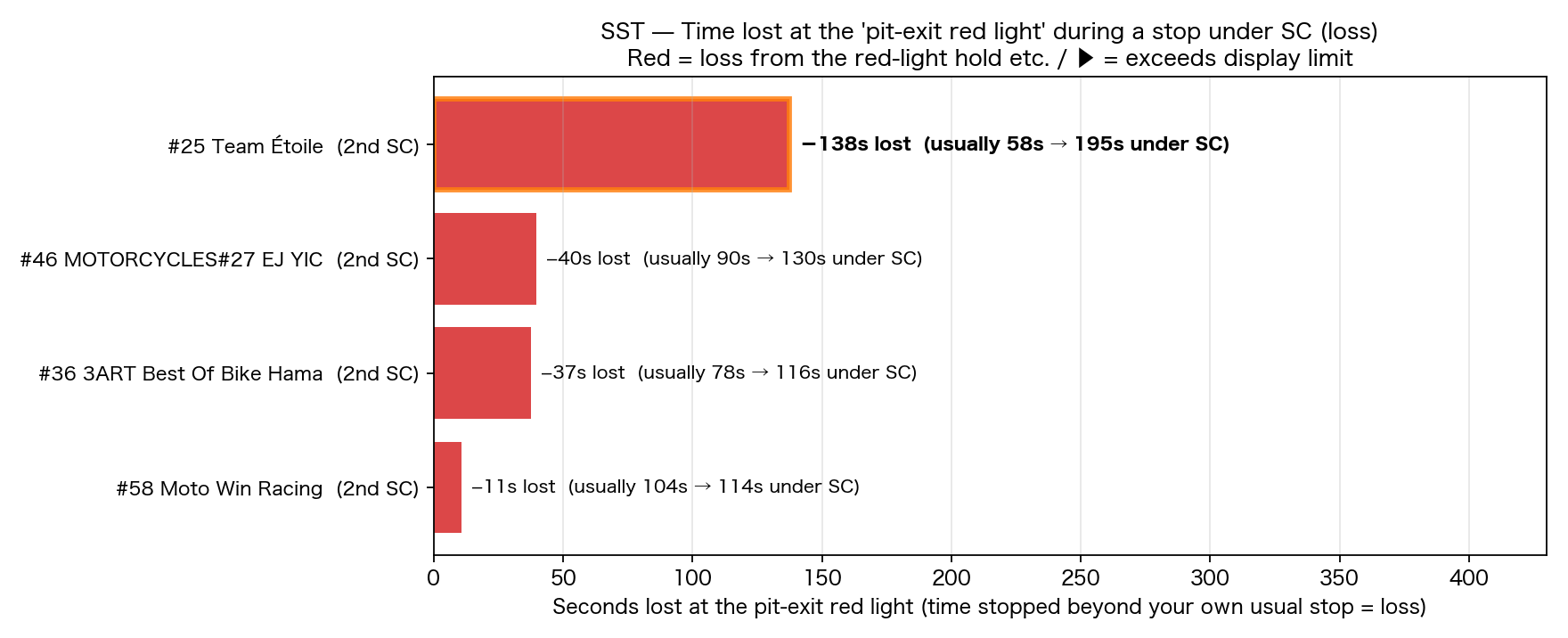
From this chart: the extra seconds a bike that pitted during an SC was held beyond its own usual stop (= the red-light loss). You can see that #25's roughly 137 seconds stands out as by far the largest.
To set the stage: when a team pits is basically decided by fuel ― they run until the tank is spent and come in when they need to refuel (the base strategy is to cover the 8 hours in as few stints as possible, and they don't pit extra by choice). But in the EWC a pit during an SC tends to cost you at the red light (Chapter 2). In fact, of all 349 pit stops in this race, only 24 (6.9%) were during an SC ― those few are the bikes that were unlucky enough to get caught by the red light.
Among the SST bikes, the ones that lost to the red light on an SC pit were the four at the 2nd SC, which happened to coincide with the pit cycle.
| Bike | When | Usual stop | Stop during SC | Loss to red light |
|---|---|---|---|---|
| #25 Team Étoile | 2nd SC | ~58 sec | 195 sec | −~137 sec |
| #46 MOTORCYCLES#27 EJ YIC | 2nd SC | 90 sec | 130 sec | −40 sec |
| #36 3ART Best Of Bike Hamaguchi | 2nd SC | 78 sec | 116 sec | −37 sec |
| #58 Moto Win Racing | 2nd SC | 104 sec | 114 sec | −11 sec |
25, which usually turns it around in around 58 seconds, took 195 seconds ― held about 137 seconds longer than usual. It missed the 15-second green window and was made to wait for the next group to pass. (Separately, #36 also had a long repair during the 1st SC ― there is a record of a crash at T15 at 12:01:52 [rider unhurt], with a 25-minute repair. That is counted separately as a repair, not as the red light.)
The calculation ― how this "roughly 137 seconds" was derived (using #25 as the example)
The number alone is hard to believe, so we disclose it in three steps from #25's timing log (raw data).
① When it pitted. Three lines from the raw log:
| Time (JST) | Timing event | Recorded value |
|---|---|---|
| 13:05:06 | Pit lane entry detected (loop 10) | — |
| 13:08:21 | Passed the pit compound loop (loop 12) | stand_time = 195.0 sec |
| 13:11:50 | Passed the control line (out-lap 403.5 sec) | — |
The deployment message for the 2nd SC was at 13:05:23. #25 had already entered the pit lane 17 seconds earlier (13:05:06) ― it dove in almost simultaneously with the SC deployment and was then made to wait at the exit for the queue to pass. The pit compound loop pass (13:08:21) falls inside the 2nd SC's window (13:05:23–13:44:25), so it is booked to the 2nd SC.
② What is inside "195 seconds." This is the elapsed time of "pit lane entry (13:05:06) → pit compound loop pass (13:08:21)" (the value timing records as stand_time, the dwell time in the pit compound), a composite dwell that includes the work time plus the red-light wait at the exit. It is not the pure standstill time itself.
③ "Usual around 58 seconds" is #25's own normal pit. Rather than an average across other teams, we use the median of that bike's own non-SC pit dwells. #25's full set of pit dwells was 57.4 / 57.7 / 57.8 sec (with tire change) plus 195.0 (2nd SC). The median of the 3 with a tire change = about 57.7 sec. Thus loss = 195 − ~58 ≈ 137 sec.
3b. Axis 2: The queue while riding ― which SC pinned you behind it
3a was the loss "while stopped." From here it is the gain/loss while riding ― even a bike that did not pit sees seconds move depending on how the SC slots in. The mechanism is simple, and it comes down to where the SC cut in relative to you:
- An SC cuts in ahead of you → loss. You are shut in right behind that SC, the bike behind you closes right up to your tail and confiscates your cushion, and on top of that you are cut off from the group ahead by a whole SC's worth (about 80 seconds).
- An SC cuts in behind you → gain. You are swept up, free of charge, to the group ahead (the line behind the SC in front), closing right up on the rival you had been chasing.
In short, if the SC gets in ahead of you it's a loss, and if it gets in behind you it's a gain. This time, winner #52 was on the side that had the SC take the spot ahead of it (the rear queue) all three times, so the bikes that were picked up by the SC ahead of #52, or that closed up on #52 from behind, all gained together relative to #52.
The chart below puts on one page, for each SST bike, how many seconds it closed up / dropped back in the queue at each of the three SCs, and the net (the queue total) (winner #52 is also shown as the baseline row = ±0). The red-light (pit) loss is not included here; it is handled separately in 3a.
Chart legend: front group = right behind the SC ahead (closed up on from behind, and separated from the group ahead ― tends to be a loss) / rear group = on the side of the SC behind (closes up on the group ahead ― tends to be a gain) / ◆ = also pitted during the SC on that occasion (the red-light loss is in 3a). The numbers are the change in the gap to winner #52, with green (+) = closed up (gained) / red (−) = dropped back (lost).
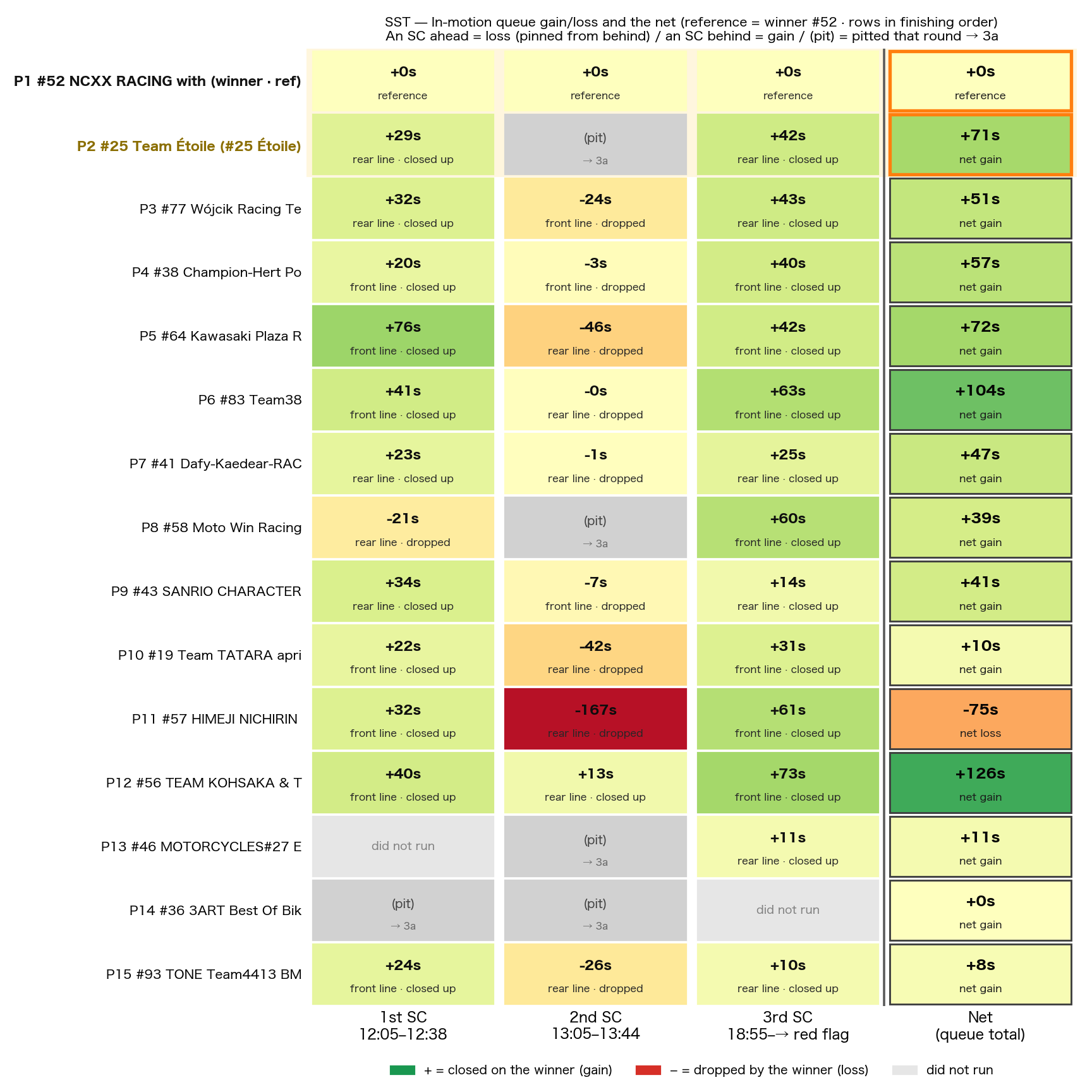
For example, #64 had the SC take the spot behind it at the 1st and closed to the front for +76 seconds, had the spot ahead taken at the 2nd for −46 seconds, and again had the spot behind taken at the 3rd for +42 seconds ― a net gain of +72 seconds. Every bike that gained near the front came through its pits unscathed, so its score is entirely down to this queue positioning.
The calculation ― measured
A gain example ― #64's 1st SC. At the 1st SC deployment, #64 was 89.0 seconds behind #52. The SC got in behind #64, and #64 was carried up to the group ahead ― when it lifted the gap had closed to 12.7 seconds (queue component +76 seconds). #64 did not ride faster. The SC got in behind it, that's all.
A loss example (= from #52's side) ― #25 / #77's 3rd SC. At the 3rd SC, #52 had the spot ahead taken and was toward the front of the group, while #25 and #77 were behind it. The instant they were pushed together, the two behind were carried free of charge right up to #52's tail (for #52, a loss of being closed up on from behind):
| Bike | vs. #52 just before 3rd SC deploy | vs. #52 after freeze | Queue component |
|---|---|---|---|
| #25 Team Étoile | 59.2 sec | 17.0 sec | +42 sec |
| #77 Wójcik Racing | 61.2 sec | 18.0 sec | +43 sec |
The razor-thin margins in the final result ― "#52 to #25 is 17 seconds, #25 to #77 is 1 second" ― are less a difference in skill than the result of the 3rd SC squeezing everyone into a single line.
4. #25's story ― a gain in the queue, the wound at the red light
In the queue, #25 was actually "in the black." Nearly all of the −140 seconds is the 2nd SC's red light. At 13:00 it led the class. But at 13:05, having pitted (on fuel) almost simultaneously with the 2nd SC deployment, it was caught at the exit red light for about 137 seconds and stopped for 195 seconds. That single event took it from P1 to P8.
Break down #25's overall −140 seconds and its true identity becomes clear:
- Queue (which SC pinned it behind) … 1st +29, 3rd +42 for a "gain," total +71 seconds (the same as the net in the combined chart). At the 2nd it pitted itself, so the queue position cannot be measured ― and in any case #25 and #52 were in the same side of the queue at the 2nd SC, so there is no queue-draw difference between the two.
- The 2nd SC's red light (pit) … −211 seconds. This −211 is a measured value, not a model ― just before the 2nd SC, #25 led the winning #52 by 71 seconds; once the queue was frozen it was 140 seconds behind. A 71-second lead became a 140-second deficit, and that 211 seconds is the total #25 lost at the 2nd SC. It is entirely the red-light loss: about 137 seconds is the "extra stopping" (3a), and the remaining ~74 seconds is being released late by the red light and dropped one queue-length back.
- Total = +71 − 211 ≈ −140 seconds
In other words, #25 was +71 in the black in the queue, and nearly all of the −140 seconds was the misfortune of the 2nd SC's red light.
And that misfortune changed how #25 raced. Precisely because it fell from the lead straight to rock bottom, from then on it committed fully to recovery, and through ordinary running alone (outside the SCs) it clawed back +122 seconds (with pit work that held total stopped time to 408 sec / #52's 394 sec, and the pace of three riders). The 2nd place, 17 seconds down, is not a number left over from subtraction but the result of forcing bad luck back with the race's own speed and strength.
#77 Wójcik Racing Team ― a podium defended in the queue. Net gain/loss +51 seconds, entirely queue component. +32 seconds at the 1st SC, and the decisive stroke at the 3rd SC: a 61-second gap to #52 was frozen right behind it in the same line ② at 18 seconds (+43). Final 3rd, 1 second behind 2nd-place #25 ― behind that 1 second lies the +43 of the 3rd SC.
5. Conclusion ― did the SCs decide the race?
A summary of how the three SCs bore on each team. 1st / 2nd / 3rd / queue total are the gain/loss of the queue (which SC pinned you behind) (+ = closed up on winner #52 / − = dropped back); red light/pit applies only to bikes that pitted during an SC; overall = queue total + red light/pit (unit = seconds).
| Final pos | Team | 1st | 2nd | 3rd | Queue total | Red light/pit | Overall |
|---|---|---|---|---|---|---|---|
| 1st | #52 NCXX RACING | 0 | 0 | 0 | ±0 | — | ±0 |
| 2nd | #25 Team Étoile | +29 | (pit) | +42 | +71 | −211 | −140 |
| 3rd | #77 Wójcik Racing | +32 | −24 | +43 | +51 | — | +51 |
| 4th | #38 Champion-Hert | +20 | −3 | +40 | +57 | — | +57 |
| 5th | #64 Kawasaki Plaza | +76 | −46 | +42 | +72 | — | +72 |
| 6th | #83 Team38 | +41 | −0 | +63 | +104 | — | +104 |
| (midfield) | #56 TEAM KOHSAKA | +40 | +13 | +73 | +126 | — | +126 |
| (for reference) | #57 HIMEJI NICHIRIN | +32 | −167 | +61 | −75 | — | −75 |
| (for reference) | #58 Moto Win | −21 | (pit) | +60 | +39 | −216 | −177 |
| (separate) | #36 3ART | (pit) | (pit) | — | ±0 | −1224 (repair) | −1224 |
The swing in the numbers is clearly large. Against final gaps of 17 seconds and 1 second, the gain/loss each time an SC comes out is ±80–200 seconds ― a different order of magnitude. You can also see the structure: the gains were handed out to the bikes that had the SC take the spot behind them and closed up to the group ahead, while the loss was concentrated on "the 2nd SC's red light."
So, without the SCs, would #25 have won? Subtract the numbers naively and it looks like "without the 2nd SC’s red light (−211 s), #25 — which actually gained +71 in the queue — was within striking range of the win." But that is a shortcut. #25 fell from the lead to rock bottom at the 2nd SC's red light ― and precisely for that reason it focused on clawing back that bad luck with sheer ability. Without the red light, it very likely would have raced differently in the first place, and there is no guarantee the +122-second comeback would have unfolded the same way. The SCs certainly moved big numbers. But to declare "subtract them and it's 1st" oversimplifies the race.
What can be said is this ― there is every chance it would have won had it not been for the red light. But depending on how things unfolded, a different ending was also possible. What is certain is #25's speed and strength, which wrenched a 2nd place out of a comeback from rock bottom.
――That is the main article. What follows is an Appendix of cross-race analysis that steps away from this particular race.
Appendix: Do the safety cars take "the spot ahead of the leader"?
Where the two SCs slot in greatly influences a race. In theory, if an SC slots in as far as possible directly ahead of the overall leader (= "head-taking"), the lead group's order should hold. What happens in reality? From the race finals at four circuits from 2021 to 2026 (Suzuka 8H, Le Mans 24h, Spa 8H, Bol d'Or 24h), we took the 30 SCs whose two-group structure could be confirmed in the lap times as our sample, and counted where in the bunched-up queue the overall leader at deployment ended up ― "how many bikes deep."
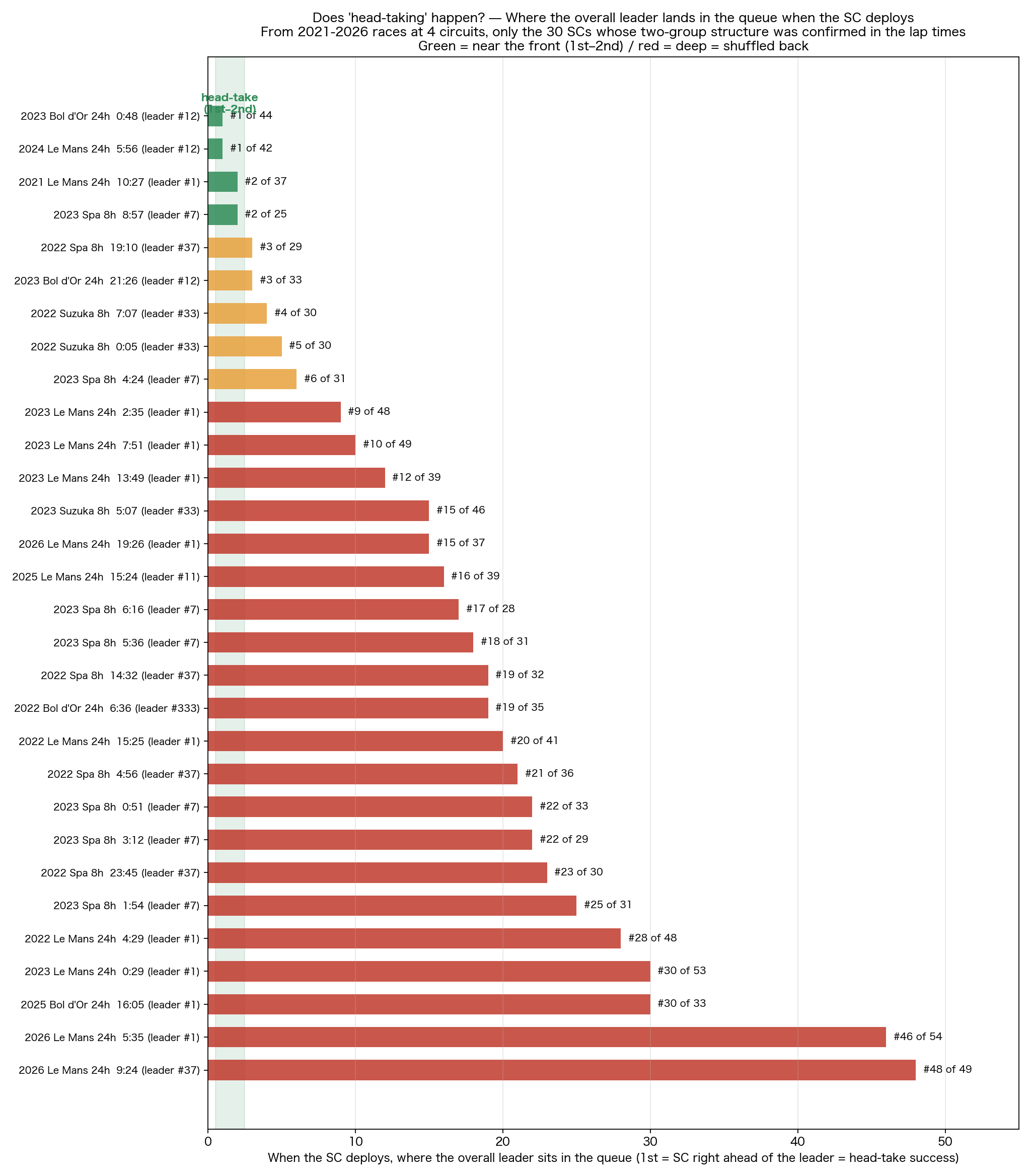
The result was clear-cut. Cases where the leader was among the 1st–2nd bikes (= near the head) numbered just 4 of 30. The median was roughly the 16th bike, and in the 24-hour races positions as deep as 46th and 48th ― all but the very tail ― also appeared. In other words, the SCs do not slot in so as to "take the spot ahead of the leader." The leader is buried behind many bikes (including lapped ones), and that position varied wildly from deployment to deployment. At this Suzuka too, the overall leader (#30 in the EWC class ― a different bike from SST winner #52) was scattered at 3rd, 9th and 12th, and at the 3rd SC it drew the front line (the one dropped into the rear line was its rival #21). (See Decoding the Race・EWC.)
ÉTOILE DATA LAB ― raising the resolution of your spectating, a data-decoding series on endurance racing