
Suzuka 8H Test・FP Days 1–2: Dissecting the Dry ― The EWC Class, and the Paradox That the Fastest #37 "Hasn't Run Race Distance"
※This is a data-analysis report written from the third-party perspective of an AI. Please forgive any points that may not be fully accurate.
Scope: The dry running in the Day 1 & 2 free practice (FP1–FP7) of the 2026 Suzuka 8H race-week test. Day 3 FP, qualifying, night practice and warm-up are still to come, so opportunities to run in the dry remain. This article reflects the situation as of FP1–Day 2. Data sources: FP1・FP2 = racenow (Turso) / FP3–FP5 = official API (Turso) / FP6・FP7 = local FRC collection DB (
EnduraBase.db, ro, as of 2026-07-01 12:25, FP6=1468/FP7=1469). The session_id space differs per source. Stint / sector analysis targets the per-lap-precise FP3–FP7. ⚠️ Tyre caveat: A single best lap can swing by up to about 1.5 s depending on the tyre used, but tyres cannot be identified from timing data. EWC in particular runs a Bridgestone-centred mix with Dunlop and Pirelli, so tyre factors weigh heavily on any single-lap comparison; we therefore read it in layers via median, stint structure, and sectors. The EXP class is out of scope.
We dissect two days of the world's premier EWC and its 32 entries across three layers: outright pace, race pace, and the aim of the test. To lead with the conclusion: the car with the fastest single lap has in fact never once run race distance ― a paradox that gets overlooked when you judge FP by lap times alone, but which is etched into the stint structure. (Machines: Yamaha R1 / BMW M1000RR / Honda CBR1000RR-R / Suzuki GSX-R1000R / Kawasaki ZX-10R・RR. EWC, with 3–4 rider changes, fundamentally changes the meaning of SST (effectively fixed) and pit-stop count.)
1. Outright best ― #37 BMW leads, the top 5 within 0.82 s
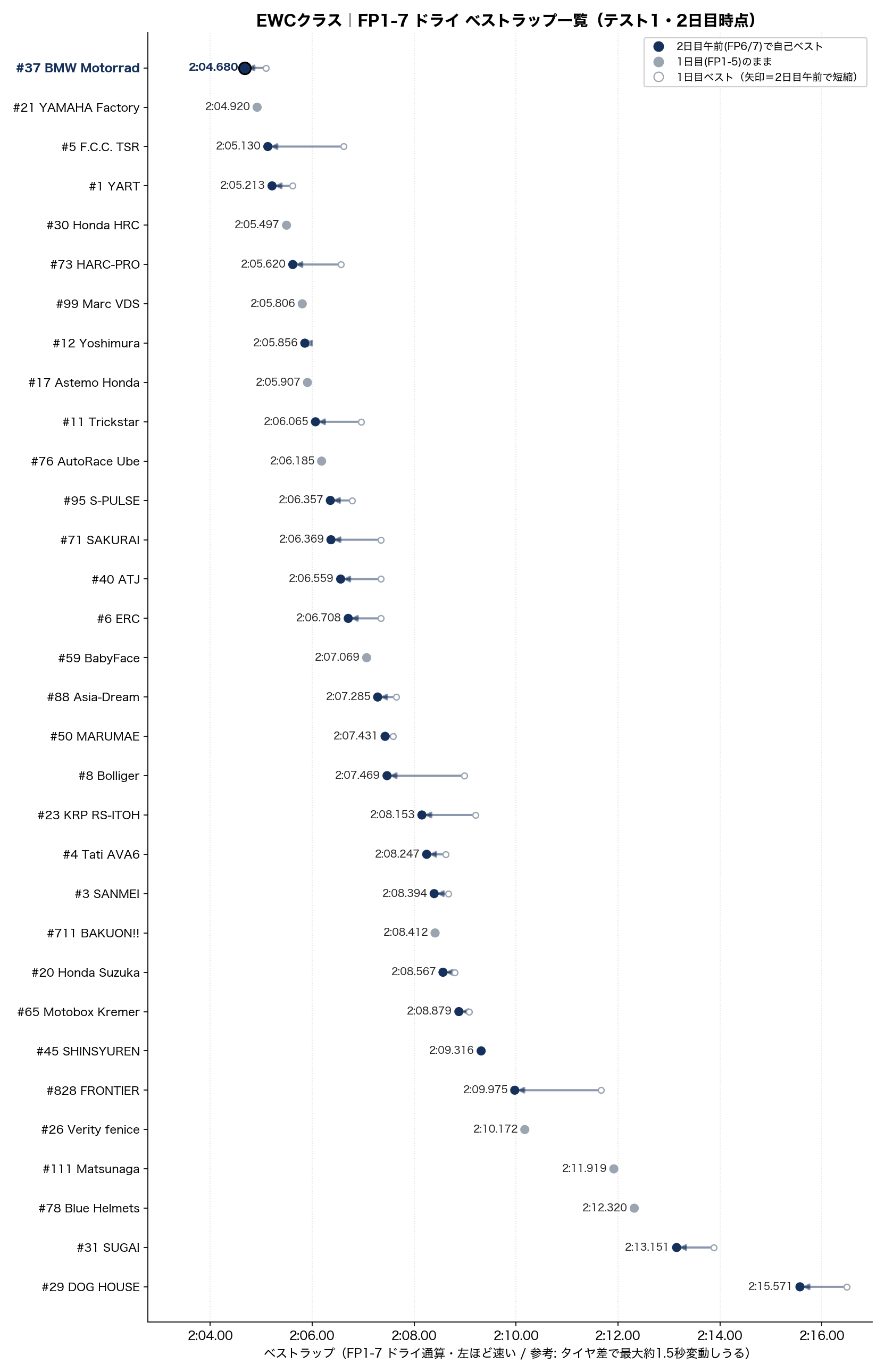
On outright pace it is #37 BMW 2:04.680/#21 YAMAHA 2:04.920/#5 F.C.C. TSR 2:05.130… with the top 5 within 0.82 s. #5 cut nearly 1.5 s, from 2:06.618 on day one to 2:05.130 (red arrow). However, EWC runs a tyre mix. This 0.8 s gap is a rough guide that also embeds "which tyre that one lap was set on," so the true order of merit is read in the next layer.
2. Race pace (median) ― #37 is not one-lap-only, #30 HRC is the steady runner-up
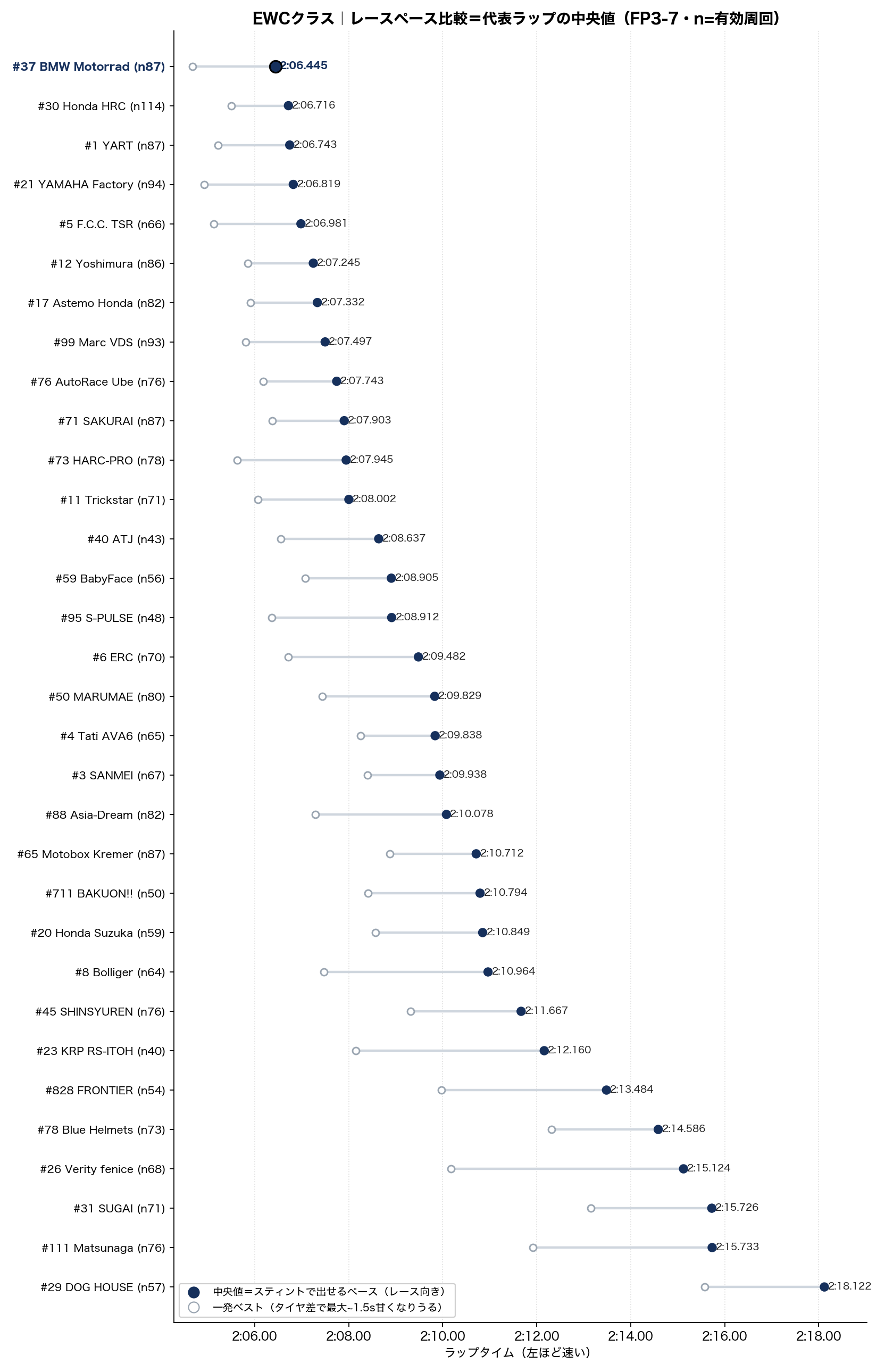
On the median of representative laps, #37 leads at 2:06.445 = fastest not just on a single lap but on the "pace that follows." So #37's speed reads as genuine. The standout is #30 Honda HRC: fifth on outright pace yet second on median (2:06.716), with an outright-to-median gap of 1.22 s that is the smallest in the class = the one that laps race pace most consistently. Conversely #21 YAMAHA, second on outright, is fourth on median, leaning somewhat toward the single lap.
3. Stint dissection ― the fact that the fastest #37 has "zero long runs" (the core of this article)
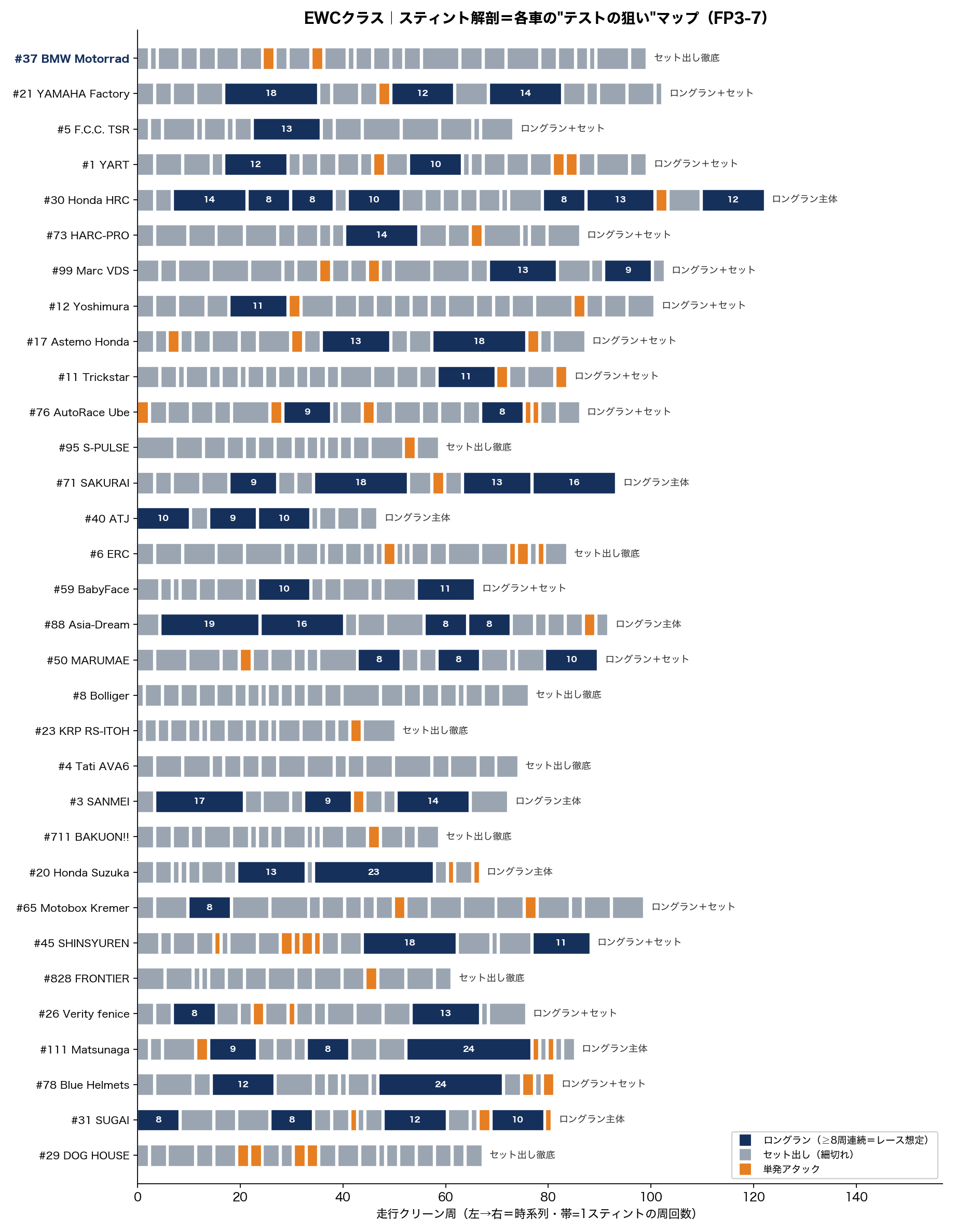
Stints are split by pit_in and classified into long runs (≥8 consecutive laps = race simulation) / set-up work (choppy) / single attacks. The volume of the navy bands (long runs) on the map tells you whether that car has tried out how it will run the race.
- The shock is #37 BMW = zero long runs, 25 set-up runs. In other words, the fastest car on outright pace has never done a race-simulation run of 8 consecutive laps across FP3–7. The speed is there, but its "behaviour over distance" is held in reserve = this can be read as possibly keeping its cards hidden.
- By contrast, #30 Honda HRC has 7 long runs (longest 14 laps) = the class's foremost race sim. This dovetails perfectly with its 2nd on median and top stability in §2. Privateer runners such as #88 Asia-Dream (19・16 laps)・#71 SAKURAI・#20 Honda Suzuka (23 laps)・#111 Matsunaga (24 laps) also completed long continuous runs.
- Outright ranking and the "ranking of who tried race distance" are different things. #37 is king of the former, #30 king of the latter. What the 8-hour race asks for is the latter.
The red-flag premise ― is "zero long runs" luck or intent?
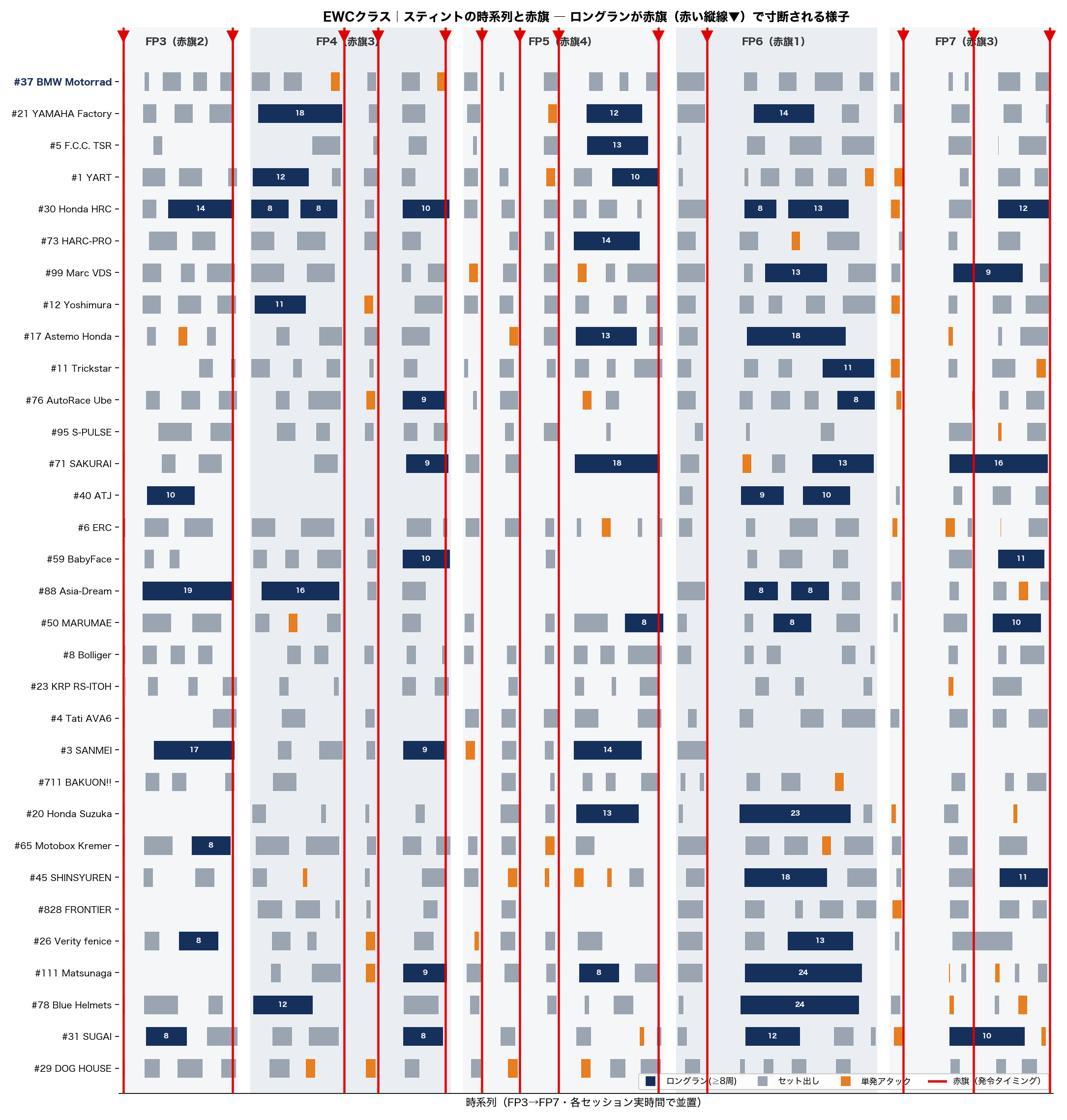
However, these two days of dry FP alone saw 13 red flags in total (FP3=2・FP4=3・FP5=4・FP6=1・FP7=3, the red vertical lines in the figure). Many cars had their long runs cut short by red flags, and some of the "choppiness" is a product of bad luck. Yet even taking that into account, it weighs heavily that the fastest #37, across five sessions, never once strung together 8 consecutive laps. Runners like #30・#88 (19・16 laps)・#20 (23 laps)・#111 (24 laps) assembled their long runs in the red-flag lulls (FP3・FP6・FP7) ― the windows were there if you wanted them. It is more natural to read #37's "zero long runs" as deliberate reserving rather than luck.
4. Degradation within long runs ― "behaviour over distance" splits even at the front
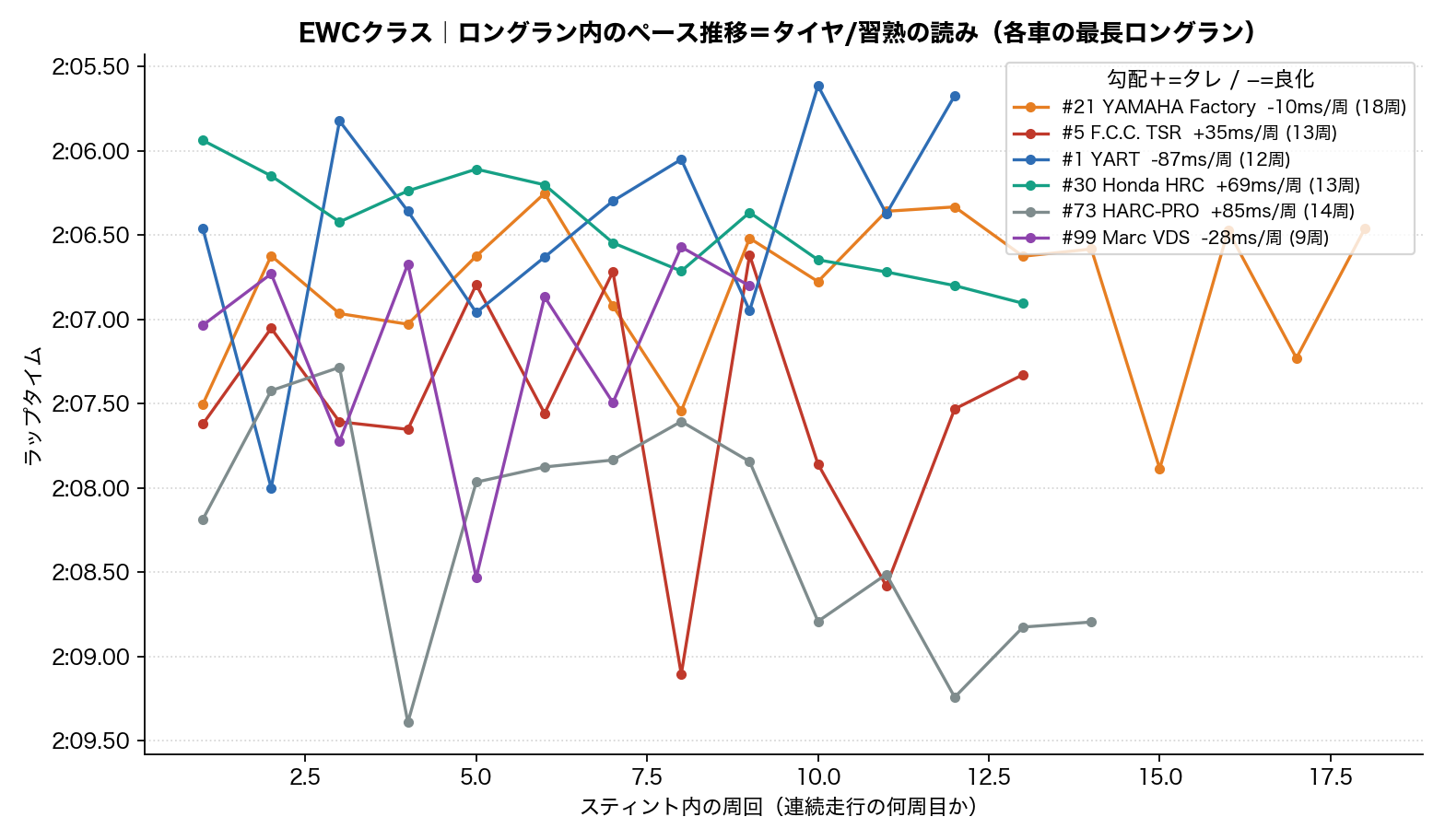
Among the outright front-runners, we look at the lap progression within stints as a slope for the 6 cars that hold a clean long run (+ = falling off = pace loss from tyres/fuel, − = improving = track learning/lighter fuel). The question is "can a fast car hold that pace over distance too?"
- #1 YART runs −87 ms/lap over 12 laps = getting faster the further it goes. As fuel lightens / the tyre comes in it extends, leaving room over distance. #21 YAMAHA (−10 ms/lap)・#99 Marc VDS (−28 ms/lap) barely fall off either.
- Against that, #73 HARC-PRO (+85 ms/lap)・#30 HRC (+69 ms/lap)・#5 F.C.C. (+35 ms/lap) fade gently toward the back end (about 0.5–1.1 s over 12–14 laps). That said, as its 2nd on median and class-smallest outright-to-median gap in §2 show, #30 is the type where, even with a gentle fade in a single stint, the spread across its running as a whole is small.
- Even within "fast on a single lap," whether pace trends up or falls off over distance splits the field. Over the 8-hour haul, this "quality over distance" is what tells.
5. Sector fingerprint ― #37 has no weakness, #5 is an S1/S3 type
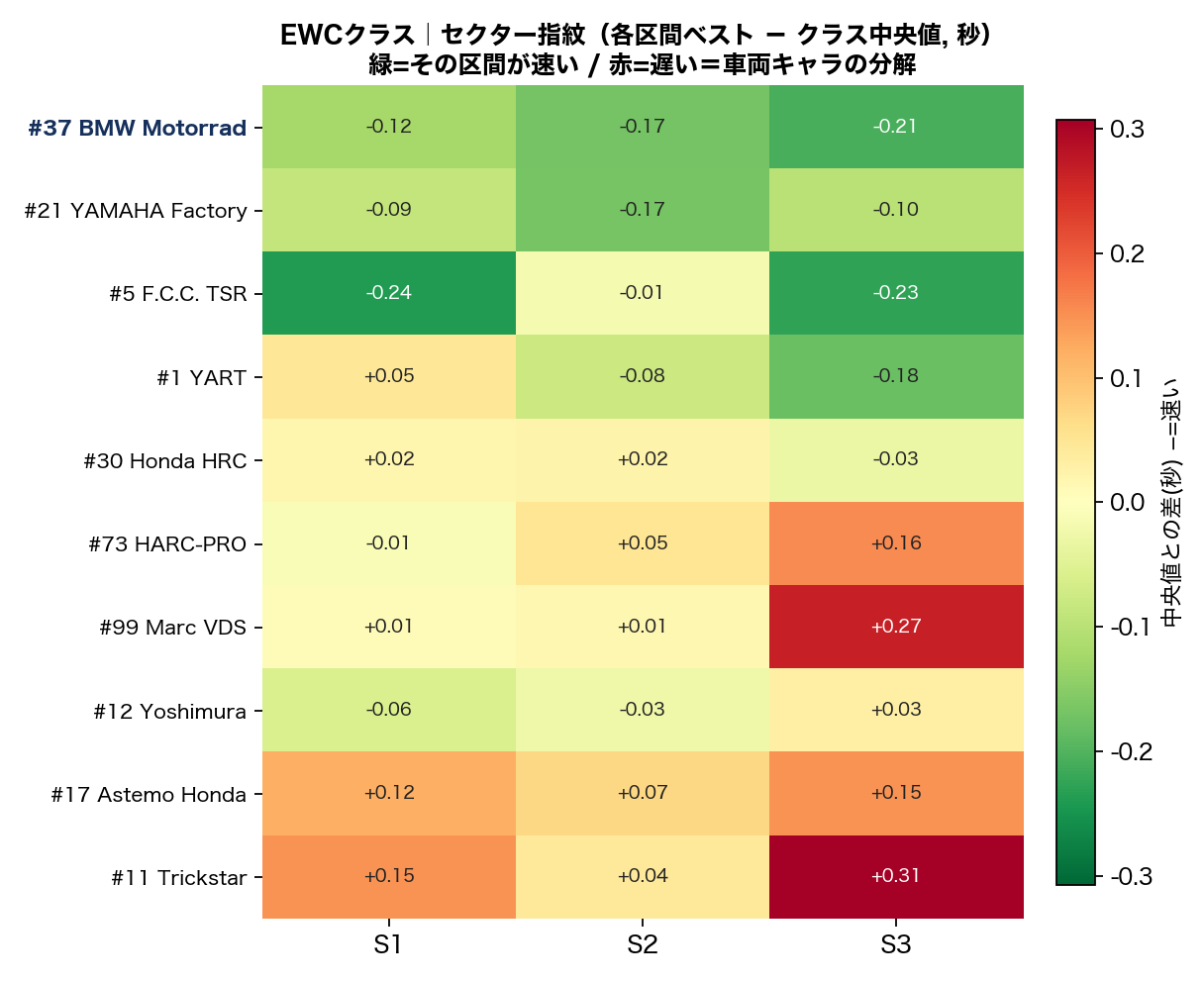
Each sector best as a difference from the class median (green = fast / red = slow. ※ sectors are S1/S2/S3; we avoid asserting the character of the course).
- #37 BMW is green in all of S1/S2/S3 (−0.12/−0.17/−0.21) = no weakness. In other words, being upfront in every sector = all-round strength is the basis of its best.
- #5 F.C.C. TSR stands out in S1(−0.24)・S3(−0.23), mid-pack in S2 = a type that gains at the ends. #1 YART has S3(−0.18) as its weapon. The difference in where the gains come from ties directly into how overtaking and defence are designed in the race.
6. The floor moved on Day 2 morning ― and the afternoon was wet
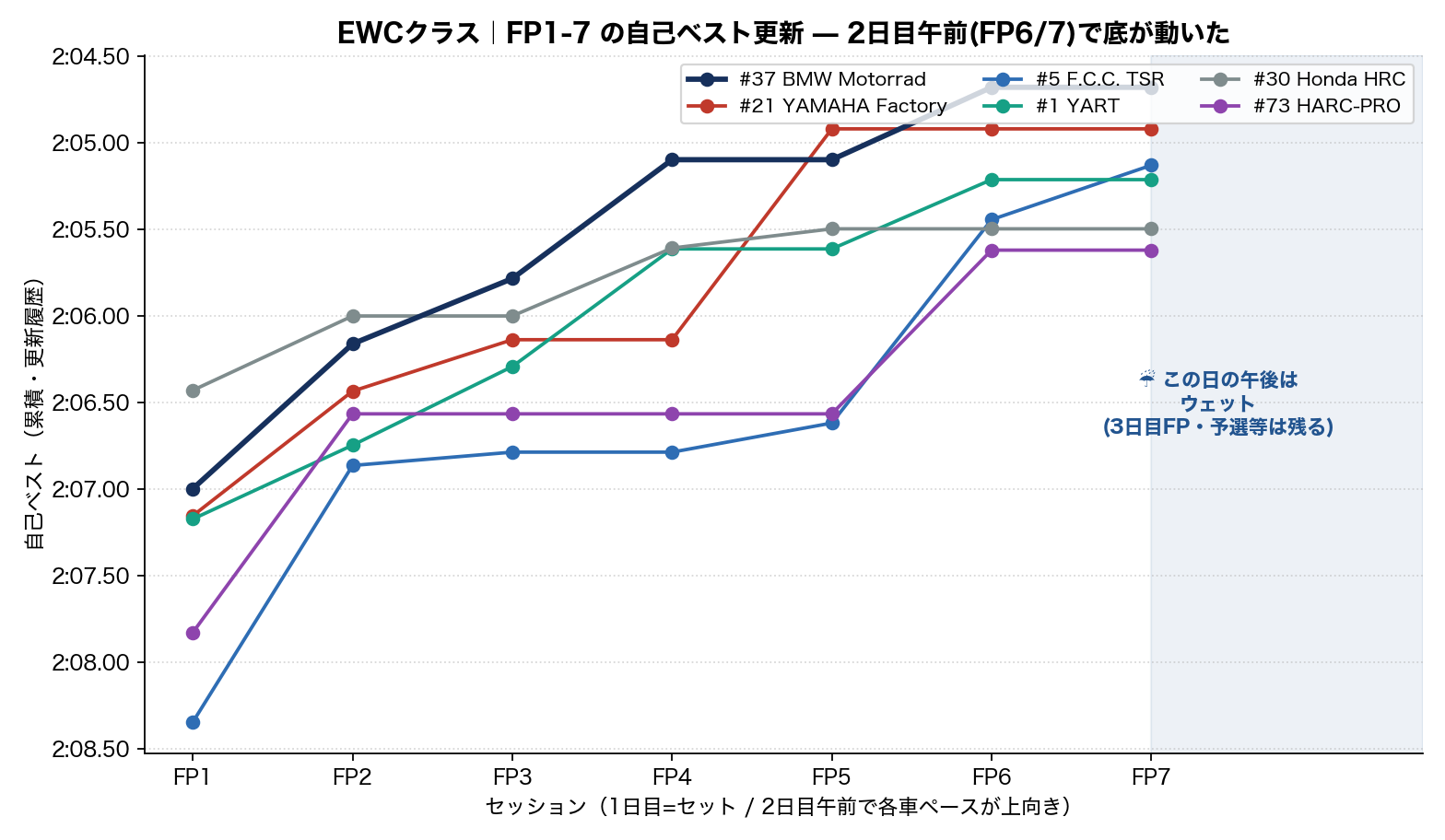
22 of the 32 cars set a personal best on Day 2 morning (FP6/7). Each camp went after the limited morning window. This day's afternoon was wet, but with Day 3 FP and qualifying remaining, this is not the final word.
Summary ― the EWC's current standing seen in three layers
- Outright: #37 BMW is fastest, top 5 within 0.82 s (a guide, given the tyre mix).
- Race pace: #37 leads on median too = genuine. #30 HRC is the steady runner-up (gap 1.22 s, near-zero degradation over 14 laps).
- Aim of the test: #37 never ran race distance (zero long runs) = reserving, while #30 HRC/#88/#71 and others completed race sims. "Outright king #37" vs "race-distance king #30" ― which is stronger over 8 hours is precisely what will be proven from here.
- Dry FP still remains, and if #37 puts in the distance the picture could shift further. Even now, the "difference in aim" is visible at this level of resolution.
Analysis & charts: ÉTOILE DATA LAB (from EnduraBase timing data). FP6/7 derive from local FRC (not yet reflected in Turso), so some metrics such as speed_trap are not collected and speed analysis is omitted. Corrupt sector values are excluded within a plausible range (18–90 s). Final cross-check against official results to follow.