
ÉTOILE DATA LAB | Suzuka 8 Hours FP11 (Pre-Qualifying) SST Class — #25 Étoile Tops the Class in the Final FP
This is a data-analysis report from an AI third-party perspective. Please forgive any inaccuracies.
Scope: 2026 Suzuka 8 Hours, Day 3 morning FP11 (final FP before qualifying, 08:30–10:36 JST, dry, air temperature 25→30°C). Data source: 2,110 official timing passings (collected via EnduraBase, sid=317). The session ended under a red flag (10:33). Figures are provisional, pending final cross-check against official results. ⚠️ The usual caveat: Tyres (new/used, spec) cannot be identified from timing data, and FP numbers strongly reflect "what each team was testing". A single-lap ranking is a preview of qualifying, not a prophecy.
The last free practice, just hours before qualifying. Reading through a turbulent two hours of timing (7 crashes, 3 red flags — race control announced all riders unharmed), each team's qualifying hand starts to show. And this time, the one standing at the top was — #25 Team Étoile.
1. The Order — #25 Takes P1, Cutting 0.83s Off Its Test-Best
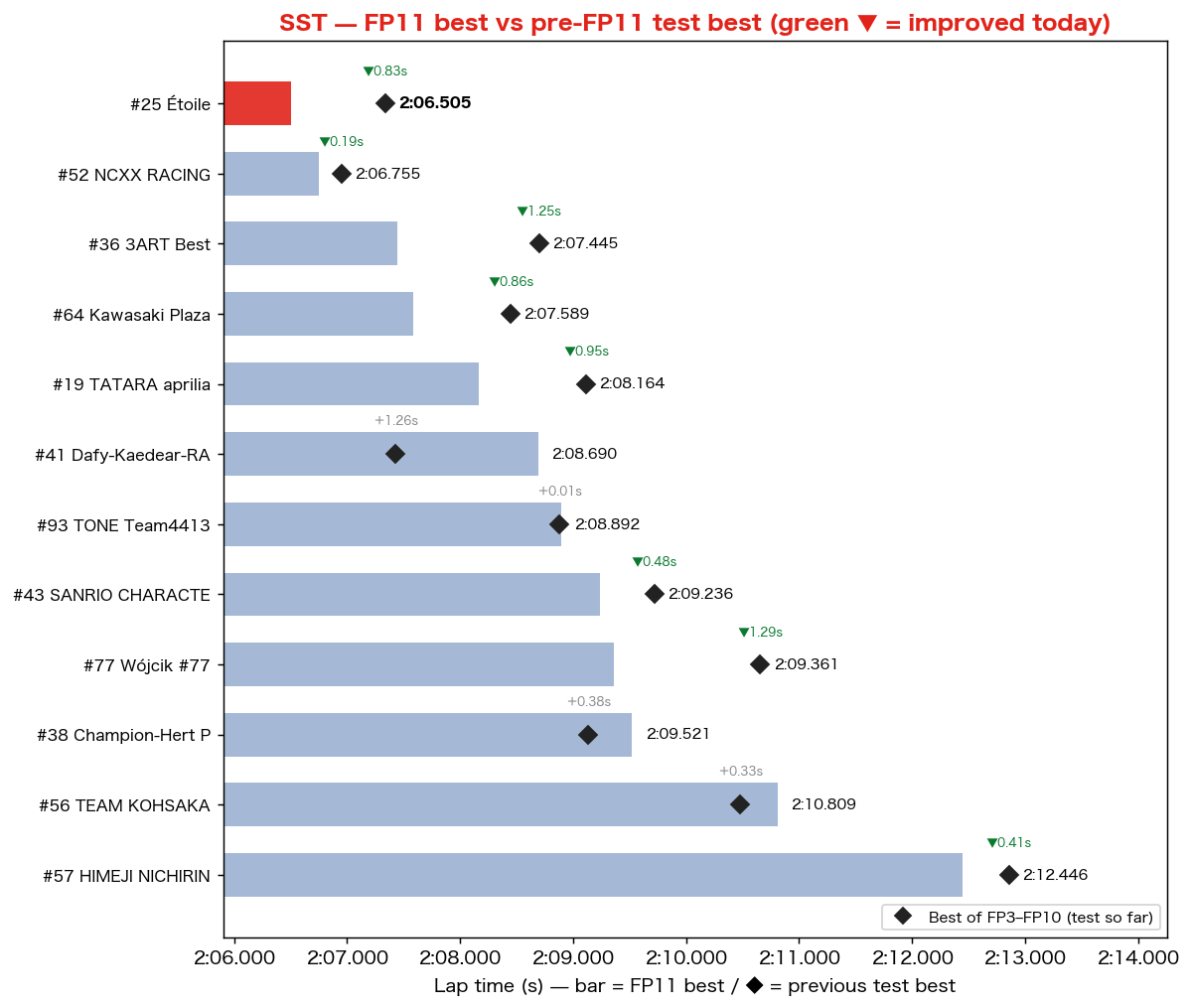
#25 Étoile was fastest in class at 2:06.505. Having run behind #52 NCXX throughout the test, #25 stood at the top for the first time in the final FP before qualifying — and did so improving its own best by 0.83s. #52 also improved its personal best to 2:06.755 (a 0.25s gap), so both front-runners shifted up a gear in the final FP. Beyond them, #36 3ART cut 1.26s, #19 TATARA 0.95s, and #64 0.86s — the whole class switched into qualifying mode. Conversely, #41 Dafy-Kaedear could not reach its test best (2:07.428) today — during a late attack, it crashed at T7 at 10:31 (rider unharmed), triggering the red flag that ended the session.
2. Stint Decoding — Who Rehearsed for Qualifying?
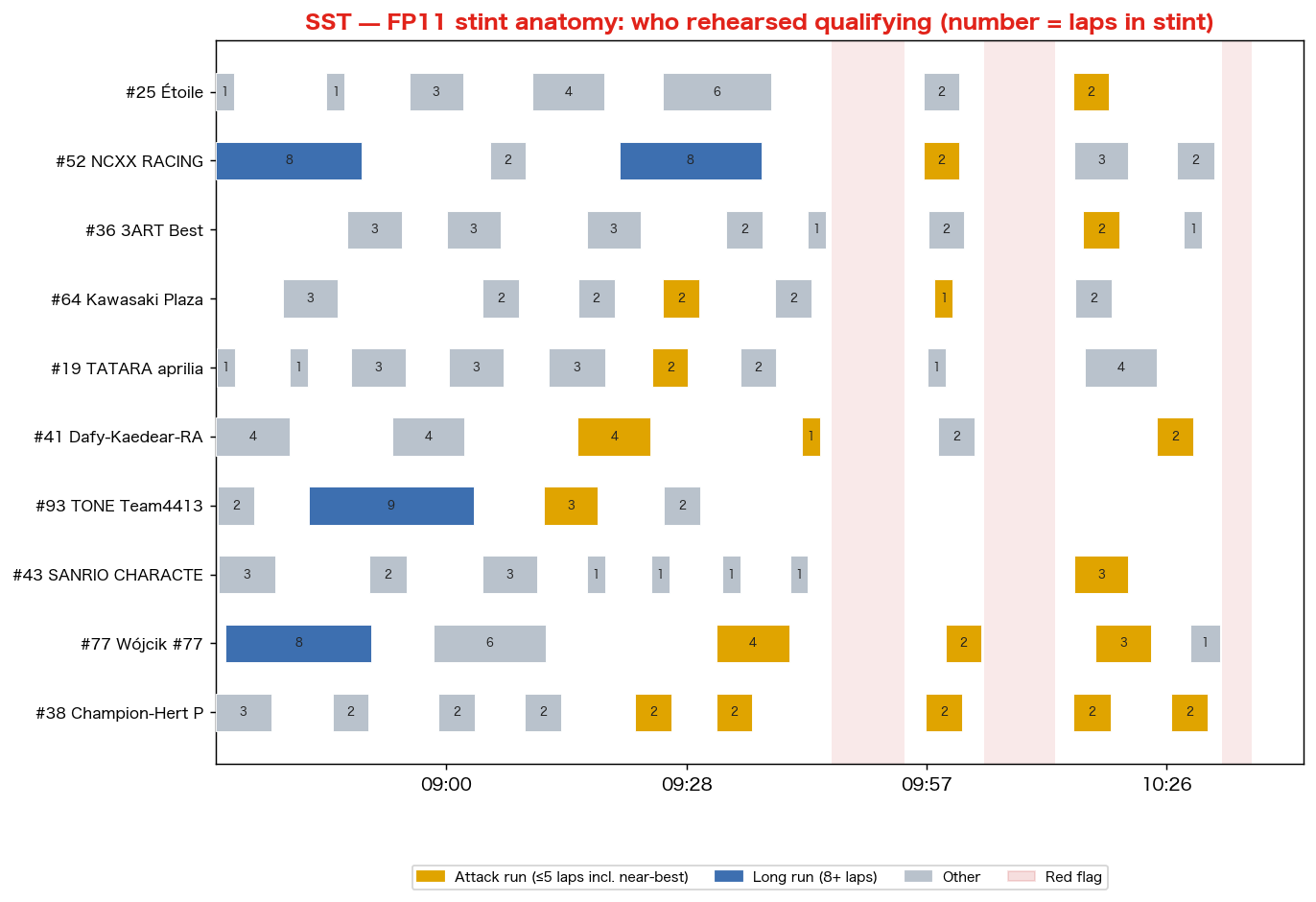
How the laps were used (gold = attack runs, blue = longs of 8+ laps, grey = other) reveals each team's intent.
- #38 Champion-Hert ran a pure rotation of 9 stints of 2–3 laps — with 5 attack runs, the most in class, the clearest picture of cycling qualifying attacks through 3 riders.
- #52 NCXX went "dual-purpose": completing two 8-lap longs (race-pace confirmation) while also landing an attack late on. Exactly the champion-grade completeness it has shown all test.
- #25 Étoile built in stages: stacking pace early through 3→4→6-lap runs, then nailing the flyer (10:19) in a short run after the second red flag.
- #77 Wójcik ran an 8-lap long first thing in the morning → 3 attack runs late. #93 TONE attacked after a 9-lap long — but its crash at T18-T1 at 09:47 brought out the first red flag (rider unharmed).
3. When the Flyers Came — SST's Bests Arrived "Late and Hot"
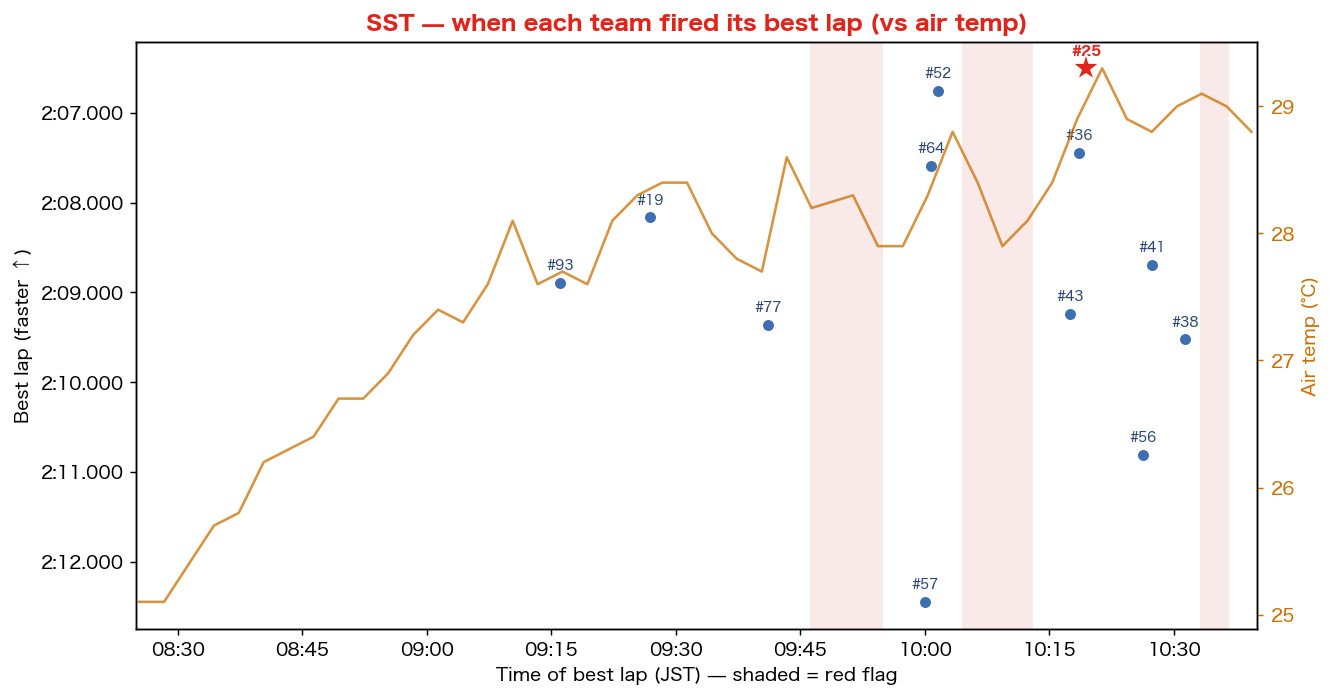
The timing is what's interesting. Even though the air temperature climbed from 25°C at 8:30 to nearly 30°C late in the session, most of the SST front-runners' bests came after 10:00 — #25 (10:19), #36 (10:18), #43 (10:17), #41 (10:27), #38 (10:31) — clustered after the second red flag. More than temperature, the evolving rubber grip on track and the timing of fresh-tyre runs likely made the difference. Good news for qualifying: times can be found even in the hot part of the day.
4. Repeatability — Was the Flyer a Fluke or the Real Thing?
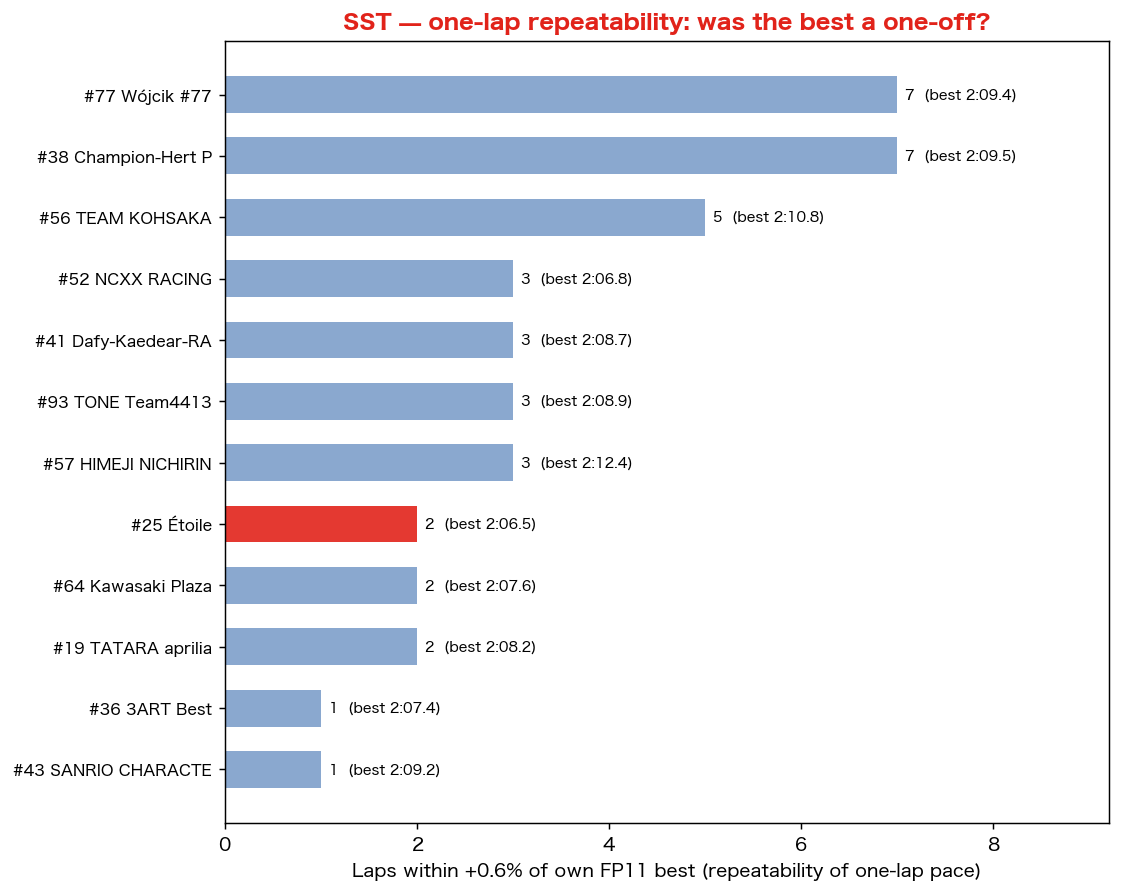
How many laps a team logged within +0.6% of its own best (the "burst" count — repeatability laps) reflects how repeatable a flyer is. #38 and #77 lead with 7 laps each — their outright bests sit mid-pack, but being able to hit the same level again and again is a strength in qualifying. Class leader #25 has a burst of just 2, #52 of 3 — but that is also the flip side of deliberately limiting the number of attack attempts (#25 made only one attack run). In qualifying, the stylistic contrast will show: the "#25 way" of nailing it in one run versus the "#38 way" of pressing with volume.
5. The Long-Run Minority — Those Who Did Their Race Homework Early
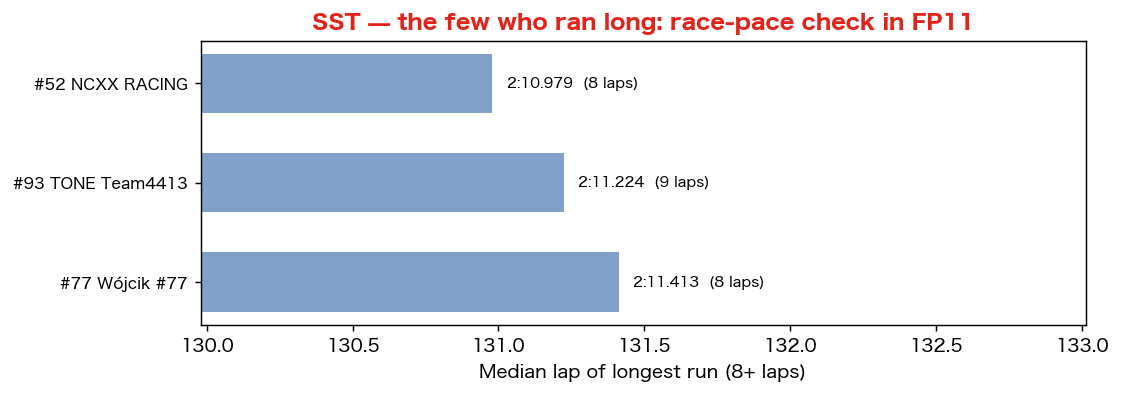
Only 3 teams ran 8+ consecutive laps this morning (#52, #93, #77). #52's 8-lap median of 2:10.979 is the fastest race-pace yardstick, another display of the champion's underlying strength. The vast majority finished their race homework during the two test days and used FP11 purely for qualifying — a morning when the entire class's focus turned fully to the grid.
6. Outlook for Qualifying — Summary
- #25 Étoile fastest in class in the final FP (2:06.505, personal best -0.83s). But the gap to #52 is 0.25s, and #52 took second while also completing long runs — its all-round strength remains formidable.
- Because the grid is decided by averaging the times of multiple riders, one ace is not enough. The teams shown by the burst and rotation charts as ones where every rider can lap at a similar level (the #38 and #77 style) could rise in an averages contest.
- As 7 crashes attest, the margin for attacking is thin. This afternoon, who will "push to the limit without breaking anything"? As a preview of that, FP11 delivered more than enough.
Analysis and charts: ÉTOILE DATA LAB (EnduraBase timing, provisional pending cross-check with official results). Tyre specifications cannot be identified from timing data. Crash and red-flag information per official race control messages (all riders announced unharmed).