
ÉTOILE DATA LAB | Reading the Suzuka 8 Hours Qualifying, SST Class — A Six-Round Magazine, and #25 Étoile Has One Bullet Left
This is a data-analysis report written from an AI's third-party perspective. Please forgive any inaccuracies.
Scope: 2026 Suzuka 8 Hours qualifying (Q1 = Rider Blue/Yellow/Red + Q2 = same 3 slots, 6 slots total). Written at the five-slot mark; the confirmed results of all 6 slots have been added at the top (written 07/03 17:15 JST). Rules: Each slot runs about 20 minutes. The grid is set by the "average of the two fastest riders' best laps" — only the quicker 2 of the 3 riders count. On top of that, there is a cap on the number of tyres each team may use, so a fresh tyre is not guaranteed every time out. Data source: Official timing (sid=318–323). Whether a tyre is new or used cannot be seen directly from the timing data, so read it as an inference from lap counts (= rubber consumption). 📖 The definitive recap built on the confirmed data is here → https://etoile25.com/lab/suzuka_qualifying_story_sst/index.html
Before qualifying is a contest of speed, it is a game of resource allocation. Twenty minutes times six slots, only two riders count, and the tyre magazine holds only so many rounds. Run too many laps in the first session and there's no fresh rubber left for the second. Save too much, and you never put a number on the board. How each team spends its ammunition is where its character shows — and that is the lens through which we dissect the five SST slots.
[FINAL] The verdict — the last round was never fired: pole to #25 Étoile
The final slot, Red Q2, is done. Nobody stepped into the "uncharted territory" that the math of §5 demanded — #25 Team Étoile takes pole position (best-2 average 2:06.210). And one symbolic ending: #52, the six-lap sniper, left no timed lap in the final Red slot — the saved last round was never fired (P2, 2:07.110). #41's Kevin Manfredi pushed to 2:06.938 in Red to climb to P5; #93's Kengo Nagao set the team's fastest lap, 2:08.758, in that same slot (which also saw a crash; rider OK). The disciplined 10+3 laps with which #25 spent its six slots proved the optimal allocation of this qualifying. (Charts updated to the final six-session data.)
1. Where We Stand — #25 Holds Provisional Pole by 0.900s
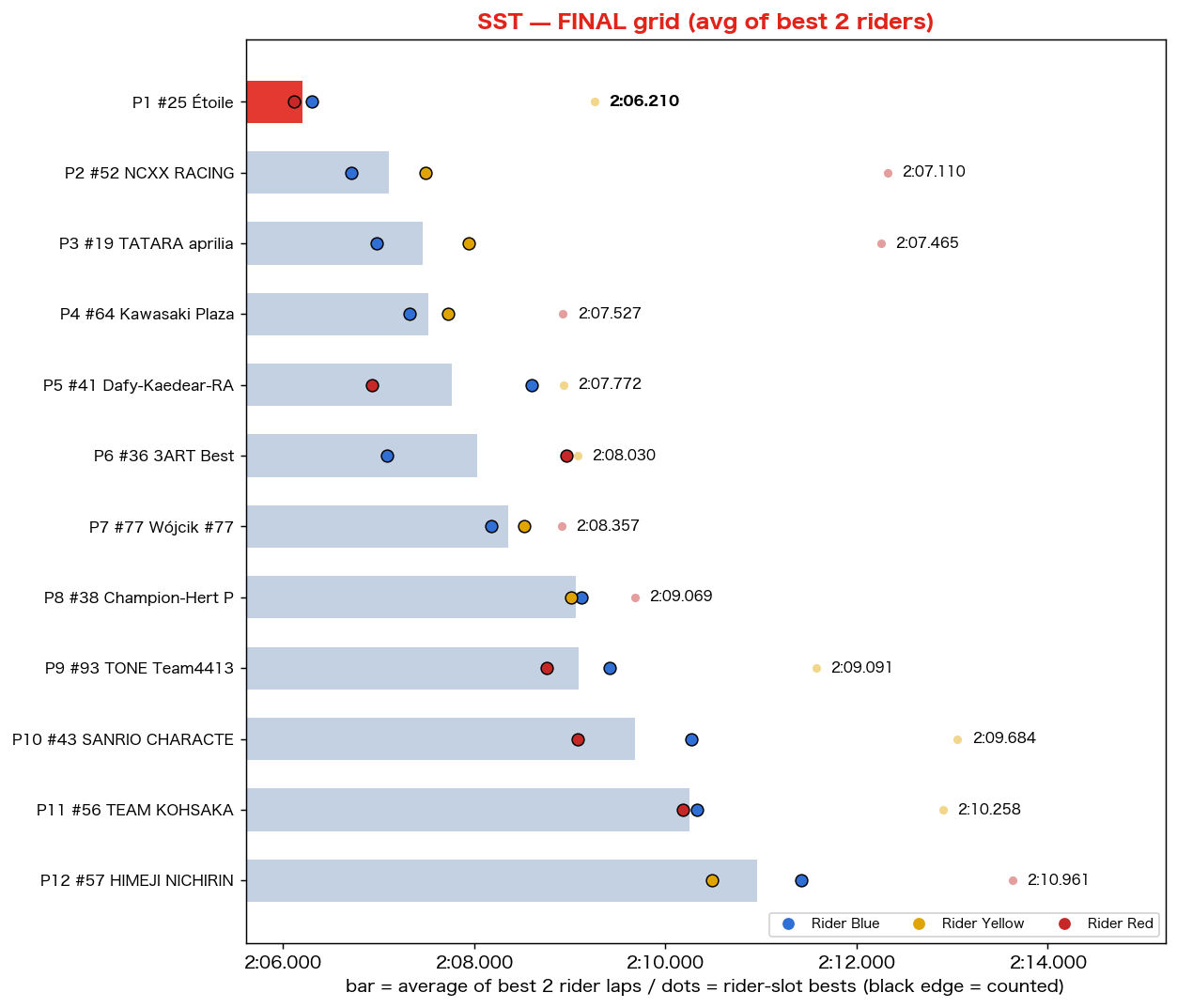
Five slots in, #25 Team Étoile leads provisionally with a best-2 average of 2:06.210. The two laps that count are the 2:06.302 that Hikari Okubo posted in the Q2 Blue slot and Kaito Toba's 2:06.117 from the Q1 Red slot — the only combination in the class where both riders are in the low 2:06s. The gap to second-placed #52 NCXX (2:07.110) is 0.900 seconds. Under the averaging format, that margin is heavier than it looks.
2. How the Magazine Was Spent — #52's "Six Rounds" vs #19's "Twenty-Six"
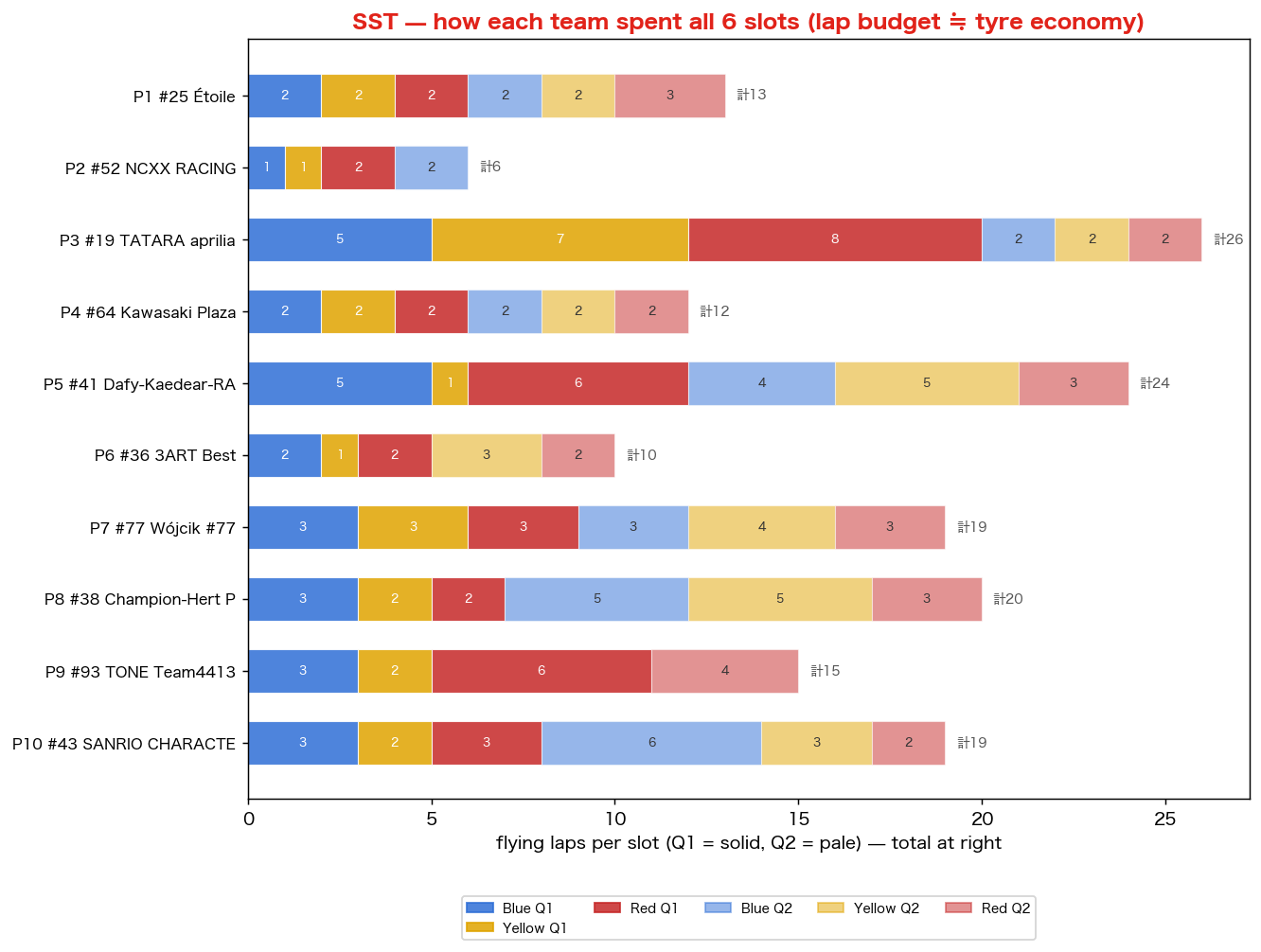
Here is the hidden side of qualifying. Look at the total number of flying laps (timed attack laps) used across the six slots —
(Rulebook note) In SST, qualifying allows just seven tyres. A fresh front-and-rear set consumes two, so all three riders taking new sets in Q1 alone eats 6 of the 7. Hence the craft: re-using your own used tyres, giving only the attack rider a second new rear, or the harshest cut — new tyres for two riders only, the third on used rubber throughout. The lap counts below are a portrait of that household budget.
- #52 NCXX used just 6 laps. One or two per slot: out-lap, one shot, back to the pits — pure sniper style. Maximum tyre conservation, to the point of setting zero timed laps in the Q2 Yellow slot (not a single round fired).
- #25 Étoile ran 2–3 laps in every slot, 13 in total. A disciplined, regimented approach — attack briefly, then come home — that both preserved ammunition and put a number on the board for every rider.
- By contrast, #19 TATARA ran 26 laps. Heavy running in Q1 with 5, 7 and 8 laps (burning rubber), then 2 laps each in Q2. A spend-it-all approach: build the pace in Q1, use Q2 only for the topping-up.
- #93 TONE saved everything for the final Red slot — and there Kengo Nagao delivered the team's fastest lap, 2:08.758 (the slot also saw a crash; rider OK, per race control).
With a tyre cap in force, total lap count is rubber economics, plain and simple. The same "2:07-something" means different things when #52 did it on six rounds and #19 on twenty-six — the resources they can carry into the race are not the same.
3. Q1 → Q2 — Who "Saved Something" for Later?
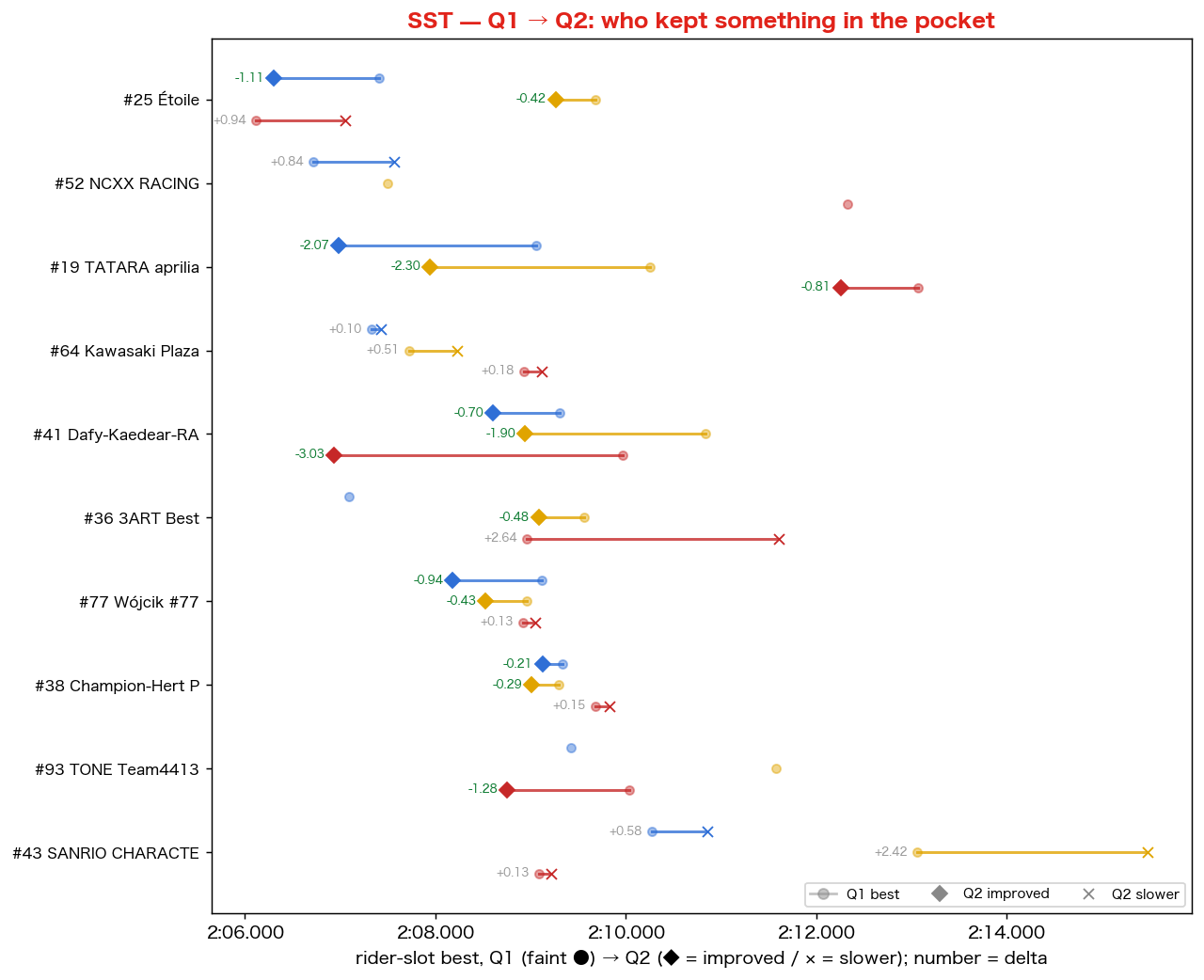
"Don't overrun the first session; keep something for the second" — did that strategy pay off? We compare Q1 to Q2 in the same colour slot.
- #25 Blue (Okubo) improved by a massive -1.111s (2:07.413 → 2:06.302). A restrained Q1 that kept fresh rubber and full focus for Q2 — and the number shows it.
- #19 Blue also improved to 2:06.985, climbing to provisional P3 — the spend-it-all approach's success story, converting all those Q1 laps of experience into one Q2 shot.
- Meanwhile, #52 has yet to improve in Q2. The sniper held his fire — but a bullet not fired moves no numbers. Read it as going all-in on the remaining Red slot.
4. On Which Lap Does the Best Come? — The Law of "the Scent of a Fresh Tyre"
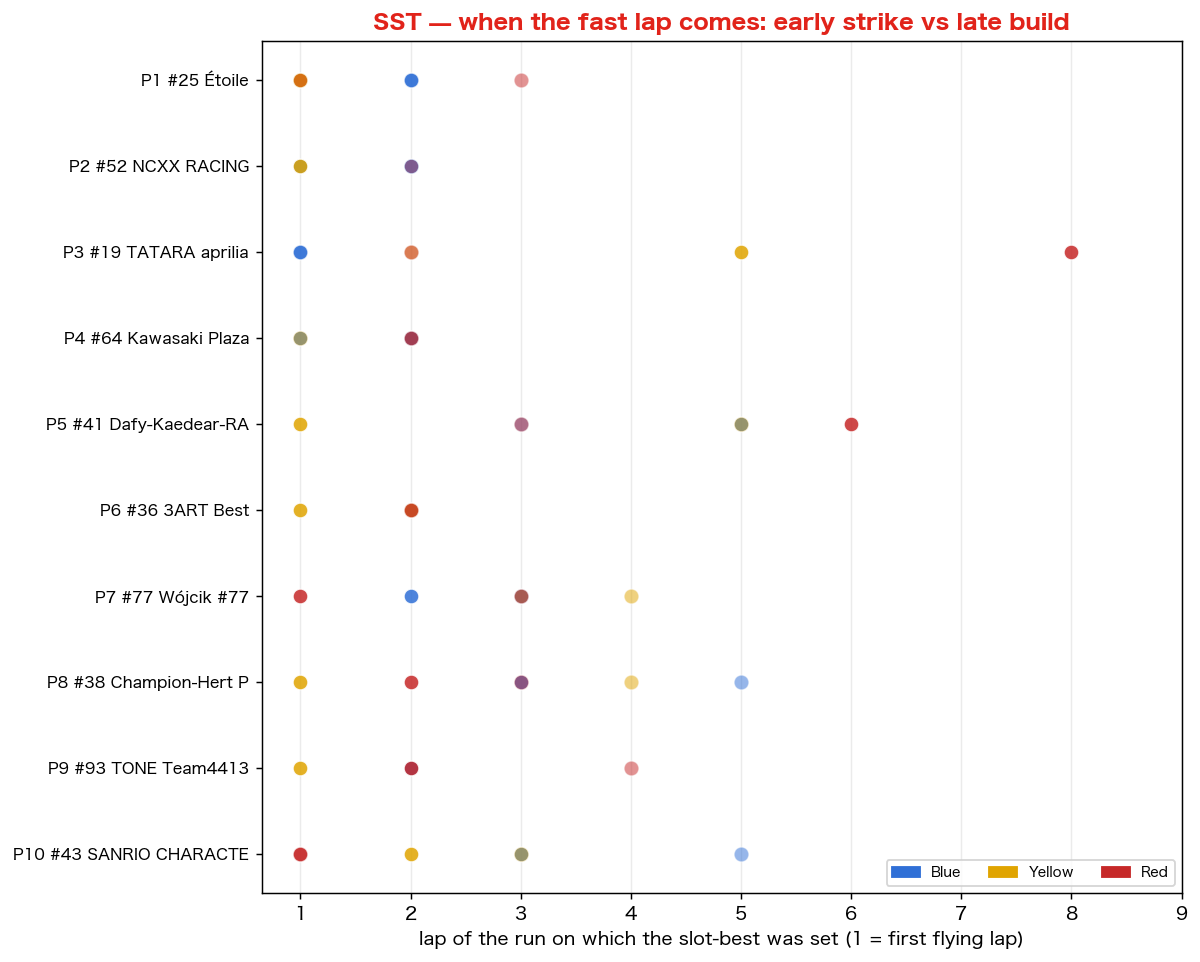
Line up which lap of the run produced each slot's best time and an interesting law emerges. Among the front-runners, the best lap comes overwhelmingly on lap 1 or 2 — a new tyre's peak grip is short-lived, and the textbook move is to harvest it on the very first attack. Slots where the best came on lap 3 or later usually mean either leftover rubber was used, or lap 1 was thrown away to traffic or a mistake. Twenty minutes of qualifying sounds long, but the truly fast window is only the first two laps.
5. The Mathematics of the Final Slot — The Upset Lies Beyond "a Time Nobody Has Set All Week"
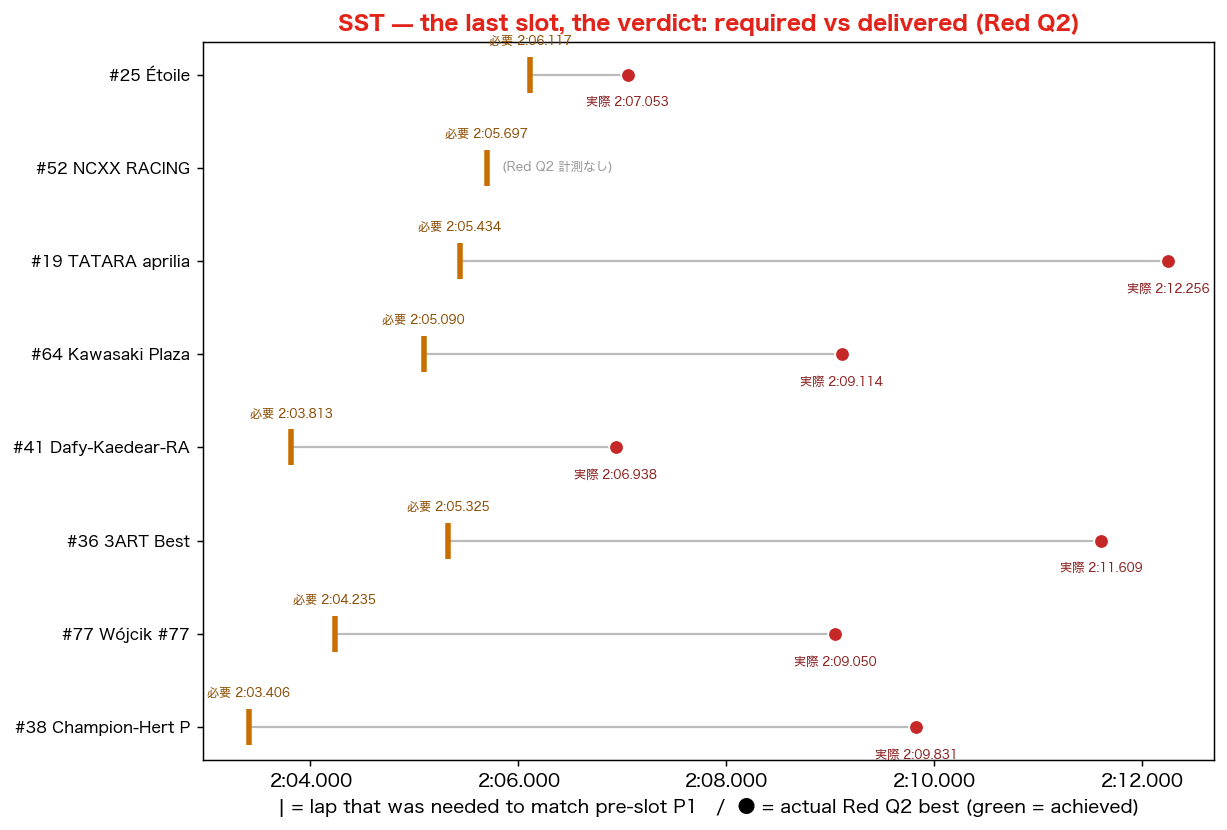
Only the Red Q2 remains. The arithmetic of an upset is merciless. To merely match #25's 2:06.210, each team's Red rider would need — 2:05.697 for #52, 2:05.434 for #19, and 2:05.090 for #64. Now recall: the fastest lap any SST rider has set all week is 2:06.117 (Toba, Q1). In other words, for every team the overtaking line lies beyond uncharted territory. Mathematically it is not zero. In reality, though, the final slot is most likely to be 20 minutes of watching #25's coronation — and if Toba improves on his own 2:06.117, that coronation becomes all the more unshakeable.
6. Wrap-Up — Viewer's Guide: Three Things to Watch in the Final Slot
- #25 Kaito Toba's attack — with pole all but in hand, does he push or protect? Watch how he commits on laps 1–2.
- #52's saved ammunition — the sniper who has used only 6 laps: what kind of shot does he fire at the end? The overtaking line is 2:05.697; even if he falls short, it bears directly on the fight for the second row.
- The 0.6s average spread across P3–P5 — the order of #19, #64 and #36 can flip on a single Red-slot performance. This is the real, living battle.
Qualifying was a game of how to fire a six-round magazine. Five rounds spent, and the team that has used its bullets most beautifully — so far — is the disciplined #25.
Data & charts: ÉTOILE DATA LAB (EnduraBase timing; cross-checked against the official results — all positions match (±0.001s rounding on averages possible)). Tyre spec and allocation cannot be identified directly from timing data and are inferred from lap counts. The #25 rider-to-slot mapping is team-confirmed (Blue = Hikari Okubo / Yellow = Motoharu Ito / Red = Kaito Toba).