
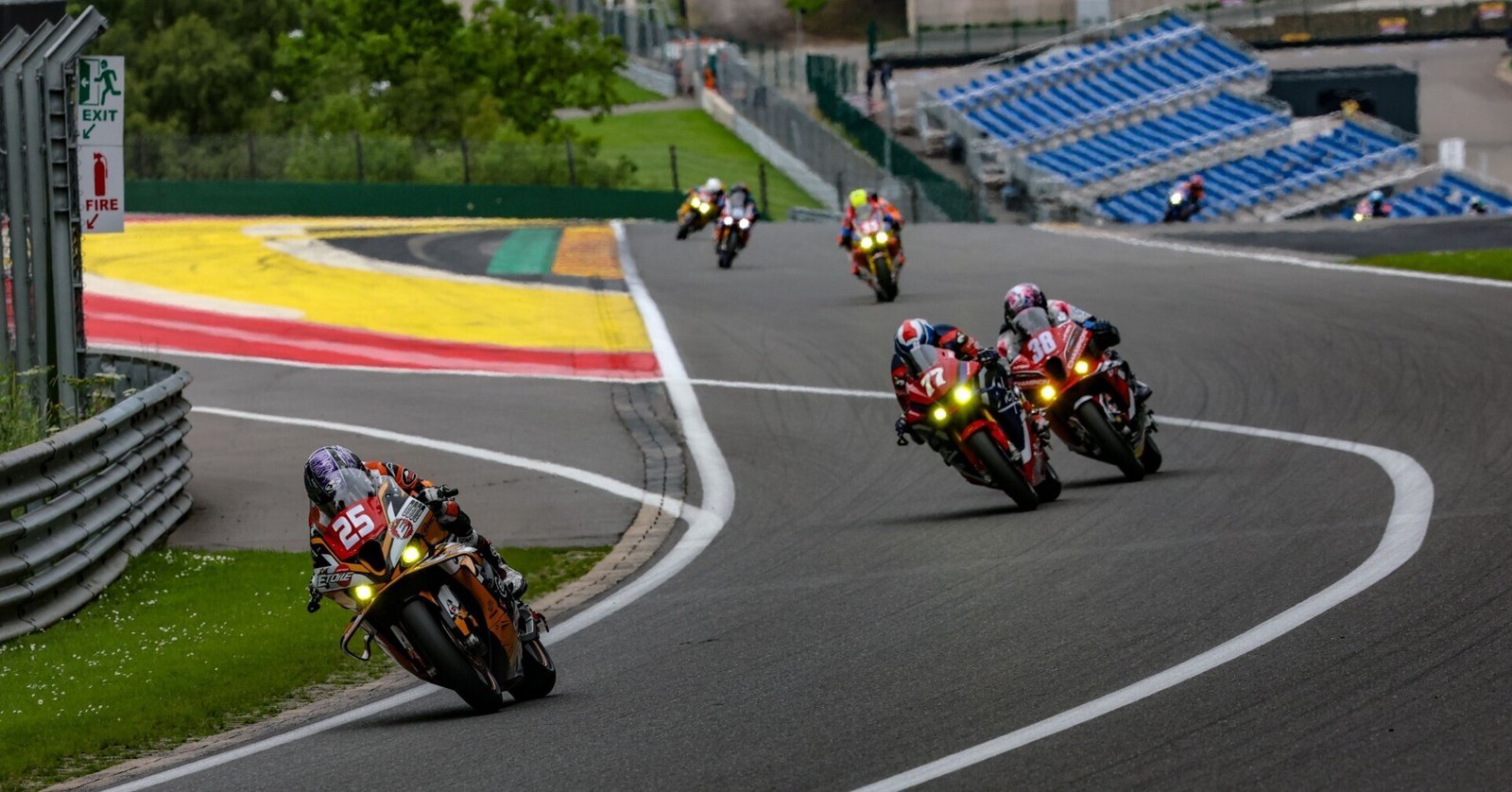
EWC 2027 calendar and changes: five races and a single qualifying session
In short
- The 2027 EWC grows from four races to five. Spa will host two races: 8 hours on Saturday and 6 hours on Sunday
- Every round goes from two qualifying sessions to one. At the 24-hour events, track action starts on Thursday evening
- With a single session, the game of how to use two sessions disappears. How a team manages its single session, and the weather at that moment, will decide qualifying
The 2027 calendar
The FIM Endurance World Championship (EWC) is the world championship for endurance motorcycle racing (new to it? Start with “What is EWC?”). On 12 November 2026, the organisers announced the 2027 calendar and changes to how race weekends are run.
| Round | Race | Circuit | Event dates (local) |
|---|---|---|---|
| Round 1 | 24 Heures Motos, Le Mans (50th edition) | Le Mans, France | 8–11 April |
| Rounds 2 & 3 | Spa: 8 hours (Sat) and 6 hours (Sun) | Spa-Francorchamps, Belgium | 4–6 June |
| Round 4 | Suzuka 8 Hours | Suzuka Circuit, Japan | 2–4 July |
| Round 5 | Bol d’Or 24 Hours | Circuit Paul Ricard, France | 16–19 September |
There will be five races, but with two of them at Spa, there are still only four circuits.
The three announced changes
- Two races over one weekend at Spa: an 8-hour race on Saturday 5 June and a 6-hour race on Sunday 6 June, counting as Rounds 2 and 3. Adding a round in another country or at another circuit would mean teams shipping bikes and people once more, and organisers running one more event. Extending the same event by a day lets teams race once more without an extra trip. The announcement presents it as a way to add a fifth round while controlling costs for teams and organisers
- One qualifying session at every round: down from two. At Spa, that single session sets the grid for both the Saturday and the Sunday race. The Top 10 Trial at the Suzuka 8 Hours stays
- 24-hour events start on Thursday evening: the races at Le Mans and the Bol d’Or keep their length. Free practice runs on Thursday evening and into the night, free practice and qualifying on Friday, and the warm-up and race on Saturday and Sunday
Claude Michy, President of Endurance Moto Promoter (EMP), which runs the series, says the Spa double header means planning bike preparation, rider management and strategy over two days. Paul King of the FIM says that with a single qualifying session every lap will count, and fans will find it easier to follow how the grid is decided.
What changes with more races?
What the announcement explains is how to add a round while keeping costs down. Why add one at all is left at “developing the championship”. What follows is not in the announcement: it is our view as a team racing in the championship.
Endurance races go on for hours. Bringing the bike home in one piece is part of a team’s strength, but some things, such as contact with another bike, are beyond a team’s control. Team Étoile, too, has lost a race to a crash or an engine problem in each of its three seasons since 2024. In MotoGP, with more than 20 races a year, one bad result can be made up elsewhere. With four races a year, each one weighs far more.
On top of that, the points are concentrated in the 24-hour races. Under the 2026 regulations, a win is worth 30 points in a race of 8 hours or less and 40 points in a 24-hour race. In 24-hour races, the positions at 8 hours and 16 hours also earn up to 10 points each. In the Superstock class, where Team Étoile races, only the best three results out of four count, so one bad result can be dropped. How many results will count out of five has not been announced yet. It depends on that rule, but as a team in the championship, we hope it means one more chance to make up for a bad day.
EWC used to have more races. In the 1980s there were up to about ten a year, and in 1989 and 1990, with too few races to meet the FIM’s rules, it was downgraded from a world championship to a “World Cup”. The run of four-race seasons began in 2022.
A single qualifying session: no more choosing between two
In qualifying, riders are split into colour-coded groups, one rider per team in each, and the groups take turns on track. Under the 2026 regulations, each group runs for 20 minutes. A team’s qualifying time is the average of its two fastest riders’ best times. Class pole position (first in class qualifying) earns 5 points, and points go down to fifth place, so qualifying also counts towards the season standings.
The other rule is the tyre limit. Under the 2026 regulations, a Superstock team may use up to seven tyres in qualifying with three riders, or nine at a 24-hour race with four riders (full wet tyres, for heavy rain, are not counted). A tyre counts as used once it leaves the pit lane. New tyres front and rear take two at a time, so not every rider can run on new tyres in both sessions.
So with two sessions, the strategy was choosing which session to go for. Based on the forecast for the weather, the time of day and the track temperature, a team chose whether to settle it in the first session or to aim for the second from the start. With nothing to tip the balance, a team would run the first session and, if that was not enough, go all out in the second. Deciding which session got new tyres was part of the strategy too. In 2027, that choice disappears.
Team Étoile: three races, three stories in 2026
Team Étoile (#25) races in the Superstock class (bikes very close to the road-going models). In 2026, qualifying played out completely differently at each race.
| Race | How qualifying went | Class qualifying position |
|---|---|---|
| 8 Hours of Spa | Practice was wet, and the first session was almost the first proper run on a dry track. Both of the team’s counting times came from that session. The track dried only in the last few minutes of the second session, and teams that improved then moved up | 5th |
| Suzuka 8 Hours | A measured first session, then Hikari Okubo found 1.111 seconds in the second to take pole position | 1st |
| Bol d’Or 24 Hours | Top after the first session on Thursday evening. In the second, late on Friday morning, a rival closed to within 0.050 seconds, and Kaito Toba improved with about four minutes left to stretch the gap to 0.307 seconds | 1st |
At Suzuka, the second session is what made the 1.111 seconds possible. At Spa it worked the other way: rivals who caught the dry track at the end of the second session moved ahead of us. Two sessions were a chance to make up for misreading the weather or the plan, and a chance for rivals to do the same. In 2027, all of that will be packed into a single session.
What to watch in 2027 qualifying and at Spa
Instead of how to use two sessions, it will come down to how a team manages a single session. Here are four things to watch.
- Session time and the sky: air and track temperature, and rain, change lap times a lot. Until now there were two sessions at different times of day; in 2027, that one session is everything
- Each rider’s first one or two laps: in qualifying at the 2026 Suzuka 8 Hours, many of the leading teams set their best times on the first or second lap of a run. With only one session, can a rider nail that first attack?
- Back to the pits and out again? If the tyre allowance stays the same, the tyres once split across two sessions can all be used in one, and more teams may come in and try again within the same session. On the other hand, a crash on the first lap leaves no next session. Bank a safe time first, or attack from the start? That is where each team’s approach will show
- Spa: one session for two races: a lap of Spa-Francorchamps is 7.004 km, and the weather there changes quickly. That one qualifying session sets the grid for both Saturday and Sunday. A crash or a technical problem in Saturday’s 8 hours will also be felt in Sunday’s 6 hours. Fixing the bike overnight and bouncing back on Sunday is a new storyline from 2027
Not announced yet
This article is based on the announcement of 12 November 2026. The following have not been announced yet. We will update this article when they are.
- Points for the 6-hour race at Spa, and whether qualifying points are awarded for both Spa races
- How many of the five results will count
- Qualifying session length and the number of tyres allowed
- Session times for each day
You can follow each race in our News, see past results in Results, and read detailed analyses of 2026 qualifying in ÉTOILE DATA LAB: Spa, Suzuka and Bol d’Or.
Sources
- FIM EWC — EWC shakes up 2027: fifth round and new event format (2026-11-12)
- 8h SPA Motos — DOUBLE RACE : WHAT’S NEW FOR 2027! (2026-11-12)
- Bol d’Or — Le FIM EWC évolue en 2027 avec une cinquième épreuve et un nouveau format (2026-11-12)
- FIM — 2026 FIM Endurance World Championship, Cup and Trophy Regulations — Art. 1.13 / 1.15.4 / 1.34 / 2.3.6 (update 29 May 2026)
- ÉTOILE DATA LAB — 8h Spa 2026 SST qualifying analysis (official timing and weather)
- ÉTOILE DATA LAB — Suzuka 8H 2026 SST qualifying analysis (official timing)
- ÉTOILE DATA LAB — Bol d’Or 24h 2026 SST Report 5 (qualifying)
- Team Étoile — Results (2024–2026)
- Wikipedia — FIM Endurance World Championship (history)