
The last bullet never fired — #25 Étoile takes pole on 13 disciplined laps
- Best-2 average gridRecomputing the grid live under the 'average of the two fastest riders' rule
- The magazine (tyre resources)Total flying laps as a proxy for rubber spent — each camp's philosophy laid bare
- Three-rider balanceRider spread measures the essence of a 'field two riders' discipline
- First-lap cultureWhich lap of the run peaks — a 20-minute slot is really a first-attack contest
- Share of the cool (condition-adjusted)Q1→Q2 gains minus the field median (conditions + herd) — what remains is real improvement
- Prediction scorecardPre-race predictions self-graded ○△✗ without hindsight edits — the LAB's honesty guarantee
#25 Team Étoile has taken pole position. A best-2 average of 2:06.210 — 0.900 seconds, or 41.5 metres of track, ahead of second-placed #52 NCXX RACING. Before it was ever a contest of speed, qualifying was a resource game: how do you spend a six-round magazine? And when the six slots were over, the strongest rival's last bullet had — never been fired. This is the definitive recap of that day, rewoven from official timing alone.
The rules in 30 seconds: Qualifying runs three slots each in Q1 and Q2 (Rider Blue/Yellow/Red, roughly 20 minutes apiece) — six slots in total. The grid is set by the average of the two fastest riders' best laps — only the quickest two of the three count. On top of that, the number of tyres you may use in qualifying is capped by regulation (and the SST allocation is especially small) — you cannot bolt on fresh rubber every time. Qualifying, in other words, is a game of how you distribute a six-round magazine and a limited tyre allocation.
Act I — The trailer: in the final FP, every team showed its hand
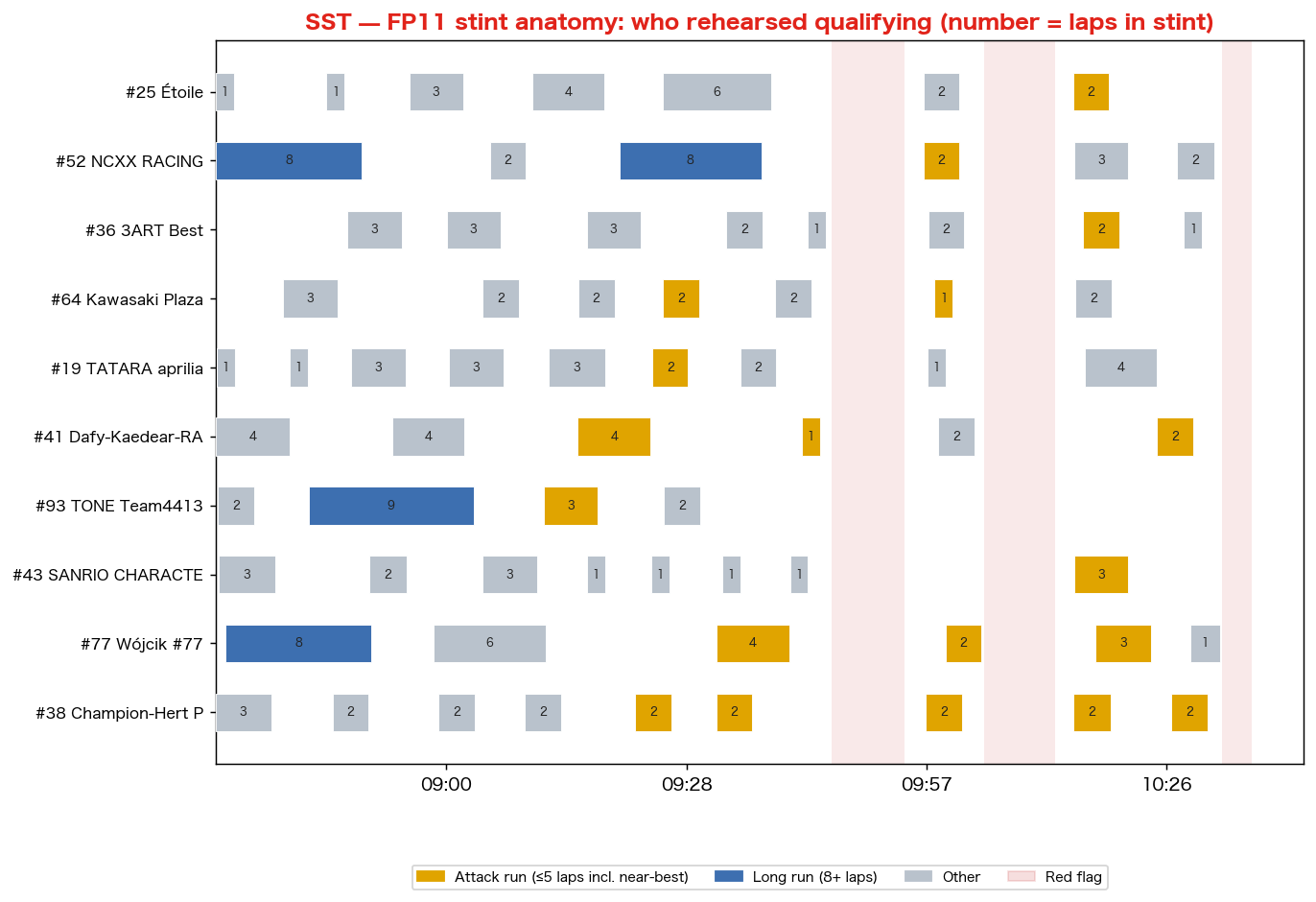
The story began hours before qualifying, in the final free practice (FP11). Looking at how the laps were spent (gold = attack runs), #38 logged the most attack runs at five (nine stints in all), a pure rotation exercise, while #25 Étoile built its pace in stages and dropped a single strike after the second red flag (2:06.505, fastest in class at the time). The morning #25 got ahead of #52 for the first time all test — foreshadowing clue number one. Clue number two was the quietness of the front-runners, who trimmed their rehearsal down to a single run.
Verification — practice could not buy grid position: the top three each rehearsed exactly once
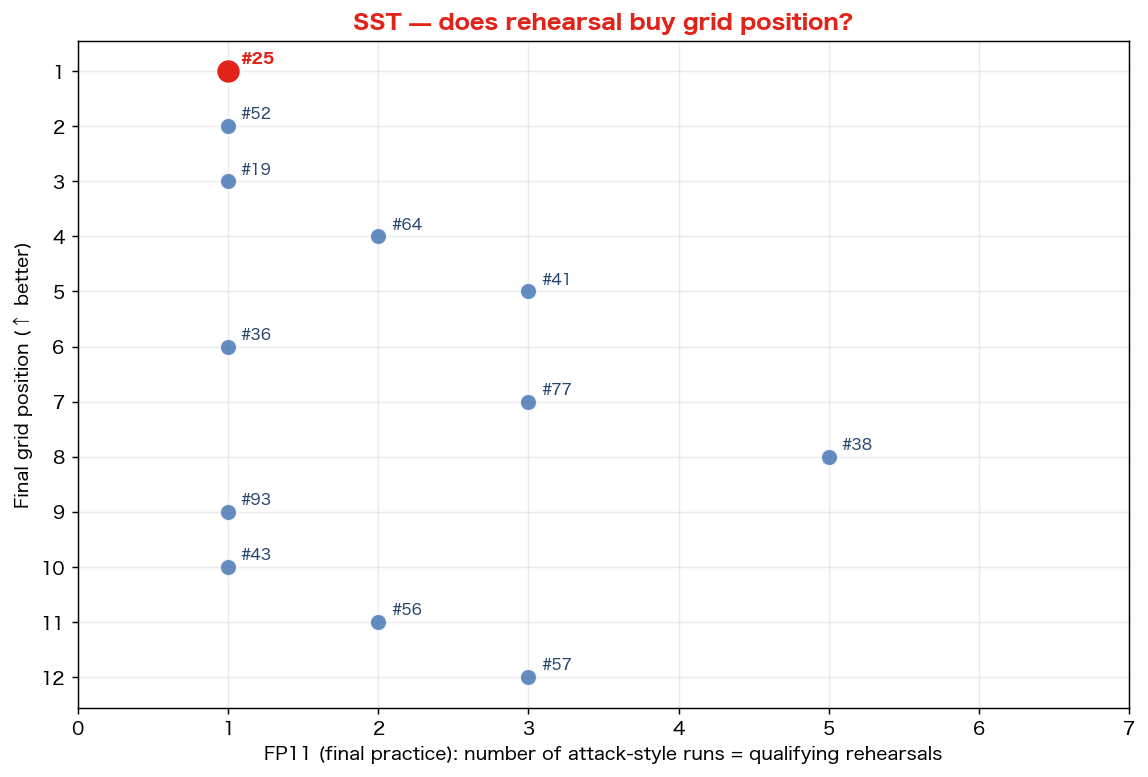
Overlay FP11's "qualifying rehearsal count" on the final grid and a striking fact emerges — the top three (#25, #52, #19) each ran exactly one rehearsal. Conversely #38, with the most attack runs (five), ended up P8. In this class, practice volume could not buy grid position. A vivid contrast with the EWC class, where the top six all ran three to five rehearsals — there, rehearsal was the ticket in. The fast teams finished their checks in a single run and saved tyres and concentration for the real thing — perhaps a high rehearsal count was really a measure of how much anxiety there was left to check.
Act II — The magazine and the three-rider balance: how you shoot reveals who you are
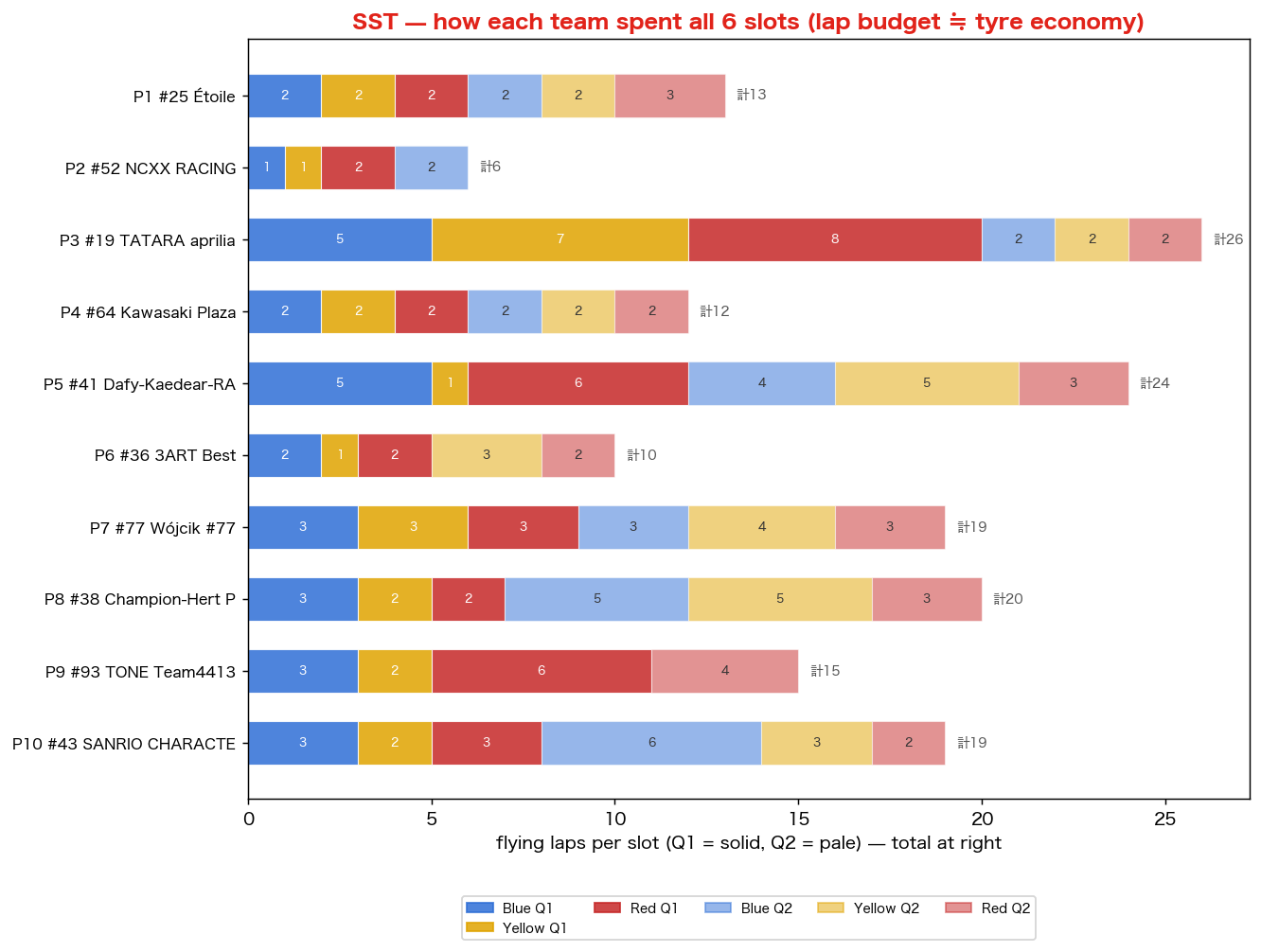
Once qualifying began, the tyre cap laid each team's philosophy bare. SST qualifying allows 7 tyres for a three-rider line-up (FIM Endurance regulations Art. 2.3.6). Fresh rubber front and rear costs two tyres per set, and all three riders taking new tyres in Q1 alone eats most of the allocation — which is why the distribution exposes doctrine.
- #52 was the sniper: just 6 flying laps across six slots. Out-lap → one strike → pit. Q2 Yellow and Red: no timed laps at all.
- #25 was the disciplined type: 2–3 laps per slot, 13 in total. Rounds kept in reserve, yet every rider brought a number home.
- #19 TATARA was the spender: 26 laps. Heavy running in Q1, Q2 for increments only. The same 2:07s mean different things from a team that fires 6 rounds and one that fires 26 — the resources carried into the race are not the same.
The other gauge is the three-rider spread (fastest to slowest). At the Q1 mark, #77 Wójcik had all three riders within an astonishing 0.20 seconds — but the absolute pace was in the 2:09s. In contrast, #52's spread was 5.61 seconds and #25's 3.57 — large. Yet only two riders count toward the average, so the third rider's shortfall does not hurt directly — everything comes down to "how fast are your top two", and on that contest #25 came out ahead. And the homework the averaging format sets is computed like this: to match the provisional P1, "one rider must cut twice the gap" (at the end of Q1 that meant 0.69 seconds per rider against #52). This arithmetic leads straight into the mathematics of the final act.
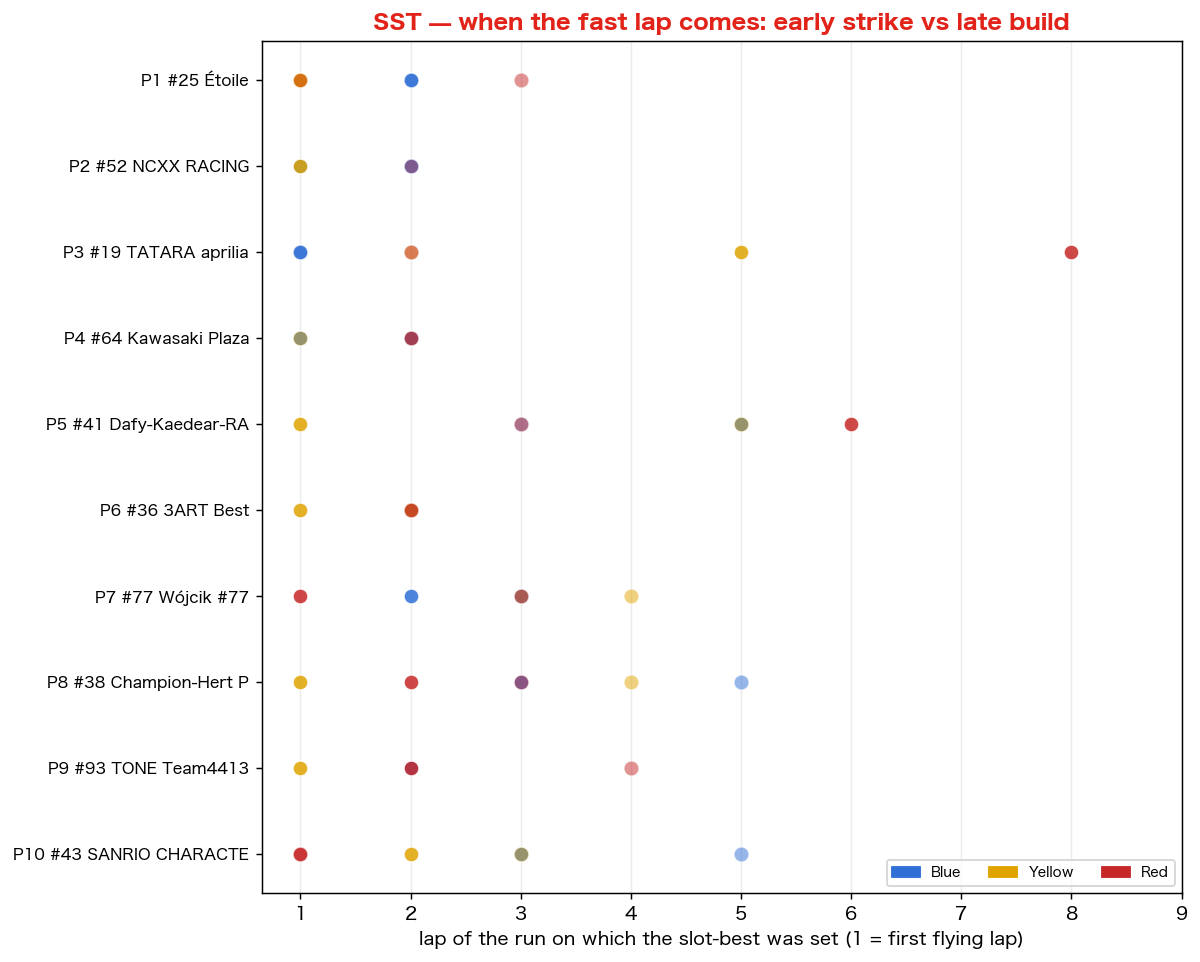
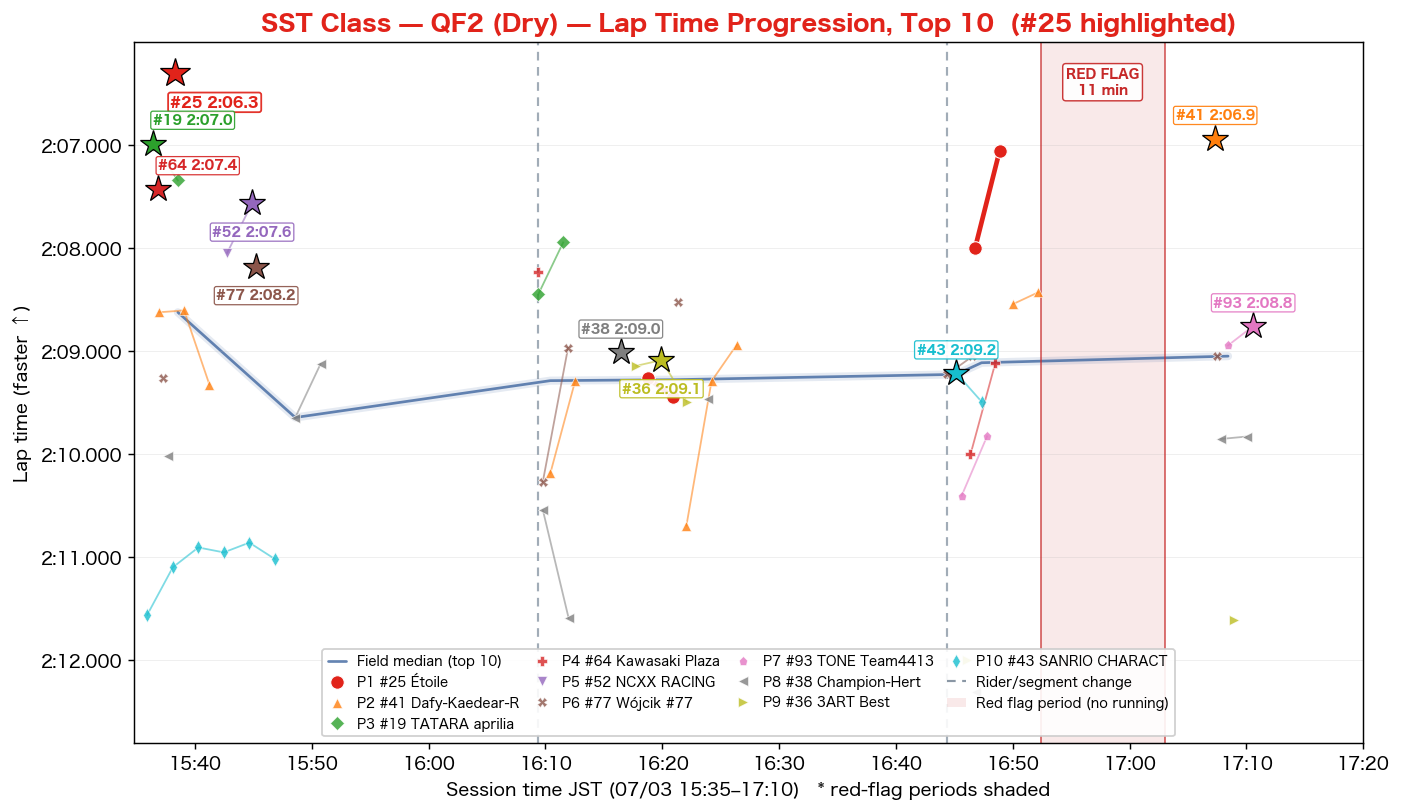
There are laws to how the rounds get fired, too. Chart which lap of the run each slot's best came on, and the front-runners' bests fall overwhelmingly on laps 1–2 — a new tyre's peak grip is short-lived, and the textbook says harvest on the first attack. Slots where the best came on lap 3 or later mostly mean either leftover tyres, or a first lap thrown away to traffic or a mistake. Twenty minutes sounds long; the genuinely fast window is only the first two laps.
Act III — Q1→Q2: the teams that "saved it", and the cool air's share of the gain
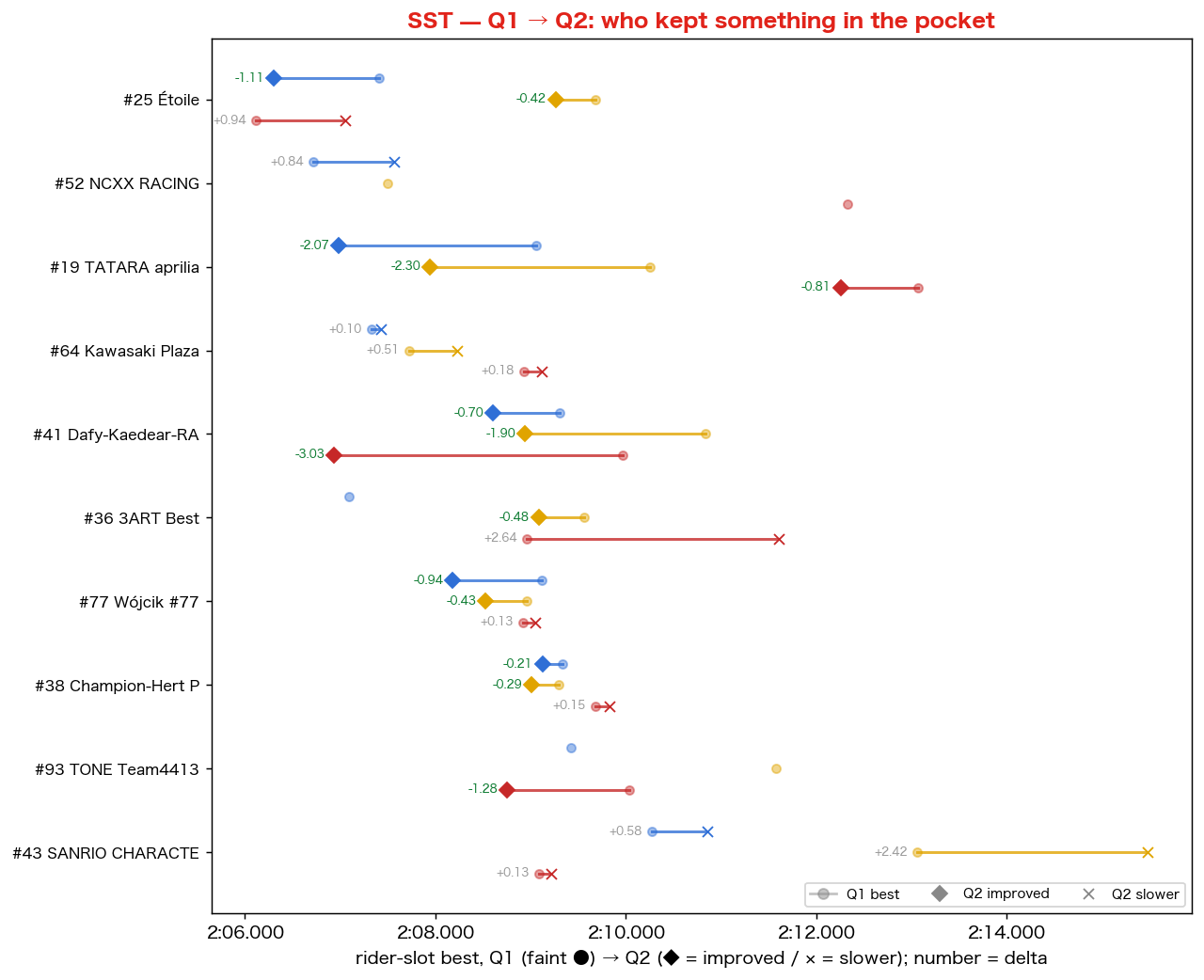
"Don't overspend the first run — save it for the second." Whether that works shows up in the same-slot comparison from Q1 to Q2. In the Q2 Blue slot, Hikari Okubo went -1.111 seconds to a 2:06.302. The strategy of closing out a restrained Q1 to keep new tyres and focus for Q2 converted straight into a number in that moment. That single lap made the two counting laps "Hikari + Kaito", lifting #25's average to 2:06.210. #52 never once improved in Q2, and the story headed for its final act.
New instrument — whose gain is the Q2 improvement? Subtracting the cool air's share
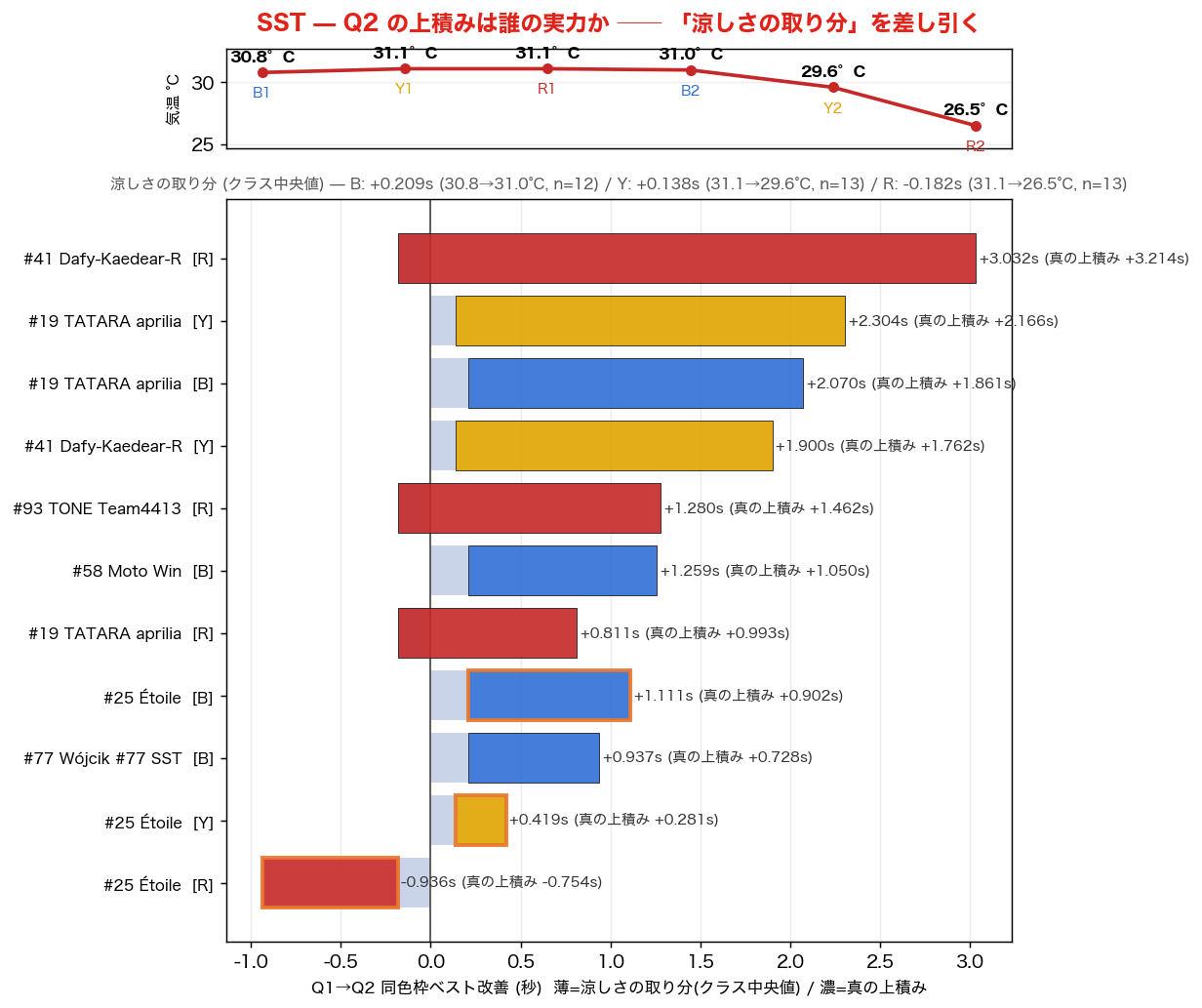
Let us pose an honest question here. Is a Q2 personal best the rider's own gain, or a gift of the cooler evening? For each colour slot we took the class-wide median Q1→Q2 change as a baseline, subtracted it, and measured the genuine gain. The baselines: Blue +0.209 / Yellow +0.138 / Red -0.182 seconds. Four things to read.
- Of Hikari's Blue +1.111 seconds, the genuine gain is +0.902. Even after deducting the cool air's share, that strike was real.
- The Red-slot baseline is negative — R2 was the coolest of the six slots at 26.5°C, yet the field's median was actually slower. In other words, in the final slot most of the field was no longer attacking (these were the 20 minutes after pole had been decided).
- Kaito's R2 was raw -0.936 seconds. He held onto his own 2:06.117 and did not push — the data-side confirmation of "choosing not to shoot". There was no need to attack.
- Amid all that, #41's MANFREDI Kevin posted a genuine gain of +3.214 seconds in R2, a real late charge that seized P5. The one man attacking in a slot where nobody else was.
(An honest footnote: this baseline conflates "cool air" with "whether the pack attacked in that slot"; it does not isolate the pure temperature effect.)
Final Act — The last 20 minutes: the mathematics held
With five slots done, the arithmetic read as follows: for #52 to draw level with #25, the Red slot required a 2:05.697. But the fastest anyone in SST had gone all week was 2:06.117 (Kaito Toba, Q1). The line for an overturn lay beyond territory the class had never entered.
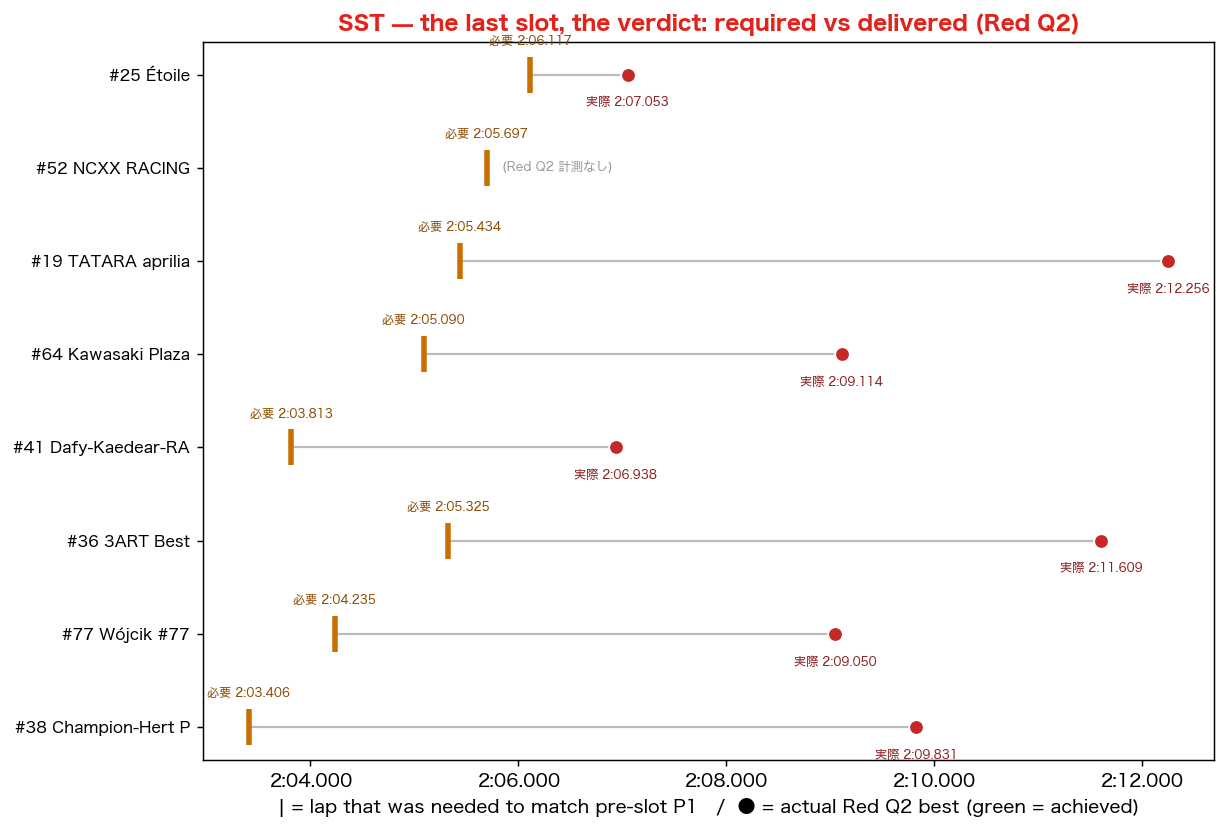
In the final slot, the answer came. Nobody stepped into the uncharted territory the mathematics had marked out. And #52 left no timed lap — the sniper who had husbanded six rounds laid the gun down without firing the last bullet. Official race control recorded no trouble for #52; a strategic call is the likeliest reading, but the reason cannot be established from timing alone. #41's MANFREDI Kevin pushed down to 2:06.938 for P5; at #93, whose allocation had saved everything for the final slot, NAGAO Kengo set a team-best 2:08.758 (with a crash in the same slot — rider unhurt, per official communication). And #25 Étoile: pole position (2:06.210).
The final grid — a coronation by 41.5 metres
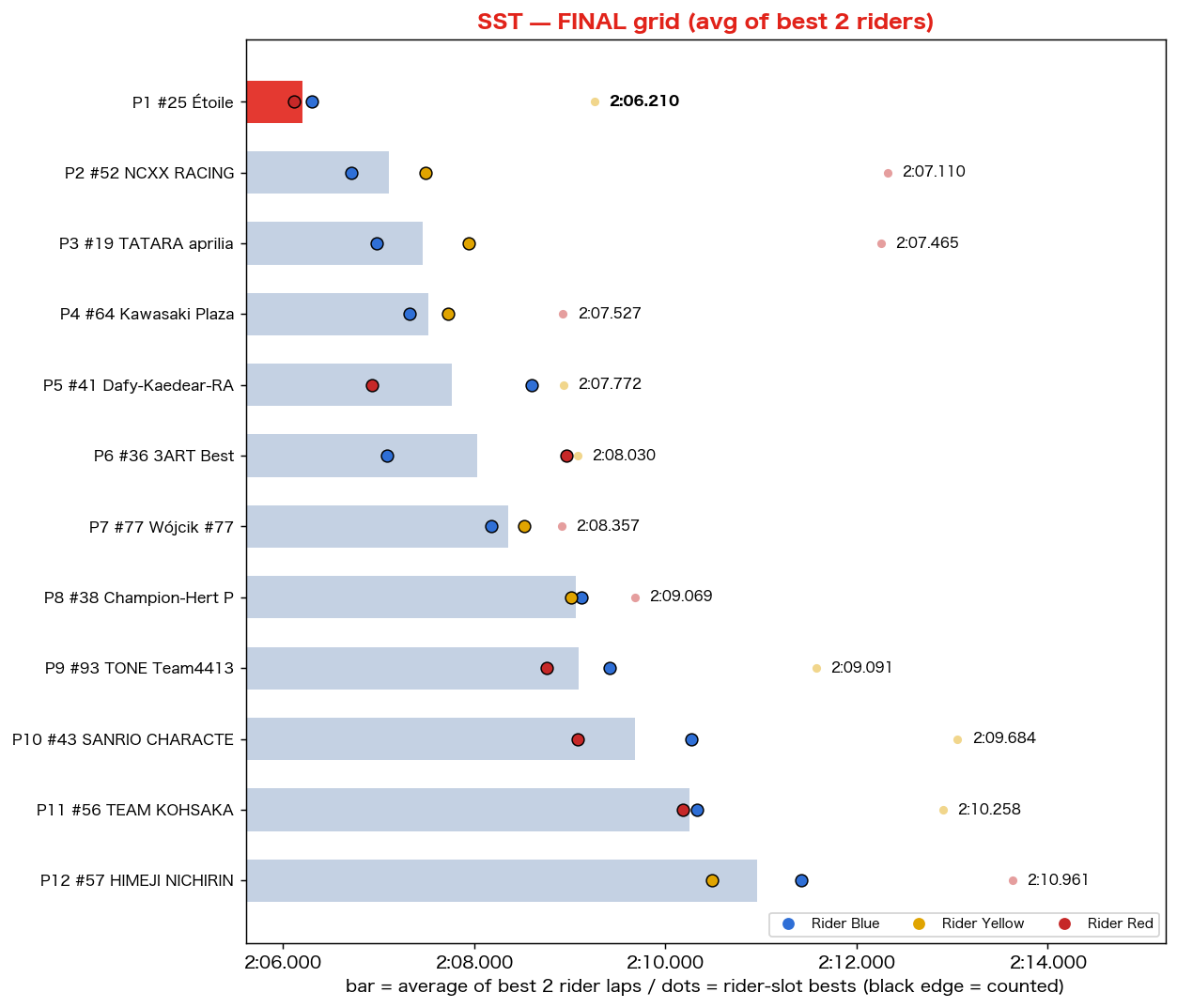
What is a 0.900-second gap? Lapping Suzuka's 5.821 km in 2:06 means an average of roughly 166 km/h. 0.900 seconds is about 41.5 metres — at a machine length of roughly 2.1 m, a queue of about 20 bikes (the same yardstick as the EWC article). The front row of an 8-hour race was decided by that distance.
The foreshadowing ledger — how much of the preview came true?
| Prediction (FP11 preview / five-slot analysis) | Self-grade |
|---|---|
| #25 fastest in class for the first time in the final FP — a leading pole candidate | ○ Carried it straight to pole |
| Kaito's 2:06.117 is the "fastest SST lap of the test" | ○ Never beaten, and became one of the counting laps for pole |
| Watch #52's held-back rounds (the 6-lap sniper) | ✗ Never fired — no timed lap in the Q2 Red slot |
| The overturn line lies "beyond the class's uncharted territory" | ○ Nobody reached it; settled exactly as the maths said |
| Watch #93's moves in the remaining slots | △ NAGAO Kengo set a team-best 2:08.758 in the final slot, but with a crash |
The original predictions are preserved exactly as written at the time in the five-slot analysis → Qualifying deep analysis (at five slots)
Epilogue — from hunter to hunted
On day one of the test, #25 was staring at #52's tail. A 2:07.3 in FP7, ahead for the first time in FP11, then pole by 0.900 seconds in qualifying. Hikari's Q2 strike (genuine gain +0.902 s) and Kaito's Q1 single shot (week's fastest, 2:06.117) — the 2:06.210 built from their "one lap each" is the product of 13 disciplined laps and tyre allocation.
Race-day watch points, within the bounds of timing fact: ① can pole-sitter #25 translate its qualifying-spec "short and fast" into an 8-hour average pace; ② between #19, which spent 26 laps in qualifying, and #52, which used only 6 — which pays off, the saved rubber or the accumulated experience; ③ the momentum of #41, the only crew that attacked in the final Q2 slot. The six rounds of qualifying have been fired. Next comes the long magazine of 480 minutes.
Four lenses on this qualifying
- Flash A4 — the one-pager issued right after Q1 → Flash A4
- Interim report — the three-rider balance analysis at the end of Q1 → Q1 interim report
- Main feature — this article (the definitive recap)
- LIVE — the session live-commentary log → LIVE
Data & charts: ÉTOILE DATA LAB (EnduraBase timing, Turso prod; qualifying sid=318–323; retrieved 2026-07-03. Cross-checked against the official results; an independent recalculation matches every position. FP11 derived from backed-up data). New/used tyre status and tyre counts cannot be identified directly from timing and are estimated from lap counts. The #25 rider–slot mapping has been confirmed with the team (Blue = Hikari Okubo / Yellow = Motoharu Ito / Red = Kaito Toba). Crash and red-flag information is per official race control. This article is a data-analysis report written by an AI from a third-party perspective; please forgive any inaccuracies it may contain.
🔬 Methodology & verification
- Source: EnduraBase timing DB (Turso prod, official timing). All six qualifying slots (Rider Blue/Yellow/Red × Q1/Q2, sid=318–323); FP11 from preserved data. Cross-checked against official results; an independent recomputation matched every position (±0.001 s possible from best-2 rounding).
- Grid computation: the 'average of the two fastest riders' rule recomputed per slot.
- Tyre rule: SST teams of three riders get 7 qualifying (QP) tyres — FIM Endurance Regulations Art. 2.3.6 (tyre sticker quantities). New vs used cannot be read from timing; flying-lap counts serve as a rubber-spent proxy, stated as such.
- Share of the cool (condition adjustment): each team's Q1→Q2 same-colour gain minus the class-colour field median = real improvement. The baseline mixes cooling with how hard the field pushed in that slot — it is not a pure temperature effect. Per-slot temperatures from the DB's weather observations.
- Crashes & red flags: per official race-control messages (injury status relies on their RIDER OK notes).
- Predictions: the five-slot preview article is preserved unchanged as the 'original'; the scorecard grades it ○△✗ with no hindsight edits.
- Verification: several independent review agents re-checked article figures against the DB before publication (several figures and attributions were corrected).
- Boundary & disclaimer: timing facts and official statements only — no team-internal setup information. This is an AI (ÉTOILE DATA LAB) third-party analysis; please excuse any inaccuracies.