
Suzuka 8 Hours 2026 Pit-Work Study ― Eight Hours, and What Really Filled the "Time Spent Standing Still"
📖 This is a companion piece ― start with the article that unpacks the race itself, Decoding the Race ― How the Safety Car Reshuffled the Order (SST edition / EWC edition), and read the two together.
The conclusion in three lines
- The single biggest factor splitting the total time each bike spent "standing still" over eight hours (the pit budget) was not the speed of the pit stops, but whether a bike avoided a long stop for repairs or trouble. The front-runners went about their pit work calmly and without mistakes, incident-free.
- Once repairs and trouble are stripped out, the "pure mechanics' working time" for the top 10 was 42–47 seconds in EWC and 57–84 seconds in SST. But the two classes use different tyre-change mechanisms (EWC = quick-changer / SST = essentially production wheels), so they cannot be compared on the same footing.
- #25 Team Étoile topped the pure working time in SST (median 57.5 seconds). Of its 408-second total budget, 195 seconds (nearly half) came from the red-light hold at the exit of the second safety-car period (an external factor, see Decoding the Race §3a), and the team's own pit execution was the fastest in the class.
This report is a companion piece to Decoding the Race. Where that article dealt with the order shuffled by the safety car (SC), this one examines the "raw pit work" performed under green-flag running from two angles ― "the total time spent standing still across eight hours," and "the speed and consistency of the pure mechanics' working time, with repairs and trouble removed." The loss from the red light at the SC exit was itself covered in the previous piece, so here we only fold it in as one line item within the total budget.
How to read this: every figure is a measured value of stand_time (stationary time) = the seconds a bike was actually stopped in the pits. This is not about who was fast or slow on track; it is about "the execution of the pit work itself." Bikes that did not complete the race distance (early retirements, or bikes whose race was effectively over after a major repair ― i.e. those that covered less than 90% of the class winner's laps) are excluded, because they would distort the comparison. The two classes covered are SST and EWC.
1. The pit budget ― what separated the order was "avoiding trouble," not "speed"
Start with the big picture. Over eight hours, every bike has to stop for fuel, tyres and rider changes. We'll call the sum of that stationary time the "pit budget." The shorter it is, the longer the bike was out on track.
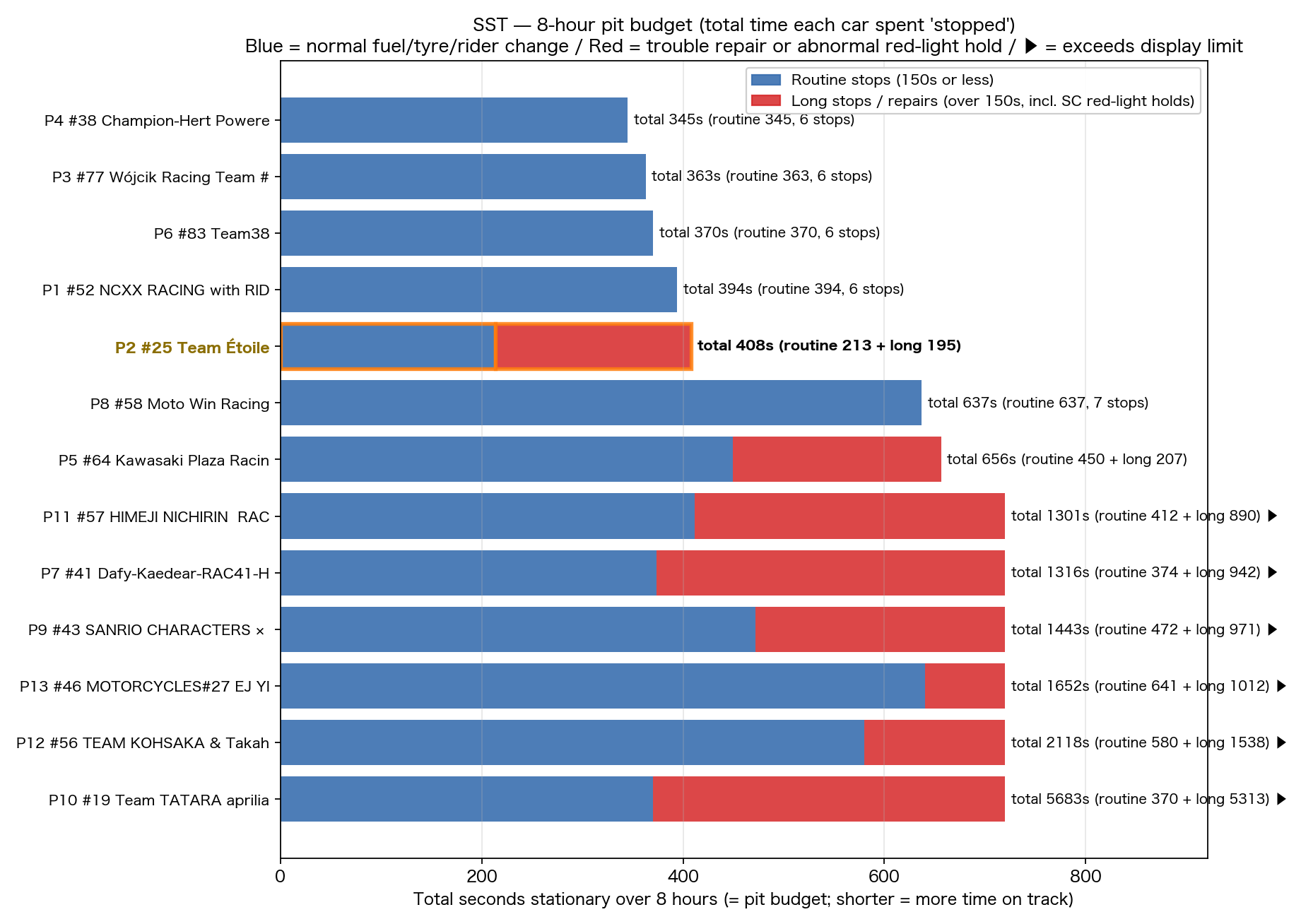
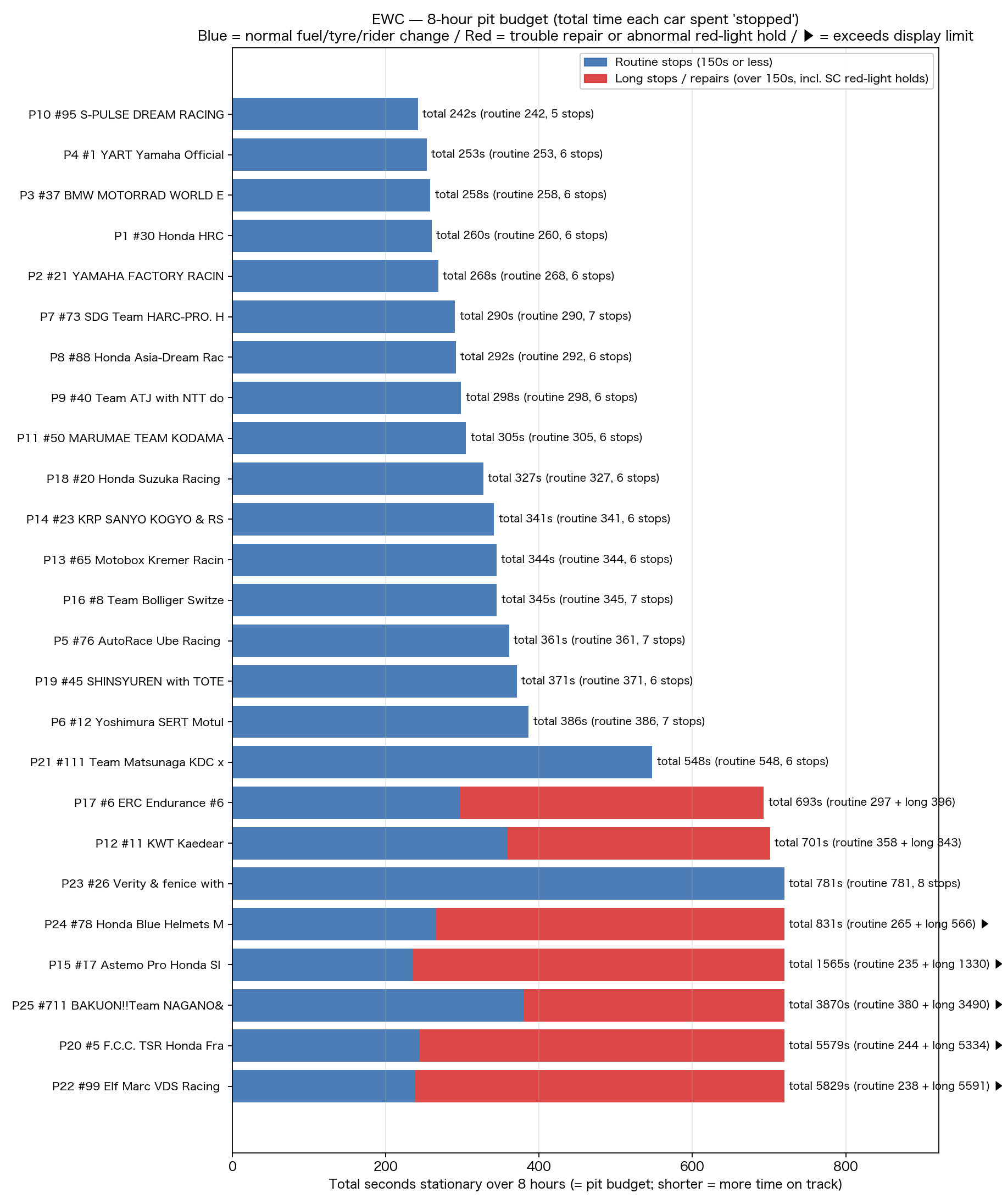
- The trouble-free front-runners are remarkably tightly bunched. In EWC, #95, #1, #37, winner #30 and #21 sit at 242–268 seconds; in SST, #38, #77, #83 and winner #52 sit at 345–394 seconds. Across eight hours of running, they stood still for just four to six and a half minutes.
- What blows the total budget up is not "a gap in speed" but "the presence of trouble." Bikes carrying the red portion of the chart ― a long stop of over 150 seconds (a repair after a crash, or an abnormal red-light hold) ― see their total budget balloon at once to thousands of seconds (tens of minutes to hours). A bike that spent a long time in the garage dropped down the order no matter how short its blue (routine stops) were.
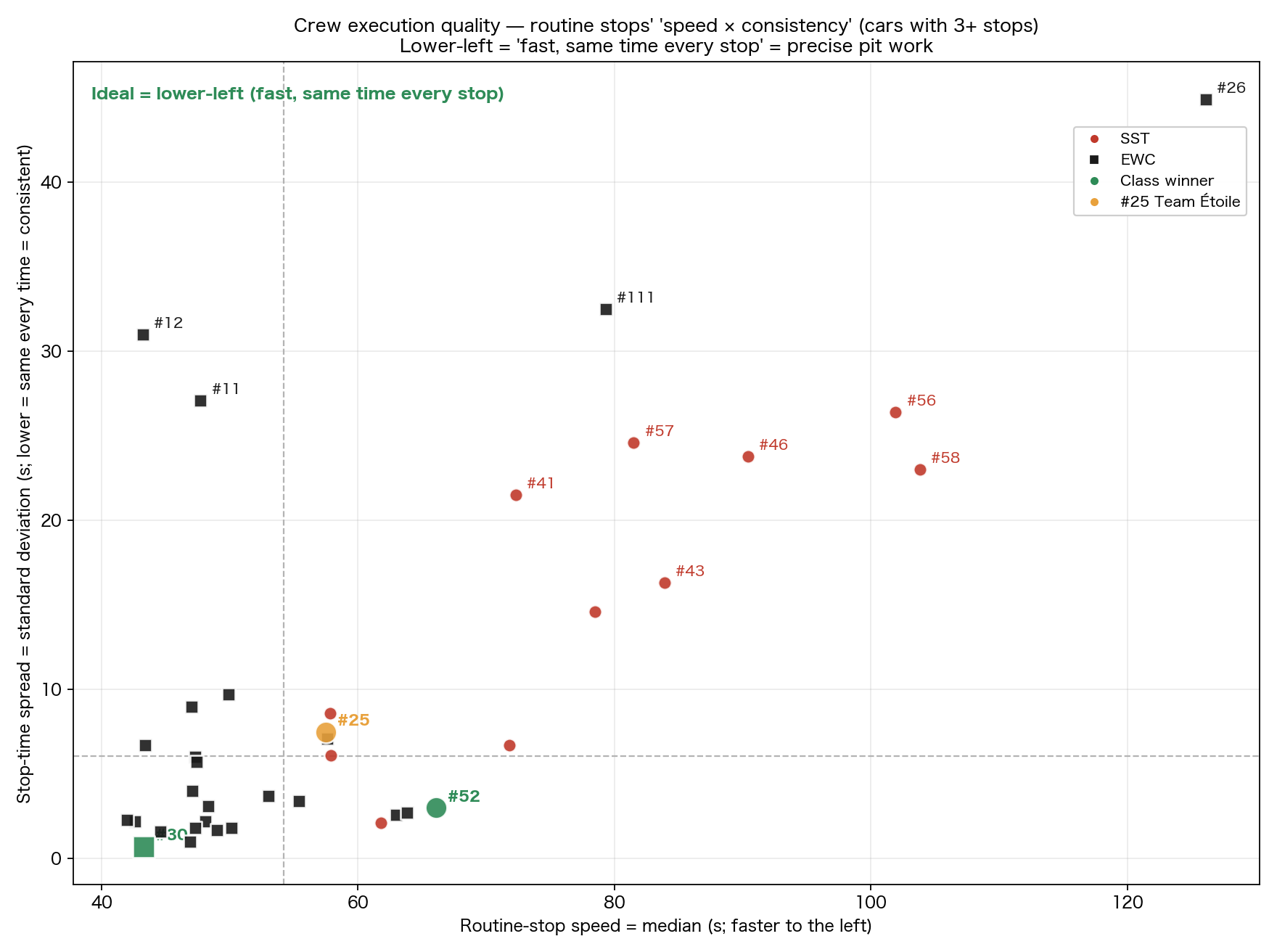
- The difference in a single normal pit stop is tens of seconds. A long stop, by contrast, is measured in minutes. The main route by which pit work affects the result is not "speed" but "getting through the pits calmly and decisively without causing an incident that extends your stationary time" ― that is what this one chart tells us. Indeed, EWC winner #30 was only fourth in the class on the "pure speed" measure discussed below, but it lined up every stop to almost exactly the same time (a spread of ±0.7 seconds) with zero trouble. That steadiness put its total budget at the very top.
2. EWC and SST cannot be compared on the same footing ― the difference in tyre-change mechanisms
Before comparing pure working time, one fundamental premise must be established. The EWC and SST classes use completely different tyre-change mechanisms. For that reason the working times cannot simply be lined up side by side, and this report also ranks each class separately.
- EWC (Formula EWC) is allowed to run a "quick-changer." A purpose-built quick wheel-change system lets a crew change the front and rear tyres in just 4–6 seconds. Specifically:
- Front wheel: the brake calipers are designed to split open left and right as the disc is withdrawn, and a dedicated axle that dispenses with a bolted-up axle lets the wheel be removed and refitted in one motion.
- Rear wheel: some top teams use a mechanism called the "pentagon" system, which leaves the sprocket and rear caliper on the swingarm side rather than on the wheel. This removes the need to detach and refit the chain and sprocket, so only the wheel and tyre are swapped in an instant. The brake lines are "dry-break" couplings too (fittings that plug in without leaking).
- Refuelling is done with a dedicated gravity-fed tank that pours the fuel in all at once (said to be an order of magnitude faster than a production pump's 0.5–0.6 litres per second).
- SST (the stock class) races in essentially production trim. The wheels are homologated production items, the swingarm is standard, the brakes keep the production bike's standard shape, and no quick-changer can be used. The act of changing a tyre simply takes far longer than in EWC.
- So the number of tyre changes varies with strategy and crew speed. Run two stints on a used tyre, for example, and lap times drop a little. Even so, for a team whose pit work is slow, cutting tyre changes to once every other stop can come out ahead overall. Conversely, if the crew is fast, they can change to fresh rubber frequently and claw back pace. Which to choose depends on the team's pit-work speed and strategy. SST's stationary times being longer than EWC's is, again, largely down to this difference in mechanism and rules ― not the skill of the crew.
And in a wet race, the split-second call of "what to do with the tyres each time you stop" is decisive. In fact, #25's low-40-second stop mentioned above was one where the crew took fuel only without changing tyres ― which is why it was fast. But especially in the wet, it is vital to respond to the state of the tyres ― a rain tyre works consistently as long as the rain keeps falling, but the moment the surface starts to dry it degrades rapidly and falls to pieces, becoming unusable all at once. Conversely, when the rain is holding up well, running consecutive stints on a used rain tyre is a perfectly viable strategy. In the instant the bike returns to the pits, reading the state of the tyre and deciding "change or press on" ― here, too, is where a team shows its craft.
In other words, when the top 10 below come out at 42–47 seconds for EWC and 57–84 seconds for SST, that is not a story of "EWC crews being excellent and SST crews inferior." The footing is different. What should be compared is only within a class, among those racing with the same mechanism.
(Sources: Bridgestone Motorsport, "A guide to Suzuka 8 Hours pit work", FIM-EWC × Webike, "Basics to enjoy EWC more", J SPORTS, "How to enjoy EWC", and others)
3. The speed of the pure pit working time ― top 10 by class
From here on it is a contest of "pure mechanics' working time." Removing the long stops of over 150 seconds ― repairs after a crash, red-light holds ― we took only the stationary time of normal pit stops (fuel, tyres, rider change) and produced a top 10, fastest first, for each class. Each dot is one stop; the diamond is the median. The further left, the faster; the tighter the dots cluster, the more the team hit the same time every stop = the more consistent.
SST ― #25 Team Étoile on top
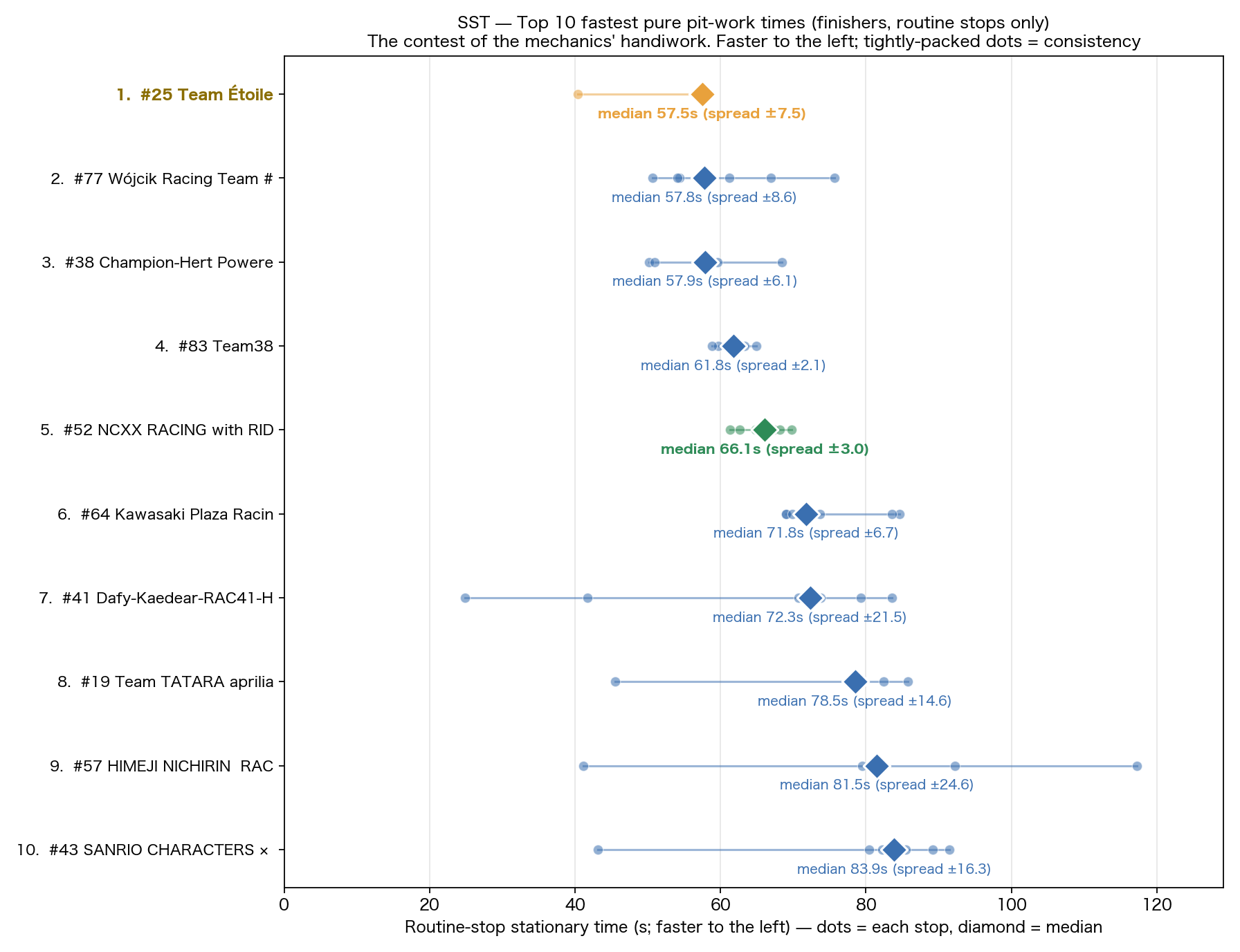
#25 Team Étoile ranks first for pure working time in SST (median 57.5 seconds). It is within 0.4 seconds of 2nd-place #77 (57.8 seconds) and 3rd-place #38 (57.9 seconds), and this leading group is slick across the board. On consistency, #83 (a spread of ±2.1 seconds) stands out. Winner #52 was fifth on speed (66.1 seconds) but steady, with a spread of ±3.0 seconds, and that fed into its strength over eight hours.
EWC ― a fight in the low 42s at the front
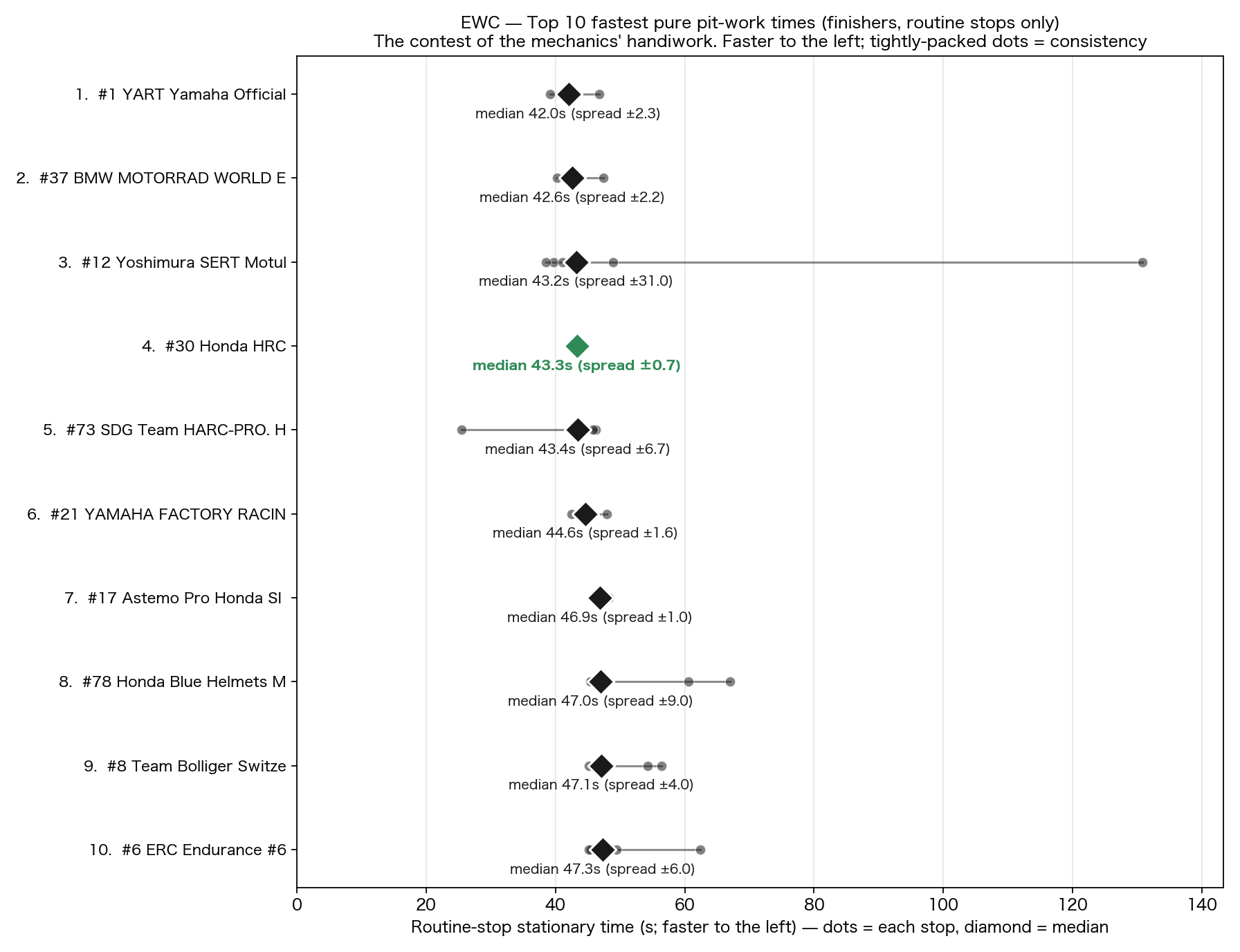
In EWC, led by #1 YART (42.0 seconds) and #37 BMW (42.6 seconds), the top 10 are packed into 42–47 seconds. The power of the quick-changer shows up directly in the numbers. The one to watch is winner #30 Honda HRC. Fourth on speed (43.3 seconds), but with a spread of an astonishing ±0.7 seconds. Lining up six pit stops almost identically, its consistency was the best of any bike ― the embodiment of "steadiness over speed."
Speed × consistency ― the full picture
Overlaying the two classes on one chart, the figure below plots speed (horizontal axis) against consistency (vertical axis) (only bikes that covered more than 90% of the race distance and made three or more stops). The further to the lower left, the more a team nailed it "fast and to the same time every stop" = the more precise the pit work. The EWC bikes cluster at the lower left (fast, uniform) and the SST bikes spread to the right ― this reflects not any difference in crew quality, but the difference in mechanism seen in §2.
4. Every pit stop of #25 Team Étoile
Now we go through our own bike, #25, one stop at a time.
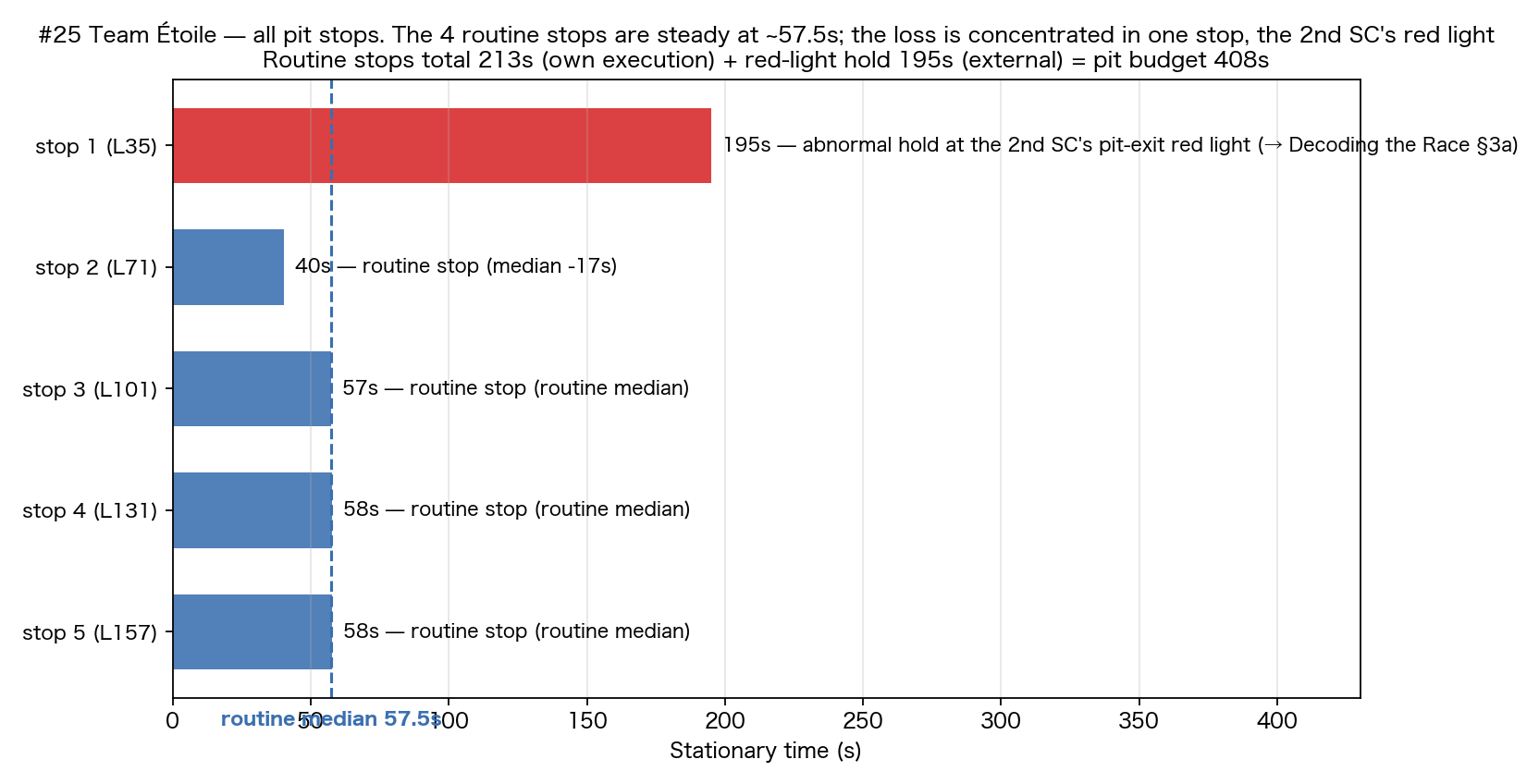
- #25 stopped five times in all. Four of those were routine stops of 40, 57, 58 and 58 seconds, a median of 57.5 seconds. As noted above, this 57.5 seconds is the fastest routine median in SST, and on the speed measure #25's pit crew sat at the very top of the class.
- What inflated the total budget was a single stop of 195 seconds. This was the abnormal hold at the red light at the exit of the second SC period ― an external factor (detailed in the previous piece, Decoding the Race §3a).
- As a result, #25's total budget of 408 seconds breaks down into "213 seconds for four normal pit stops (the team's own execution) + 195 seconds for the red light (an external factor)." The headline total budget stands out among the leading group, but half of that breakdown was a loss out of the team's hands.
5. Conclusion ― steadiness over speed
To sum up, what moved the order most in this pit work was "getting through without causing trouble, calmly and decisively," rather than "speed." Be quick as you like on pure work, and if you lose minutes to a crash repair the order sinks. Conversely, as with EWC winner #30, being fourth on speed but getting every stop done to ±0.7-second precision without a mistake is what led to the very top over eight hours.
On top of that, viewed through the separate yardstick of pure working time ― #25 Team Étoile was fastest in SST, while in EWC the factory teams wielding quick-changers clocked into the low 42s. Pit work is a composite of "speed, precision, avoiding trouble, and luck," and on the speed and precision parts of that, #25's crew did the top job in SST ― that is the record these eight hours left behind.
6. Data and method
- Stationary time: we used the stand_time from the timing system's pit-box passage records (loop_id=12) as the measured value. Stops were classified as routine (150 seconds or under) versus long stop / repair (over 150 seconds).
- Subjects and exclusions: among the SST and EWC bikes, we took only those that took the chequered/red flag and covered at least 90% of the class winner's laps. Bikes below this (early retirements, or bikes whose race was effectively over after a major repair; this time EWC #4/#59/#71/#29/#828/#3/#31 and SST #93/#36, nine bikes in all) were excluded because their pit times run short, or the timed stationary values become unrealistic, distorting the comparison. The race data is session 327.
- Pure working-time top 10 / speed × consistency: only bikes that recorded three or more routine stops were considered (for the reliability of the median and standard deviation). "Spread" is the standard deviation.
- Cross-class asymmetry: EWC and SST differ in their tyre-change mechanism (whether a quick-changer is available), so working times cannot be compared directly. Rankings were done within a class (§2).
- A detailed breakdown of the loss from the red light at the SC exit is outside the scope of this piece (see Decoding the Race §3a).
ÉTOILE DATA LAB ― data analysis by Team Étoile. Companion pieces: Decoding the Race (SST) / Decoding the Race (EWC).