
Suzuka 8H Test, Day 2 Afternoon — Wet Edition, EWC Class: Rain washes away the dry order — the collapse of #37 and the Yamaha counterattack
※This is a data-analysis report written from the third-party perspective of an AI. Please forgive any points that may not be fully accurate.
Scope: 2026 Suzuka 8H Test, Day 2 afternoon wet running FP8 / FP9 / FP10 (today 13:22–18:10 JST). The morning was dry (see the Dry Edition); the afternoon was wet. Data source: local FRC collection DB (
EnduraBase.db, local sqlite, ro, FP8=sid1470 / FP9=sid1471 / FP10=sid1472) + rainfall (precip_rate mm/h) from weather_observations sampled at roughly 3-minute intervals. The session_id space differs by source. ⚠️ Fundamental premise for wet comparison: the rain was variable and intermittent, and on top of that a tyre-choice gap (race tyre / intermediate / rain) is baked in, so a one-off best lap is unreliable. This article compares using the "gap from the class-field median measured at the same moment (= same rainfall)" = "condition-normalized (same-rainfall) pace" (the wet version of the "same-moment" comparison used in the race analysis). Best laps are for reference only. The EXP class is out of scope.
In the morning dry, #37 BMW set the fastest dry time of the whole test. But the afternoon rain turned the view from the summit upside down. When you measure the true form of the 32 machines with the rainfall held constant through the intermittent rain, you see the dry order get completely rewritten.
1. The ECG of the rain — rainfall and pace move together
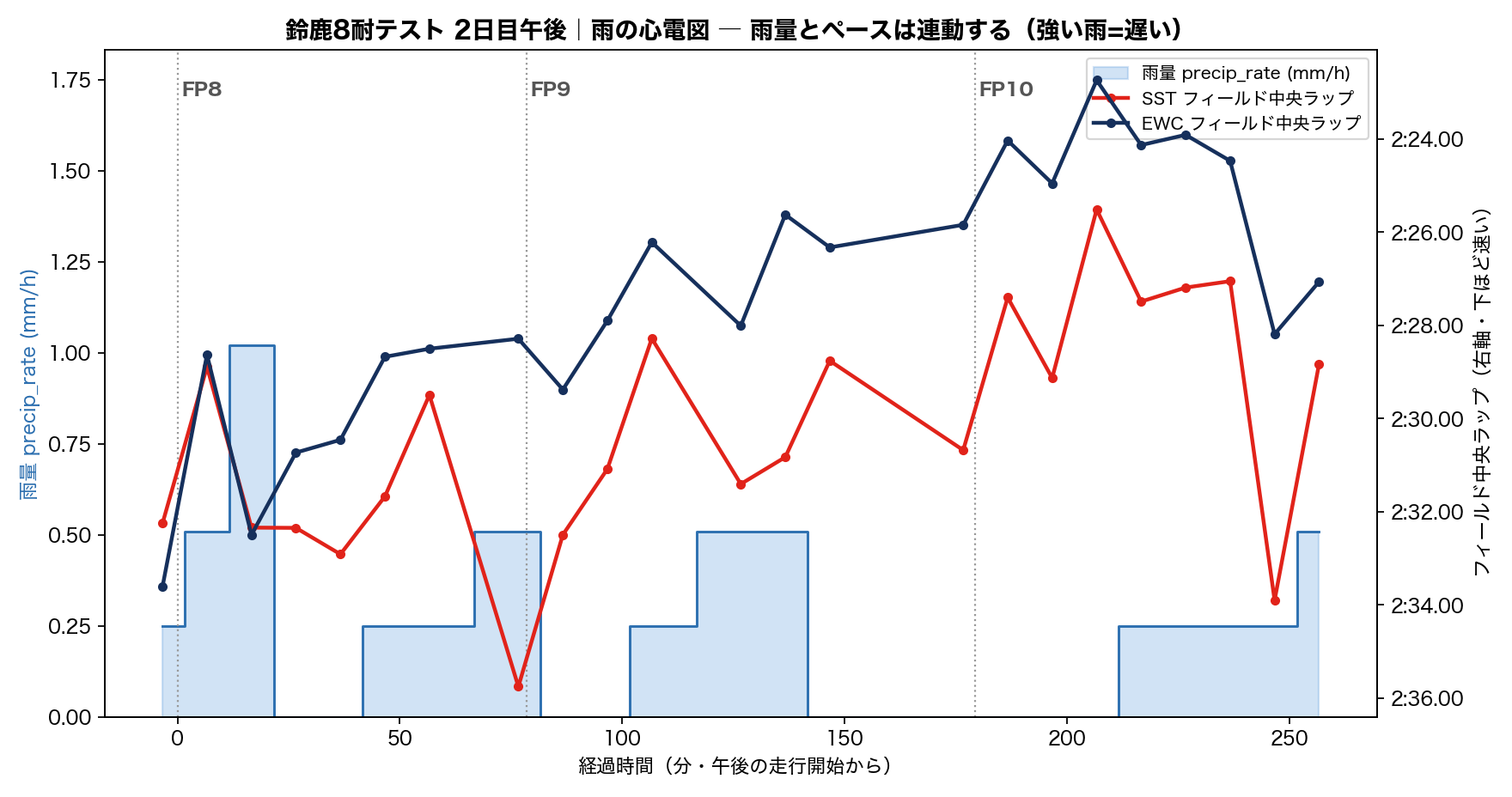
Right after FP8 began, precip_rate built a peak of 1.02mm/h, and the EWC field median lap dropped to around 2:25. After that the rain eased (~0.5mm/h) and the surface recovered, and by the FP10 evening it was into the 2:24 range. The pattern heavy rain = slow is clear, and raw times swing by several seconds depending on "when you ran." So from here on we correct for rainfall.
2. "Condition-normalized (same-rainfall)" pace — the form order with rain conditions held equal
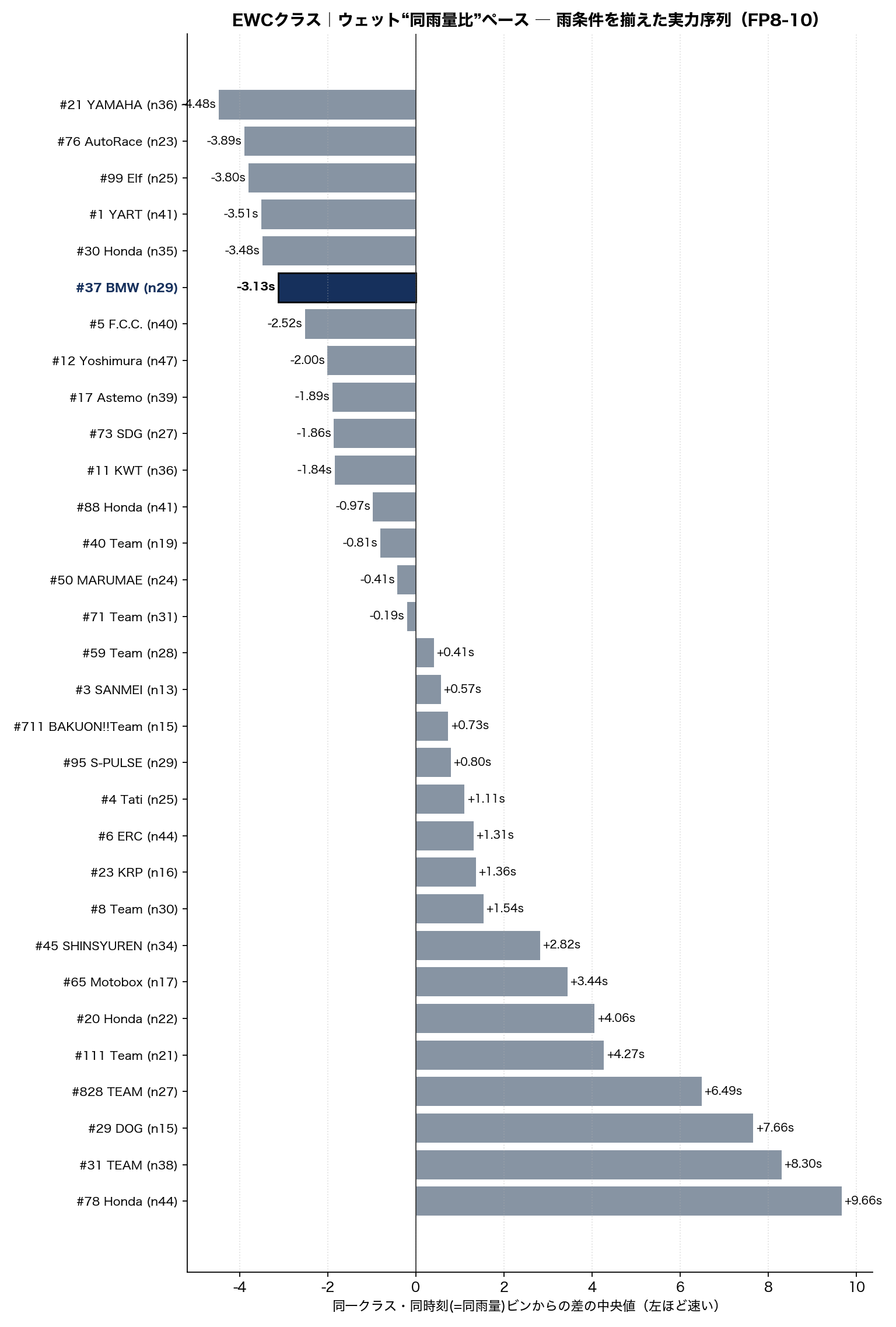
Each lap is compared against the class median at the same moment (= same rainfall), and this is the "rain form order" sorted by the median of that gap.
▼ How the "same-rainfall Δ" is computed (it is neither a best time nor a plain average) 1. Extract clean laps — drop pit-in laps and keep only laps between 2:10 and 3:40 (mechanically removing out/in laps and red-flag-affected anomalies). 2. Slice into 10-minute bins — bucket every lap by run time into 10-minute windows. Since the rain changes constantly, aligning by "when you ran" via a time window is the key. 3. Use each (class × 10-min) median as the baseline — only when a window/class holds ≥3 laps, adopt that window's "field-median lap" as the reference. 4. Per-lap gap from the baseline — each lap − same-window/same-class median = "how many seconds faster than the others who ran in the same rainfall" (− is faster). 5. Median of the gaps per car — for cars with ≥5 laps, aggregate those gaps by the median, not the mean (so a single good/bad lap does not distort it). The "same-rainfall Δ" column is this value.
In short, the table is not a best or a raw average, but "the median of the relative gap against the peers who ran in the same rainfall." The "Wet best" column is merely a single lap caught in the lightest-rain moment — reference only, not used for the ranking.
| Rank | # | Team | Machine | Same-rainfall Δ | Wet best |
|---|---|---|---|---|---|
| 1 | 21 | YAMAHA FACTORY | Yamaha | −4.48s | 2:18.906 |
| 2 | 76 | AutoRace Ube | BMW | −3.89s | 2:17.502 |
| 3 | 99 | Elf Marc VDS | Yamaha | −3.80s | 2:19.168 |
| 4 | 1 | YART Yamaha | Yamaha | −3.51s | 2:19.669 |
| 5 | 30 | Honda HRC | Honda | −3.48s | 2:18.678 |
| 6 | 37 | BMW Motorrad World | BMW | −3.13s | 2:20.010 |
The king of the rain is #21 YAMAHA FACTORY (condition-normalized −4.48s). And it catches the eye that the Yamaha runners (#21 / #99 / #1) line up together near the top. Yamaha is strong in the wet — this is the first finding of the afternoon. The single fastest wet lap belongs to #76 AutoRace at 2:17.502 (a single lap that caught the window when the rain was at its lightest — a reference value).
3. Dry → wet: the order gets a "total reshuffle" (the heart of this article)
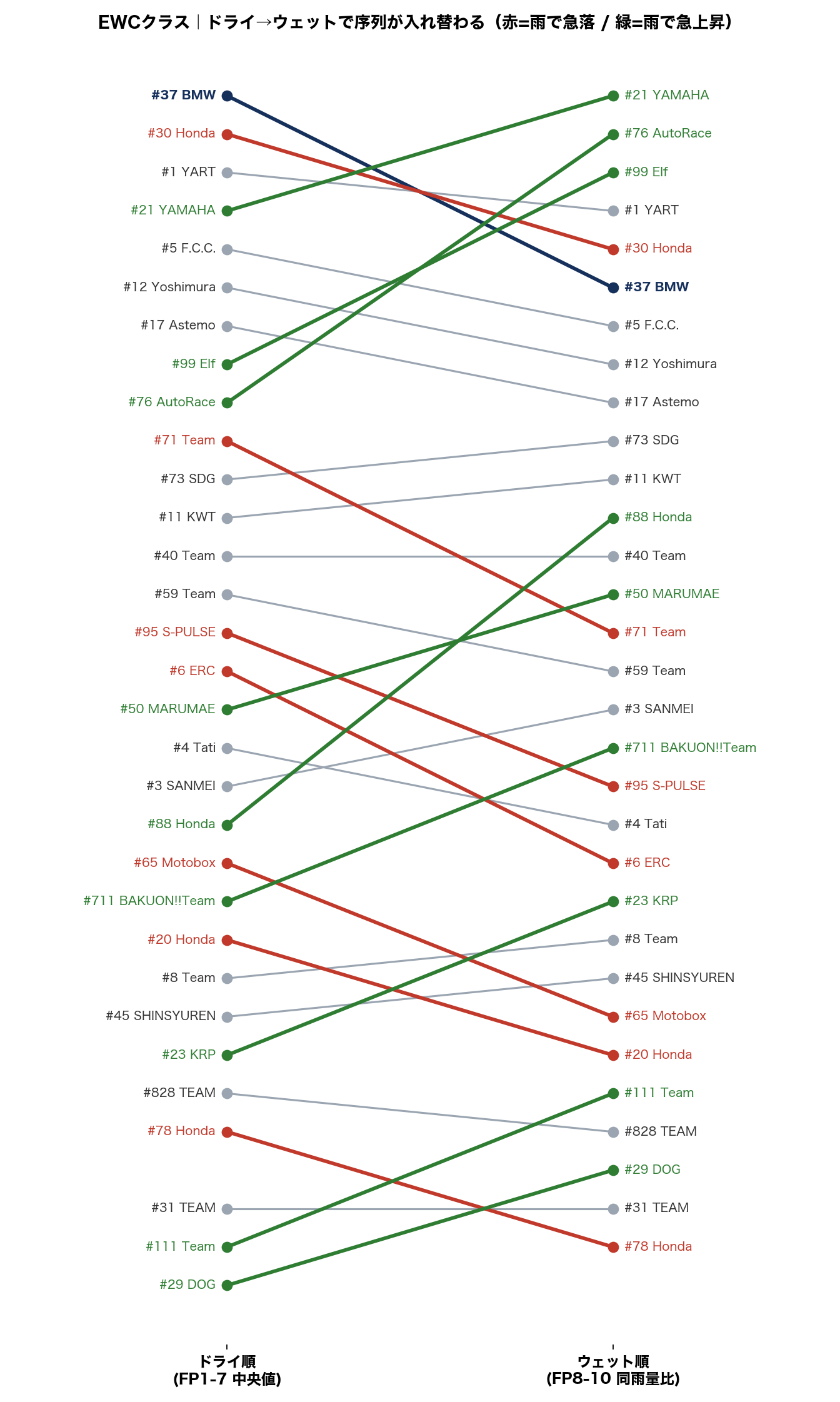
This is the biggest highlight. When you join the morning dry (by median order) to the afternoon wet (by condition-normalized order), the lines cross violently.
- Dry king #37 BMW is only 6th in the wet (dry 1st → wet 6th). The absolute dry advantage vanished in the rain.
- In its place, #21 YAMAHA went from dry 4th → wet 1st, #76 AutoRace made a huge leap from dry 9th → wet 2nd, and #99 Elf went from dry 8th → wet 3rd. #30 Honda HRC also went dry 2nd → wet 5th — its stability in the rain is alive and well, but it ceded the summit.
- What's interesting is BMW's split fortunes: with the same M1000RR, #76 gained in the rain while #37 lost ground. In other words, you can't tell the story by manufacturer alone — setup and the rider's wet aptitude decided the order. On the other hand, the Yamaha runners are strong across the board — here the underlying nature of the machine may be at work.
"The one-off dry king #37" and "the king of the rain #21" are different people. If the eight-hour final becomes a mixed-conditions race, this "strength in the rain" will rewrite the standings.
4. Who is strong in heavy rain
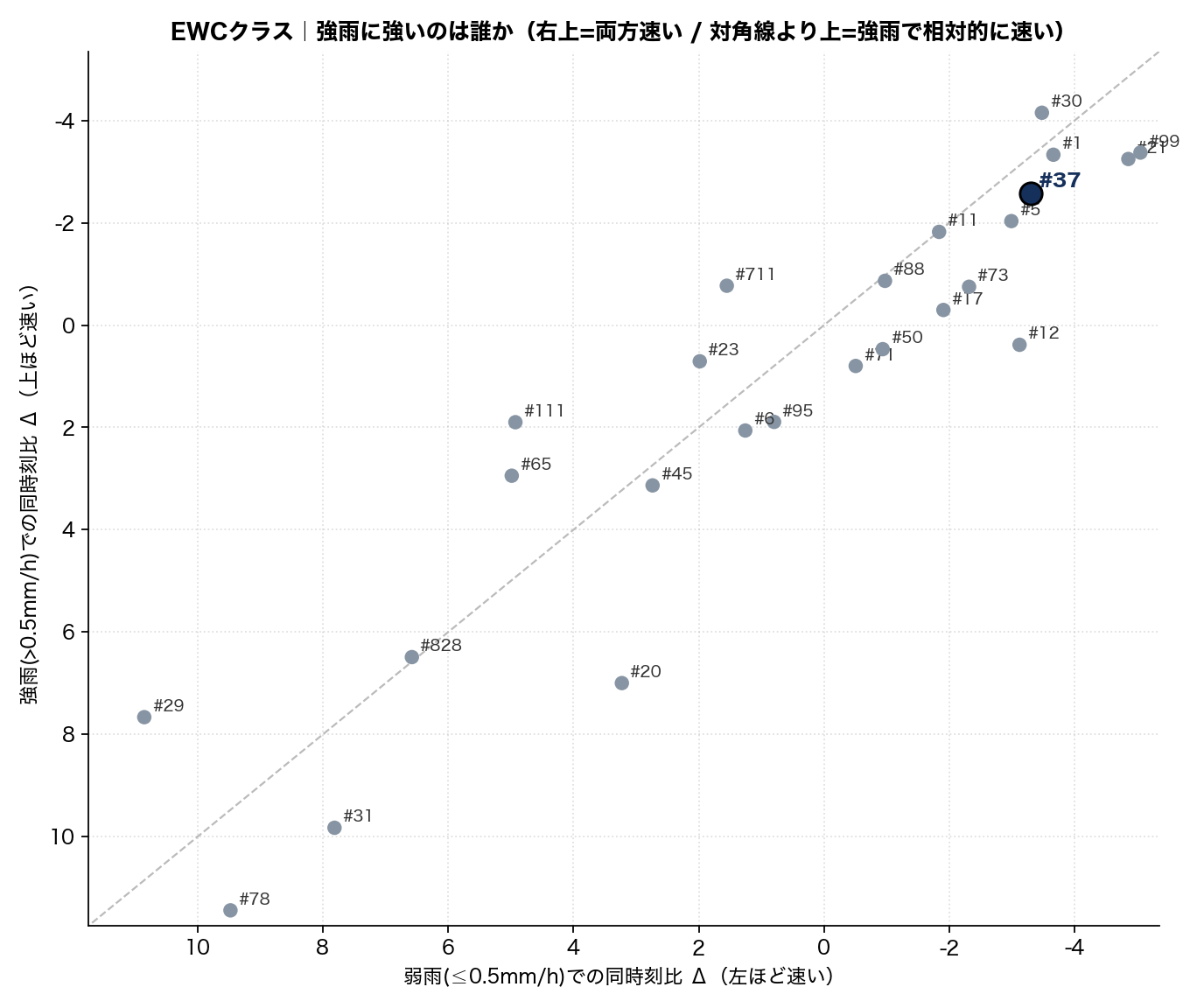
The condition-normalized pace is plotted split into heavy rain (>0.5mm/h) and light rain (≤0.5mm/h). Above the diagonal = relatively strong in a proper downpour. The Yamaha runners and #30 HRC cluster in the upper right (fast in both conditions), and #30 in particular is relatively fast on the heavy-rain side = it comes alive the harder it rains. Conversely, there are machines that are fast in light rain but fall apart in heavy rain. When the final tips into a downpour, it is the camps on the upper side of the diagonal that will benefit.
5. Wet stints — who put in the wet mileage (+ red flags)
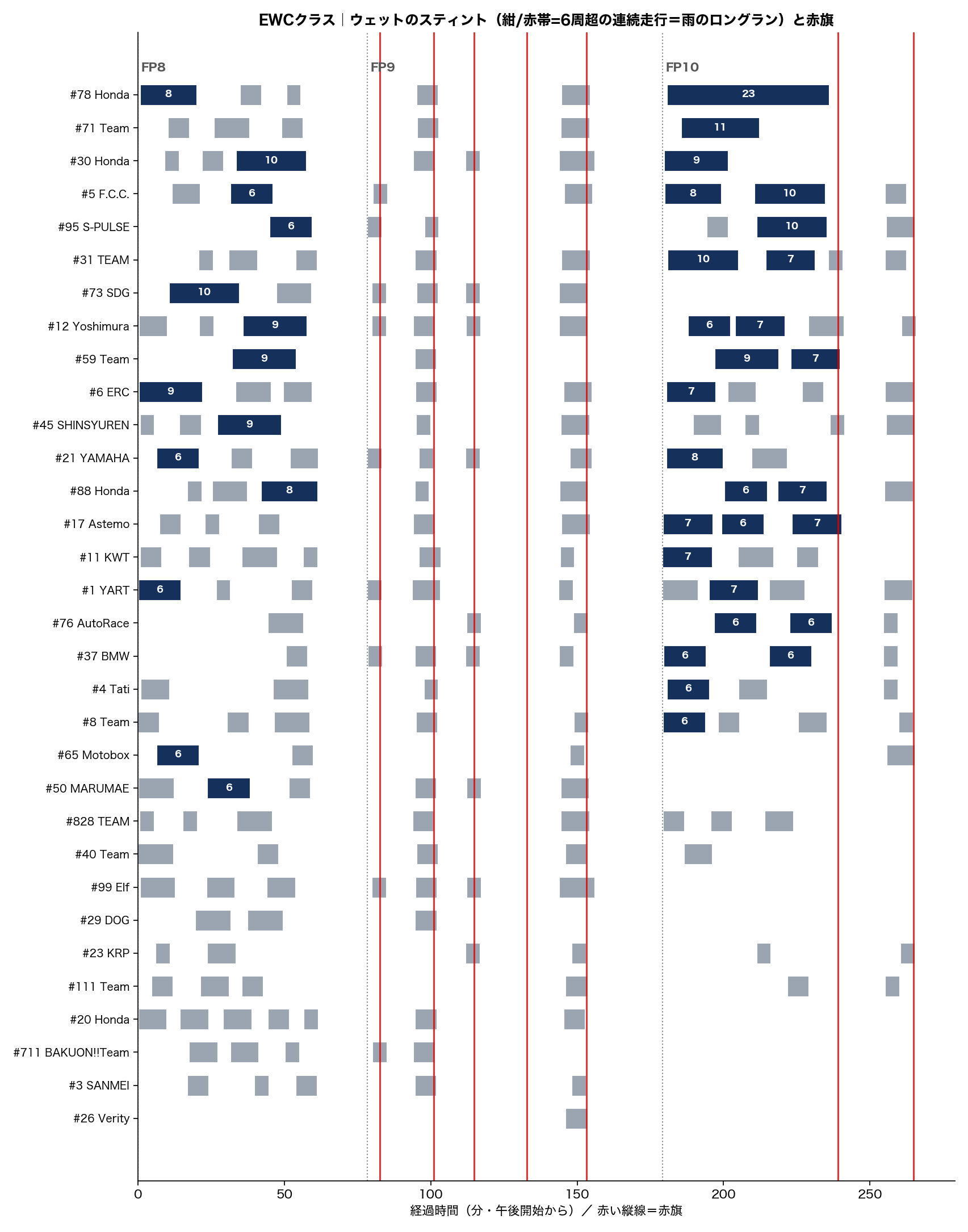
In a wet FP, the amount run consecutively reflects how much a team tested rain-tyre life and wet race operation (including rider changes). The colour bands (more than 6 laps) are the wet long runs. In the afternoon there were 7 red flags in total (FP9 = 5, FP10 = 2, red vertical lines), which tends to chop up continuous running, so there is luck involved in a wet long run. Even so, the factory and leading privateer teams got through long continuous runs in the rain and advanced their preparation for a wet final.
6. Who adapted to the rain fastest — the learning curve of the season's first wet
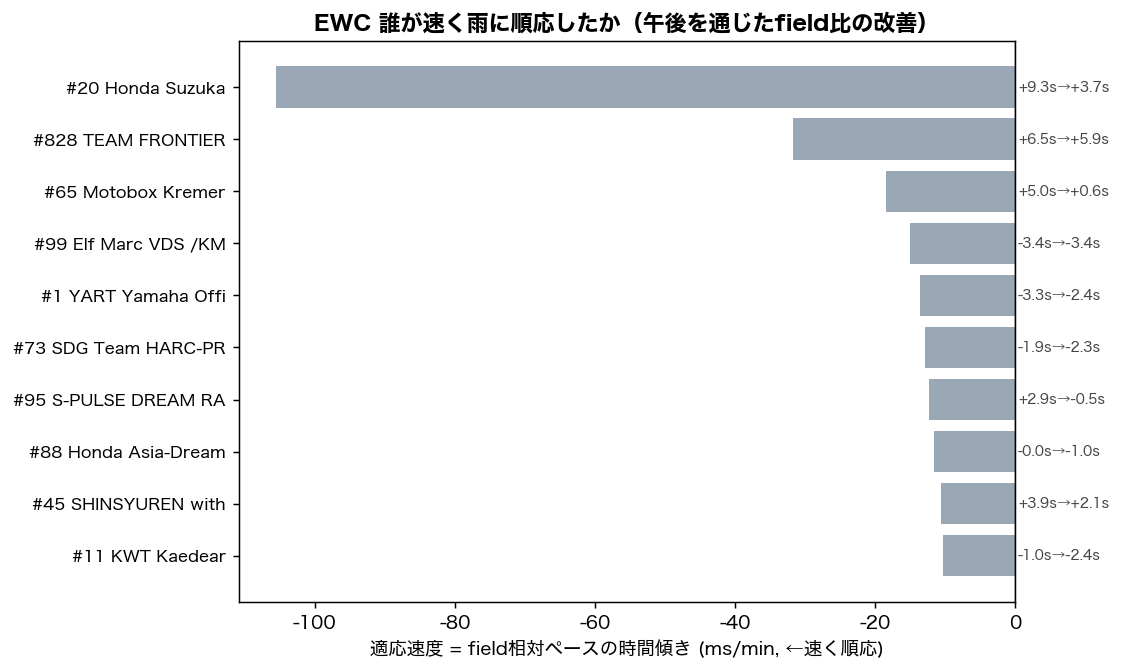
This year, including the May test, the FP running had all been dry, so for many teams this was the season's first wet session. That means this afternoon asks not so much "who is fast" as "who adapted fastest." We read it through how much each car's field-relative pace (same-rainfall Δ) improved over the course of the afternoon = the time slope (ms/min).
At the start of FP8 the field was widely spread. #20 Honda Suzuka charged furiously from +9.3s to +3.7s on the field-relative basis (−106ms/min), and #828 and #65 also adapted markedly — the group that started behind learned all at once through the afternoon. Conversely, front-runners like #21, #37 and #30 have a gentle or slightly negative slope (= already fast, with little room to close). What is visible here is not "speed" but "how much of the gap was closed" — the very character of an afternoon in which every car, in its first wet, learned from a level start. In particular, dry king #37 rather drifted backwards on the field-relative basis through the afternoon, which chimes with its fall to "6th in the wet" in §3.
7. Speed × consistency — who is fast without mistakes over eight hours
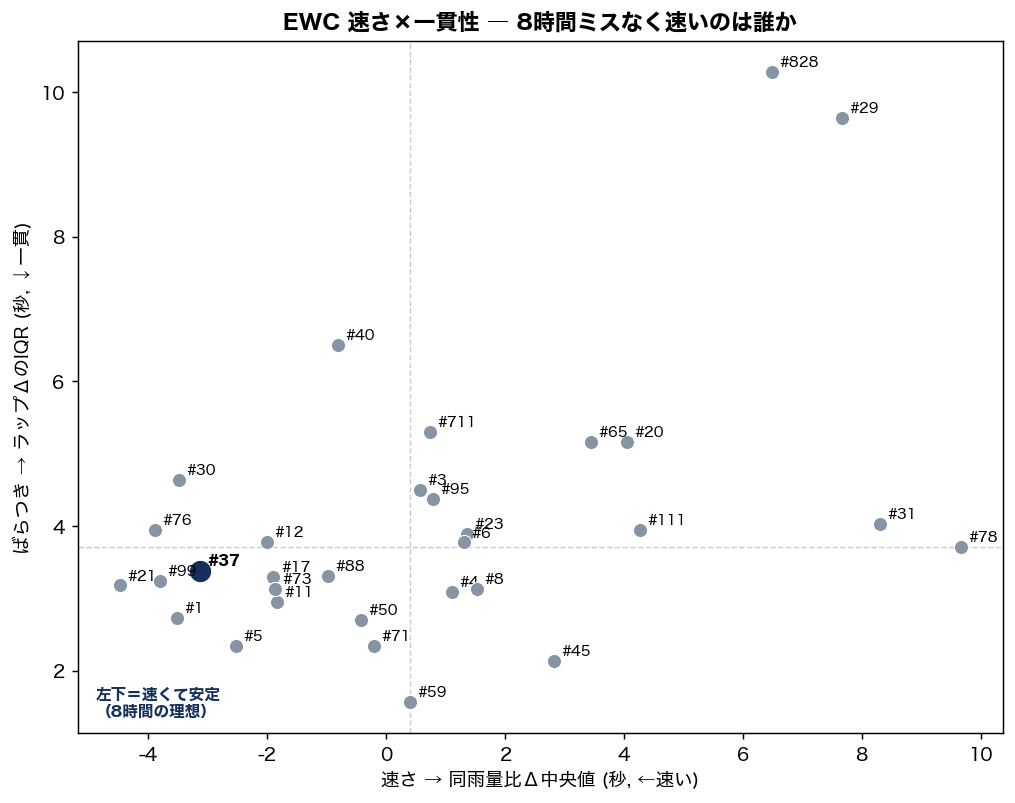
What counts in an eight-hour endurance race is not one-off speed but "being consistently fast" = not making mistakes. Putting speed (median same-rainfall Δ) on the horizontal axis and spread (IQR of the lap Δ) on the vertical, lower-left = fast and stable = the endurance ideal.
The king of the rain #21 YAMAHA stands out on speed (−4.5s), and #1 YART is "the most stable among the very fastest" (IQR 2.7s) = showing the kind of dependability that is exactly suited to endurance. In contrast, #30 Honda HRC is fast but has one of the class's largest spreads (IQR 4.6s) — its peaks are sharp but its valleys are deep, and over eight hours this swing is a risk. #76 is also fast but somewhat wild (IQR 4.0s). Viewed by "is it fast for eight hours stably," not just "is it fast," the meaning of the order changes.
8. The anatomy of the wet long runs — who rehearsed the wet final
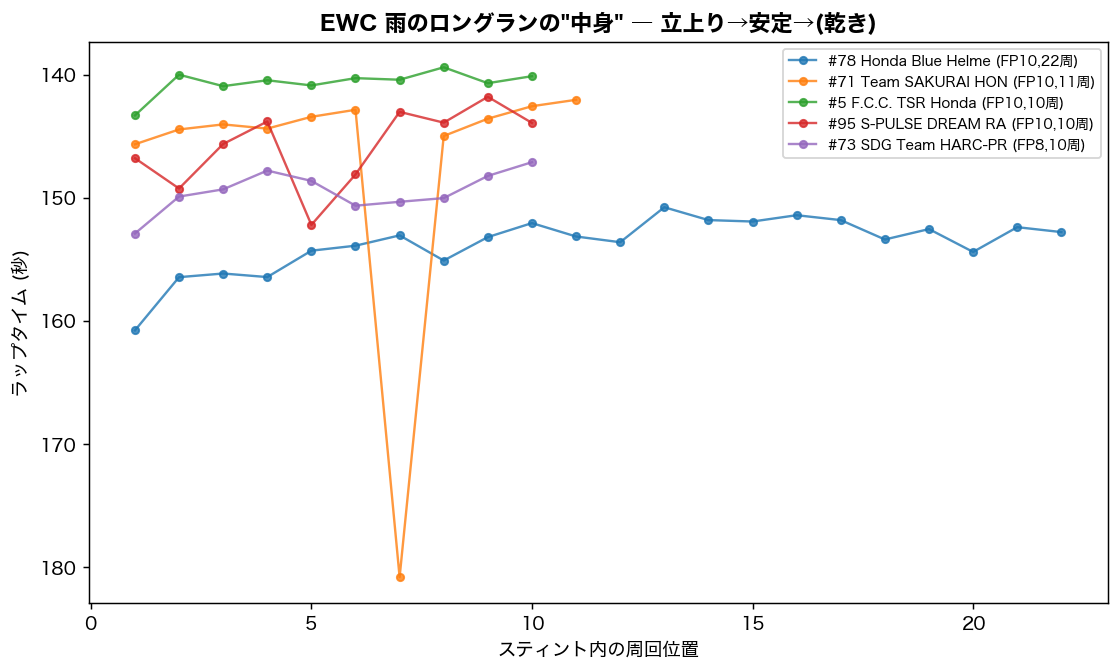
A long continuous run is a rehearsal of the wet eight-hour final itself. The lap progression within a stint reveals "the substance of the test" (evaluated on the stable part, excluding the opening 2 laps = the warm-up/build-up).
The stand-out is the 22-lap long run #78 Honda Blue Helmets got through in FP10 — almost a straight line at 2:31–2:33, reproducing "a whole slice of the wet final" with metronome-like consistency (stable part −0.15s/lap). Rather than prioritizing speed, this is a "keep going, keep clicking off laps" race simulation. Meanwhile #5 F.C.C. TSR put together 10 laps crisply in the 2:19 range, and #71 has a single big drop-off on lap 7 (2:59, probably traffic/a mistake) etched into its trajectory. The front-runners short and fast, #78 the longest and unhurried — you can read that even the same "long run" has different aims.
9. Sector fingerprint and wet penalty — where the differences open up
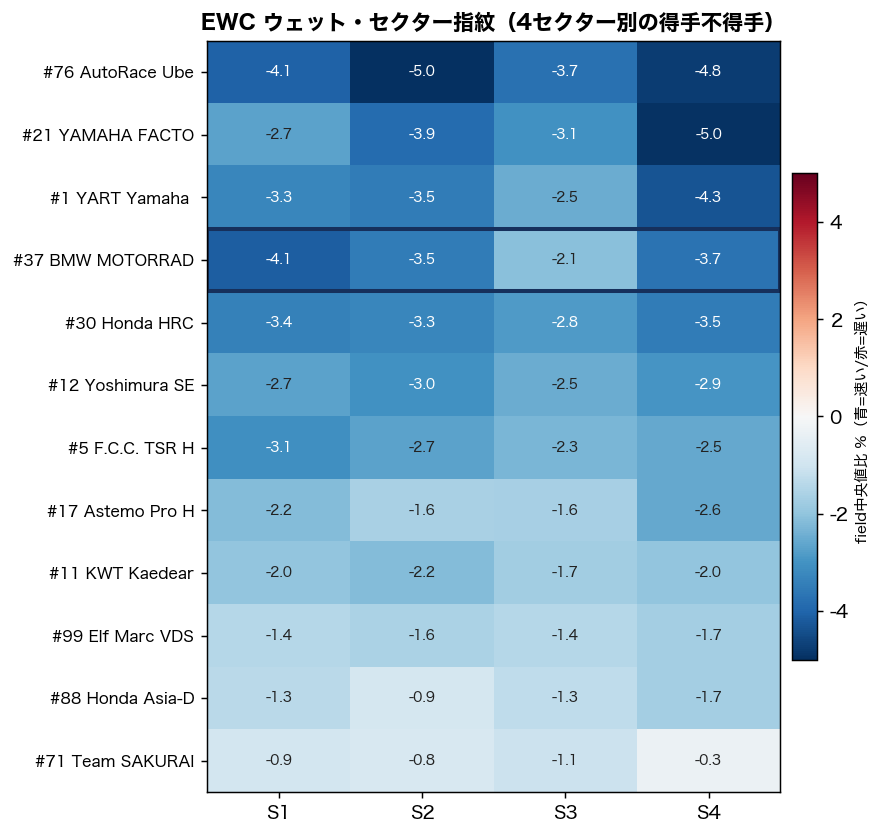
Taking the field-median ratio for each of Suzuka's four measured sectors (S1–S4) brings out each car's "fingerprint" (blue = relatively fast). What catches the eye is the character of the manufacturers: #37 BMW is strongest in S1 (−4.1%) and relatively weak in S3 (−2.1%) — a typically BMW shape, gaining in the power sector and giving it back in the technical S3. The Yamaha runners #21 and #1 have their forte in the final sector S4 (−5.0 / −4.3%), while #76 AutoRace stands out across all sectors, especially S2 (−5.0%). ※ This chart is on an absolute basis that does not include the "when you ran" time correction, so rather than the shading, the right reading is "which sector is relatively strong within that car = the shape along the row" (for a fair ranking, see §2).
And then, the time loss from the dry (morning median) into the wet = the wet penalty. The smaller the drop, the better the wet package.
| # | Team | Dry → wet increase | vs. field |
|---|---|---|---|
| 76 | AutoRace Ube | +13.9s | −4.1s (smallest) |
| 30 | Honda HRC | +15.5s | −2.5s |
| 21 | YAMAHA FACTORY | +15.8s | −2.2s |
| 1 | YART Yamaha | +16.3s | −1.7s |
| … | |||
| 37 | BMW (dry king) | +17.7s | −0.3s (≈ field average) |
#76 AutoRace's drop, at just +13.9s, is by far the smallest in the class — even with the same BMW, #76 "loses almost nothing" in the rain, an outstanding wet package. The Yamaha runners (#21 / #1) also have small drops, chiming with the top of §2. In contrast, dry king #37's drop is +17.7s = roughly the field average, and the picture of "the absolute advantage built in the dry being wiped out in the rain" is borne out by the numbers. It can't be grouped by manufacturer (BMW) — #76 gained while #37 lost ground — the core of §3, that what counts in the rain is not just the car's underlying nature but setup and the rider's wet aptitude, is confirmed here too from another angle.
Summary — rain washes away the dry order
- Once you correct for rainfall, dry king #37 is 6th, and the king of the rain is #21 YAMAHA. The fact that the Yamaha runners are all strong in the wet is the heart of the afternoon. #21 for speed, #1 for being "the most stable among the very fastest" — their roles divide.
- Even with the same BMW, #76 gained in the rain while #37 lost ground = wet aptitude splits not just by manufacturer but by setup / rider. The wet penalty is by far the smallest for #76 at +13.9s, while #37 is roughly the field average — the numbers, too, show #37's absolute advantage wiped out in the rain. The sector fingerprint brings out the characters: #37 = strong S1 / weak S3, Yamaha = strong S4.
- Because this was the season's first wet, the large spread at the start narrowed over the afternoon (#20 charging from +9.3s → +3.7s) = every car was still learning. Over eight hours "consistently fast" counts (#30 is fast but swings the most, #1 is dependable). #78 rehearsed the wet final with a 22-lap metronomic long run. Read together with the Dry Edition, each camp's "all-weather overall strength" comes into view.
Aggregation and charting: ÉTOILE DATA LAB (from EnduraBase timing + rainfall data). The rain sensor is at a single location and cannot fully capture local differences across the whole circuit (reference value). The team/vehicle of rival machines is supplemented from FRC classification and Day 1 timing. Final cross-check against the official results to follow.